Can you believe it, December already!
Here are the stories to start the month...
Be safe out there!
Tom
-
2 hurt as small plane veers off runway near Downers Grove
The single-engine plane was trying to land shortly after noon Friday at Brookeridge Airpark, the DuPage County sheriff’s office said. The pilot and passenger were taken to a hospital for evaluation.
By Daily Herald
A small single-engine airplane veered off the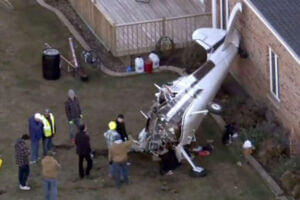 runway and rolled over Friday afternoon at a private residential airpark near Downers Grove, injuring the pilot and a passenger, authorities said.
The accident occurred shortly after noon as the plane was attempting a landing at the Brookeridge Airpark, the DuPage County sheriff’s office said.
The pilot lost control of the plane, causing it to veer off the runway, roll over and come to a rest in a backyard, according to the sheriff’s office. The pilot and passenger were alert and taken to an area hospital for evaluation.
The runways are surrounded by homes that primarily have hangars attached to them, said Dave Rutter, board president of Brookeridge Aero Associates Inc., which owns and operates the airpark near the Carriage Greens Country Club.
The plane sustained a fair amount of damage, he said. But both occupants of the aircraft emerged under their own power, Rutter said. According to preliminary information, the Federal Aviation Administration said a Cessna 195 struck a hangar at the airpark about 12:10 p.m. Two people were on board. The FAA will investigate.
https://chicago.suntimes.com/chicago-suburbs/2025/11/28/plane-veers-off-runway-rolls-over-at-airpark-near-downers-grove
Plane skids off icy runway as snow snarls post-Thanksgiving travel
By Nadine El-Bawab, Clara McMichael, and Kyle Reiman
A cross-country storm dumping snow across the Midwest has led to hundreds of canceled flights and car crashes amid the post-Thanksgiving travel rush.
In one terrifying incident for air travelers, a Delta Connection flight with 54 passengers and a crew of four skidded off an icy runway at the Des Moines International Airport overnight, according to Sarah Hoodjer, the airport's communications manager.
The incident occurred around 9:30 p.m. local time as Flight 5087, operated by Endeavor Air and originating in Detroit, was landing at the airport, according to a statement from Delta Air Lines.
The aircraft, a Bombardier CRJ-900, "left the paved surface of the taxiway due to icy conditions upon landing," according to the Delta statement. No injuries were reported and passengers were evacuated from the aircraft and bused to a terminal, according to Delta.
Hoodjer said the National Transportation Safety Board is investigating the incident.
In a statement, Delta airlines said: "Delta teams at Des Moines International Airport are working to ensure our customers are taken care of after Delta Connection flight 5087 operated by Endeavor Air left the paved surface of the taxiway due to icy conditions upon landing. Safety comes before all else and we apologize to our customers for the experience."
https://abc7ny.com/post/delta-flight-5087-bombardier-crj-900-skids-off-icy-runway-des-moines-airport-snow-snarls-post-thanksgiving-travel/18230785/
NTSB Final Report: Remos Aircraft GmbH Remos GX
Pilot’s Decision To Attempt Takeoff With Frost Covering The Airplane’s Wings
Location: Taylor, Arizona Accident Number: WPR24FA052
Date & Time: December 6, 2023, 07:44 Local Registration: N449RA
Aircraft: Remos Aircraft GmbH Remos GX Aircraft Damage: Substantial
Defining Event: Loss of control in flight Injuries: 1 Serious
Flight Conducted Under: Part 91: General aviation - Personal
Analysis: The pilot of the light sport airplane was preparing to depart for a cross-country flight. A witness reported that when he arrived at the airport that morning, he saw the airplane on the parking ramp, not moored down, and the engine was running. As the airplane taxied through the ramp area, he saw that it was covered with frost. Soon after the witness had gone inside the airport office, he was notified from an airplane flying over the airport that an airplane had crashed on the runway. A photo of the accident site minutes after the accident revealed that the upper surfaces of the horizontal stabilizers were covered in frost.
Postaccident examination of the airframe and engine revealed no evidence of any preimpact mechanical malfunction or failure that would have precluded normal operation. Based on the witness’s statement and photo evidence, the airplane likely had frostcontaminated wings, which the pilot did not remove before takeoff. His subsequent rotation of the airplane during takeoff with its lift capability degraded due to contamination of its flying surfaces resulted in exceedance of the airplane’s critical angle of attack, an aerodynamic stall, and subsequent impact with the ground.
Probable Cause and Findings: The National Transportation Safety Board determines the probable cause(s) of this accident to be -- The pilot’s decision to attempt takeoff with frost covering the airplane’s wings, which led to an exceedance of the airplane’s critical angle of attack and an aerodynamic stall.
FMI: www.ntsb.gov
NTSB Prelim: Cirrus Design Corp SR20
The Airplane Made An Uncommanded Right Yaw And Roll, And He Was Unable To Maintain Control Of The Airplane
Location: Chesterfield, MO Accident Number: CEN26LA044
Date & Time: November 11, 2025, 17:50 Local Registration: N866CD
Aircraft: Cirrus Design Corp SR20 Injuries: 2 Minor
Flight Conducted Under: Part 91: General aviation - Personal
On November 11, 2025, about 1750 central standard time, a Cirrus SR20, N866CD, was substantially damaged when it was involved in an accident near Chesterfield, Missouri. The pilot and copilot received minor injuries. The airplane was operated as a Title 14 Code of Federal Regulations Part 91 personal flight.
The pilot reported that during the night flight, they were on approach to the destination airport and continued to descend with the flaps set to 50%. He slowed the airplane below 100 knots indicated airspeed (KIAS) and extended the flaps to 100%. Shortly after, they heard a “bang” from the front of the airplane and the engine RPM increased. At the same time the airplane made an uncommanded right yaw and roll, and he was unable to maintain control of the airplane. As the airplane was in a steep right spiraling descent, he activated the Cirrus Airframe Parachute System (CAPS), then retarded the throttle and mixture levers. The airplane descended under the canopy and impacted trees and terrain in a nose low attitude. The pilots egressed the airplane without further incident.
Postaccident examination of the airplane revealed that the airplane descended into a wooded area and the empennage separated during the accident sequence. The airplane remained suspended vertically by the parachute and harness. The propeller was embedded in the ground and the left wing was resting on the ground.
The flaps were found in a fully retracted position, and the flap switch was positioned to 100%. The flap control system and associated hardware remained intact from the flap actuator to the control surfaces. The bottom of the airplane was mostly covered with engine oil and there was a large pool of engine oil in the engine cowling, but the engine did not exhibit evidence of a catastrophic failure.
The airplane’s avionics were sent to the NTSB Vehicle Recorder Laboratory for data extraction.
The airplane was retained to further examination.
FMI: www.ntsb.gov
NTSB Prelim: Jabiru USA Sport Aircraft LLC J230-SP
The Pilot Would Often Fly Over Their House At A Low Altitude And That Family Members Would Go Outside To Wave
Location: New Bavaria, OH Accident Number: ERA26FA039
Date & Time: November 14, 2025, 17:08 Local Registration: N755J
Aircraft: Jabiru USA Sport Aircraft LLC J230-SP Injuries: 2 Fatal
Flight Conducted Under: Part 91: General aviation - Personal
On November 14, 2025, at 1708 eastern standard time, a Jabiru USA Sport Aircraft LLC J230-SP, N755J, was substantially damaged when it was involved in an accident near New Bavaria, Ohio. The sport pilot and passenger were fatally injured. The airplane was operated as a Title 14 Code of Federal Regulations Part 91 personal flight.
A review of preliminary ADS-B data showed that the airplane departed Fulton County Airport (USE), Wauseon, Ohio, where the airplane was based about 1458. It then flew for about 2 hours around northwest Ohio at geometric altitudes between 3,100 ft mean sea level (msl) and 1,700 ft msl. At 1656 the airplane entered the accident area and began a descent from about 3,000 ft msl. It circled the accident area multiple times, descending to a minimum altitude of 103 ft above ground level (agl) at 1707:02. The airplane then began a climbing left turn which reached a maximum altitude of 428 ft agl at 1707:11. The left turn continued and the last data point, at 1707:17, showed the airplane at an altitude of 152 ft agl.
A family member who lived across the street from the accident site reported that the pilot would often fly over their house at a low altitude and that family members would go outside to wave. On the day of the accident, a family member reported hearing the airplane fly overhead and going outside to wave. The airplane flew over the house at a low altitude and, after passing over the house, began a left turn to pass over the house again. Before the airplane passed back over the house, while in the left turn, the family member heard sounds of an impact. The family member further reported that the airplane’s engine sound was loud and constant. Another witness, who was working in a field near the accident site, reported that he saw the airplane circle overhead 3 times. As the airplane passed over the family members’ house it began a steep left turn, with its wings nearly perpendicular to the ground indicative of the debris path located in a tilled field, was about 370 ft in length, and oriented on a magnetic heading of about 125°.
The initial impact mark was located about 250 ft past the last ADS-B track data point. The main impact crater was about 25 ft from the initial impact mark. The airplane fuselage came to rest on top of the right wing on its left side. It was on a magnetic heading of 235° at an altitude of 731 ft mean sea level and was located about 220 ft from the initial impact mark. The vertical stabilizer and rudder remained attached to the fuselage and the horizontal stabilizer and elevator were impact separated and found about 120 ft from the main wreckage. The left wing and left aileron were impact separated and found 70 ft and 175 ft from the main wreckage, respectively. The right aileron was impact separated and was found about 130 ft from the right wing. Flight control continuity was confirmed from all flight control surfaces to the cockpit area through multiple impact separations.
The left wing fuel tank and header fuel tank were breached and contained no fuel. The right wing fuel tank was about half full of liquid consistent with fuel. The engine was impact separated from the firewall and was found about 70 ft from the main wreckage. The engine was able to be rotated by hand and continuity of the crankshaft was confirmed to the accessory case. The engine carburetor was impact separated and found about 40 ft past the main wreckage. The carburetor exhibited impact damage, and the carburetor bowl was impact separated from the carburetor. Both propeller blades were impact separated and found in the debris path. One blade was impact separated at the propeller hub and the other blade was impact separated about 6 inches from the propeller hub.
Multiple electronic devices capable of recording flight data were located in the debris path and exhibited impact damage. They were retained and sent to the NTSB Vehicle Recorders Laboratory for data download.
The wreckage was retained for further examination.
FMI: www.ntsb.gov

Today in History
44 Years ago today: On 1 December 1981 Inex-Adria flight 1308, a MD-81, impacted a mountain on the French island of Corsica, killing all 180 occupants.
| Date: | Tuesday 1 December 1981 |
| Time: | 08:53 |
| Type: | McDonnell Douglas DC-9-81 (MD-81) |
| Owner/operator: | Inex-Adria Aviopromet |
| Registration: | YU-ANA |
| MSN: | 48047/998 |
| Year of manufacture: | 1981 |
| Total airframe hrs: | 683 hours |
| Engine model: | P&W JT8D-217 |
| Fatalities: | Fatalities: 180 / Occupants: 180 |
| Other fatalities: | 0 |
| Aircraft damage: | Destroyed, written off |
| Category: | Accident |
| Location: | 24 km SE of Ajaccio-Campo dell'Oro Airport (AJA) - France |
| Phase: | En route |
| Nature: | Passenger - Non-Scheduled/charter/Air Taxi |
| Departure airport: | Ljubljana-Brnik Airport (LJU/LJLJ) |
| Destination airport: | Ajaccio-Campo dell'Oro Airport (AJA/LFKJ) |
| Investigating agency: | BEA |
| Confidence Rating: | Accident investigation report completed and information captured |
Narrative:
Inex-Adria flight 1308, a MD-81, impacted a mountain on the French island of Corsica, killing all 180 occupants.
Flight JP1308 was a charter service from Ljubljana, Yugoslavia (now Slovenia) to Ajaccio, Corsica, France. The flight departed at 07:41 local time and climbed to the cruising altitude of FL330. The en route part of the flight was uneventful.
About 08:35, while descending to FL190, a the copilot's son entered the flight deck and was allowed to take the observers seat.
Further descent instructions and radar vectors were obtained and at 08:47 the flight transferred to the Ajaccio Approach controller. The controller cleared the flight to the AJO VOR at FL110 and to report when overhead the VOR. He also passed on weather information and the reported that runway 21 was the runway in use.
At 08:49 the crew reported over the AJO VOR. The controller cleared the flight to descend to 3300 feet on the 247 radial of the AJO VOR.
Three minutes later the flight radioed: "Rolling inbound out of six thousand". By that time the airplane had descended below the minimum holding altitude of 6800 feet for that area. He then reported: "Turning inbound to Ajaccio because at the moment we are in cloud." The controller then replied: "Roger, 1308, report Charlie Tango on final, surface wind two eight zero degrees, twenty knots." There was no response from flight 1308.
Flight 1308 was flying a holding pattern to lose altitude, but the controller believed the aircraft was going to make a direct descent to begin the final approach. Hence the reference to the Charlie Tango (CT) NDB beacon.
After several aural GPWS warnings (starting 13 seconds before impact) the crew increased engine thrust relatively slowly and pulled up too late. The left wing contact the top of Mont San-Pietro. Control was lost and the airplane crashed in mountainous terrain.
CAUSES (translated from original French language report):
1. The Committee considers that the cause of this accident was that the descent undertaken by the crew led the aircraft to find itself in clouds below the instruments safety altitude for that part of the flight path.
2. The Committee noted that when the crew, alerted by the GPWS, tried to regain altitude, the maneuver proved to be insufficient to overcome the effect of strong descending air currents due to relief and strong wind, present in the area where the aircraft was flying at that time.
OTHER FACTORS
The Commission further noted that the combination of the following factors contributed to the crew being put in a situation it could not overcome:
1. The committee felt that the crew did not show the necessary rigor when preparing its approach.
It does not appear that a logical order has guided the crew in the revision and memorization of various parameters, including the safe altitude and the maximum speed of the holding circuit, which in any case, did not catch the attention of the crew in an appropriate manner.
In addition, the presence of a young child on the observer seat cockpit, until the end of the flight was a dispersion factor of attention;
2. The misunderstandings which have developed in the exchange of messages between the captain and the approach controller could disrupt, at certain times, the working conditions of the crew. The controller consequently did not have an accurate representation of the progress of the aircraft in the performance of its procedure and, therefore, did not intervene when two messages "call you inbound on radial two forty seven", and then "rolling inbound out of six thousand" would have told him, if he had better interpreted them, an ambiguous situation for the first and abnormal and dangerous for the second;
3. The advice to the commission on vectoring habits and on habits supposedly used by some national air traffic services to systematically take into account the safety altitudes in formulating control permissions, leads to the suspicion that some crew have a slightest concern about the safe altitudes;
4. Airspeed of the aircraft was greater than the maximum speed of the holding pattern and crew did not adopt the correction factors adapted to altitude wind they had encountered during the previous segment th flight. This led to the airplane overfly an area where, although it is included in the protected area of the holding pattern, the upper air movements were particularly important;
5. The symbolic representation of the holding pattern on the approach chart used by the crew corresponds to a path, with no wind, and an aircraft which would have approximately 150 knots indicated airspeed. It calls not evident attention to Airmen on the actual dimensions of the actually travelled circuits in flight, nor therefore on altitude over the terrain reliefs.
