From beautiful Amsterdam, Capital of The Netherlands, these are your stories for today...
Be safe out there!
Tom
-
Sand truck collides with plane on Minot airport tarmac, no injuries
MINOT, N.D. (KMOT) – A sand truck crashed into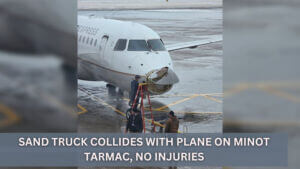 the front of a SkyWest plane Tuesday morning on the tarmac at Minot International Airport amid icy conditions.
A spokesperson for the city of Minot, which oversees the airport, confirmed the crash occurred around 8:45 a.m.
A report from the city states that an airport employee driving the sand truck responded to a request for sand in front of the plane by Gate 2. The driver hit ice, sliding to the left and then backwards, striking the aircraft’s nose.
The spokesperson said no one was on the plane at the time of the collision, and no one was hurt. Both the plane and the sand truck were damaged.
Photos shared with Your News Leader by viewers show the cap on the nose of the plane partially detached from the aircraft.
United Airlines, which operates the plane, canceled flights out of Minot as of noon Tuesday due to weather conditions, according to the city.
The city said all appropriate reports are underway, including weather conditions and drug and alcohol screening.
The North Dakota Highway Patrol will lead the investigation, as is standard protocol for the airport.
Travelers should check with their respective airlines on the status of their flights.
Two injured in an incident at Montmagny airport
Two people were injured in an incident involving a small plane Tuesday morning at Montmagny airport.
Jasmine Guillemette
At approximately 11:20 a.m., firefighters and police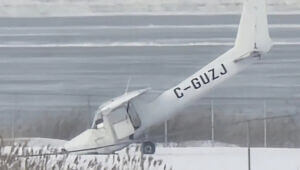 were dispatched to the scene to respond to a training flight. "A training flight operated by Orizon Aviation Québec Inc. was approaching Montmagny Airport when it touched down just short of the runway. The aircraft then dropped nose-first," the Transportation Safety Board told us.
The Sûreté du Québec (SQ) was called to ensure everything was in order, as were the firefighters, who are called in case of a fire. The two individuals suffering from minor injuries were transported to the hospital for treatment.
The Transportation Safety Board (TSB) will be mandated to investigate the causes of the incident, but no investigators will be dispatched to the site.
https://journaloieblanche.com/nouvelles/faits-divers/deux-blesses-dans-un-incident-a-l-aeroport-de-montmagny-GN5359910
NTSB Final Report: Cessna T188C
Airplane Descended Into Trees Located Beyond The Departure End Of The Runway
Location: Mount Gilead, Ohio Accident Number: ERA25LA243
Date & Time: June 26, 2025, 09:15 Local Registration: N3619J
Aircraft: Cessna T188C Aircraft Damage: Substantial
Defining Event: Loss of control in flight Injuries: 1 None
Flight Conducted Under: Part 137: Agricultural
Analysis: The pilot departed in variable light wind conditions for an aerial application flight. During the initial climb, the airplane reached an altitude of about 40 ft agl as the pilot began a turn away from the runway. The pilot described that the wind shifted to a tailwind and the airplane’s airspeed decreased. The airplane then exceeded its critical angle of attack, resulting in an aerodynamic stall at low altitude. With insufficient height to recover, the airplane descended into trees located beyond the departure end of the runway and came to rest in an upright position near a tree line. The airplane’s wings, fuselage, and tail section were substantially damaged during the accident sequence.
The pilot reported that there were no preaccident mechanical malfunctions or failures with the airplane that would have precluded normal operation.
Probable Cause and Findings: The National Transportation Safety Board determines the probable cause(s) of this accident to be -- The pilot’s failure to maintain adequate airspeed while in a turn during initial climb and the exceedance of the airplane’s critical angle of attack, which resulted in an aerodynamic stall at a low altitude.
FMI: www.ntsb.gov

Today in History
20 Years ago today: On 10 December 2005 Sosoliso Airlines flight 1145, a DC-9-30, crashed after a windshear encounter during landing at Port Harcourt Airport, Nigeria, killing 108 occupants; 2 survived the accident.
| Date: | Saturday 10 December 2005 |
| Time: | 14:08 |
| Type: | McDonnell Douglas DC-9-32 |
| Owner/operator: | Sosoliso Airlines |
| Registration: | 5N-BFD |
| MSN: | 47562/685 |
| Year of manufacture: | 1972 |
| Total airframe hrs: | 51051 hours |
| Cycles: | 60238 flights |
| Engine model: | P&W JT8D-9A |
| Fatalities: | Fatalities: 108 / Occupants: 110 |
| Other fatalities: | 0 |
| Aircraft damage: | Destroyed, written off |
| Category: | Accident |
| Location: | Port Harcourt Airport (PHC) - Nigeria |
| Phase: | Landing |
| Nature: | Passenger - Scheduled |
| Departure airport: | Abuja-Nnamdi Azikiwe International Airport (ABV/DNAA) |
| Destination airport: | Port Harcourt Airport (PHC/DNPO) |
| Confidence Rating: | Accident investigation report completed and information captured |
Narrative:
Sosoliso Airlines flight 1145, a DC-9-30, crashed after a windshear encounter during landing at Port Harcourt Airport, Nigeria, killing 108 occupants; 2 survived the accident.
Sosoliso Airlines flight 1145 was scheduled to depart Abuja (ABV) for Port Harcourt (PHC) at 10:00, but the flight was delayed to 13:26. At 13:41 the flight contacted Port Harcourt while maintaining FL240. The approach controller then gave the flight an in-bound clearance for an ILS approach to runway 21.
About 13:50, the crew contacted Approach Control for initial descent clearance and was cleared down to FL160. The aircraft continued its descent until about 14:00 hours when the crew asked Approach Control whether it was raining to which the controller reported negative rain but scattered CB and the crew acknowledged.
At 14:04, the crew reported established on the glide slope and the localizer at 8 nautical miles to touch down. Then the Approach controller informed the aircraft of precipitation approaching the airport from the direction of runway 21 and passed the aircraft to the Tower controller for landing instructions.
The flight contacted Port Harcourt Tower and reported established on glide slope and localizer at 6 nautical miles to touch down. The controller then cleared the airplane to land on runway 21 but to exercise caution as the runway surface was slightly wet and the pilot acknowledged. On final approach, the flight encountered adverse weather with wind speed and direction changing from 220 deg/09 kts to 360 deg/05 kts.
Although the runway was not in sight, the crew continued their descent below Decision Altitude. The crew initiated a go-around below the altitude of 204ft, which is 103ft below the Decision Altitude; the attempt of which was not
successful. The aircraft continued until the tail section contacted the grass area between runway 21 and a taxiway, 70 metres to the left of the runway edge and 540 metres from the runway threshold. Some 60 m further on, the rear fuselage impacted an exposed concrete drainage culvert. The no. 2 engine was sheared off and the rear airstair broke away from the fuselage. The aircraft disintegrated and caught fire, skidding for another 790 m. The cockpit section with the forward fuselage was found a further 330 m from the rest of the wreckage trail on the taxiway, giving a total wreckage distance of 1120 m.
PROBABLE CAUSE: "The probable cause of the accident was the crew's decision to continue the approach beyond the Decision Altitude without having the runway and/or airport in sight.
The contributory factors were:
1. The crew's delayed decision to carry out a missed approach and the application of improper procedure while executing the go-around.
2. The aircraft encountered adverse weather conditions with the ingredients of wind shear activity on approach.
3. The reducing visibility in thunderstorm and rain as at the time the aircraft came in to land was also a contributory factor to the accident. And the fact the airfield lightings were not on may also have impaired the pilot from sighting the runway.
4. Another contributory factor was the fact that the aircraft had an impact with the exposed drainage concrete culvert which led to its disintegration and subsequent fire outbreak."
