Here's what we have for today...
Be safe out there!
Tom
-
Aer Lingus plane swarmed by fire engines after Manchester Airport landing
Crews raced to the aircraft this morning
By Ashlie Blakey Live and breaking news reporter
Footage captured the moment fire engines 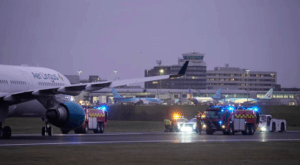 surrounded a plane as it landed at Manchester Airport this morning.
The video, taken by the Think Planes livestream, caught the moment crews raced over to the Aer Lingus aircraft as it landed on the tarmac. At least two fire engines swarmed the plane on blue lights.
The flight had previously taken off from Barbados as planned. But it then experienced a 'technical issue' and was met by emergency services as it arrived in Manchester.
The plane landed safely and was met by the crews as a 'precaution', a spokesperson for Aer Lingus said. Passengers reportedly had to sit on the aircraft while crews inspected the plane, but have since been safely taken off.
No further details on the technical issue have been revealed. In a statement, a spokesperson for Aer Lingus said: "Aer Lingus flight EI030 from Barbados to Manchester landed safely in Manchester Airport this morning following a technical issue.
"Due to the technical issue, the aircraft was met by emergency services as a precaution and passengers have safely disembarked."
https://www.manchestereveningnews.co.uk/news/greater-manchester-news/aer-lingus-plane-swarmed-fire-33132756
NTSB Final Report: Beech 95-B55 (T42A)
Pilot’s Failure To Extend The Landing Gear Prior To Landing
Location: St. Petersburg, Florida Accident Number: ERA25LA343
Date & Time: August 20, 2025, 09:24 Local Registration: N8313N
Aircraft: Beech 95-B55 (T42A) Aircraft Damage: Substantial
Defining Event: Landing gear not configured Injuries: 1 None
Flight Conducted Under: Part 91: General aviation - Personal
Analysis: The pilot of the multi-engine airplane departed from the airplane’s home airport on a crosscountry flight. The pilot stated that the takeoff and initial climb were normal; however, shortly after departure, he noted that the alternators went offline and the battery began to discharge.
The pilot attempted to restore the alternators by resetting the switches and field circuit breakers. Unable to regain alternator functionality, the pilot elected to abort the flight and return to the departure airport. The pilot reported that he attempted to extend the landing gear and heard the gear motor operate. During the return to the airport, the pilot reported additional electrical issues, such as the airplane’s primary flight display turning off and rebooting. While on final approach to the airport, the pilot reported that the landing gear down and locked light was not illuminated; however, the mechanical tab on the floorboard indicated the landing gear was down. Upon touchdown, the landing gear collapsed, and the airplane skidded down the runway to a stop resulting in substantial damage to the fuselage. Surveillance images of the airplane as it was on final approach revealed that the nose landing gear was not extended and the main landing gear appeared to be at least partially extended. Had the pilot coordinated with the control tower to observe the landing gear position, it is possible that they would have been able to alert the pilot that all of the landing gear were not fully extended.
Postaccident examination of the airplane revealed that the landing gear motor circuit breaker had tripped and that the landing gear was capable of being extended and locked in place using the emergency extension system. The examination also revealed that both alternator belts were in place on the alternators, and the battery had sufficient voltage to operate the airplane’s electrical system. Since the landing gear was able to be extended using the emergency extension system, it is likely that the landing gear circuit breaker had tripped due to an electrical wiring issue or an issue with the landing gear motor.
Probable Cause and Findings: The National Transportation Safety Board determines the probable cause(s) of this accident to be -- The pilot’s failure to extend the landing gear prior to landing. Contributing to the accident was a malfunction of the landing gear’s electrical retraction/extension system, which tripped the circuit breaker.
FMI: www.ntsb.gov

Today in History
67 Years ago today: On 30 December 1958 A VASP SAAB Scandia crashed into the water of Guanabara Bay, Brazil, following an engine failure after takeoff from Rio de Janeiro-Santos Dumont Airport, RJ (SDU), killing 21 occupants; 16 survived the accident.
| Date: | Tuesday 30 December 1958 |
| Time: | 12:09 |
| Type: | SAAB Scandia 90A-2 |
| Owner/operator: | VASP - Viação Aérea São Paulo |
| Registration: | PP-SQE |
| MSN: | 90.103 |
| Year of manufacture: | 1950 |
| Engine model: | P&W R-2180-E1 |
| Fatalities: | Fatalities: 21 / Occupants: 37 |
| Other fatalities: | 0 |
| Aircraft damage: | Destroyed, written off |
| Category: | Accident |
| Location: | Guanabara Bay, RJ - Brazil |
| Phase: | Initial climb |
| Nature: | Passenger - Scheduled |
| Departure airport: | Rio de Janeiro-Santos Dumont Airport, RJ (SDU/SBRJ) |
| Destination airport: | São Paulo-Congonhas Airport, SP (CGH/SBSP) |
| Confidence Rating: | Accident investigation report completed and information captured |
Narrative:
A VASP SAAB Scandia crashed into the water of Guanabara Bay, Brazil, following an engine failure after takeoff from Rio de Janeiro-Santos Dumont Airport, RJ (SDU), killing 21 occupants; 16 survived the accident.
The Saab took off from Rio de Janeiro and was climbing through an altitude of 50 m when the no. 1 engine failed. The pilot made a 90 degree left turn and started another left turn after flying straight on for about 500 m. During that turn, the aircraft stalled and crashed into the sea.
PROBABLE CAUSE: "The accident was attributed to the pilot' incorrect handling of the controls in flight."
