Not much on the ARFF side this morning, which makes it all the better time to share a message from "The Secret List" that shares a video produced by the Los Angeles City Fire Department featuring footage, graphics and interviews with Firefighters who survived - and in some cases, barely survived - working fire incidents.
 makes it all the better time to share a message from "The Secret List" that shares a video produced by the Los Angeles City Fire Department featuring footage, graphics and interviews with Firefighters who survived - and in some cases, barely survived - working fire incidents.
You will see actual incidents that were caught on film-featuring the words and reflections by the Firefighters narrating-who were directly involved.
 on film-featuring the words and reflections by the Firefighters narrating-who were directly involved.
As is mentioned in "The Secret List", "Don't keep this opportunity to yourself-use it as a drill for all of your members-together-and discuss it."...
Be safe out there!
Tom
-
WATCH: “MY LAST DYING BREATH” Firefighters Fight To Survive (The Secret List)
All,
We are sharing this phenomenal video as it is a must be seen by every Firefighter, Fire Officer and Chief. We promise.
This video is professionally produced by the Los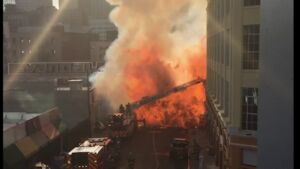 Angeles City Fire Department and features raw footage, graphics and interviews with the Firefighters who survived - and in some cases, barely survived - these working fire incidents. You will see the actual incidents that were caught on film-featuring the words and reflections by the Firefighters narrating-who were directly involved.
PLEASE NOTE THAT the video covers five separate incidents, which makes it perfect to break it up (incident by incident) for company drills, review, discussion and comparison between yours, mine, our fire departments and each of our resources, response areas, etc.
Don't keep this opportunity to yourself-use it as a drill for all of your members-together-and discuss it.
This is a rare opportunity because these Firefighters and the LA City FD leadership are allowing us to hear the brutal facts of what went right - and what went wrong on each of the fires, so we can all learn. Please take advantage and spend some time with all your Firefighters utilizing this phenomenal resource and opportunity.
This brutally honest film features deeply personal interviews by the Firefighters who were there. This is a must see for everyone, regardless of time on the job or rank.
Our sincere thanks to LA City Training Division Captain Andy Ruiz, as well as LA City FD Chief of Department Jaime Moore for providing us the opportunity to share this with you. We especially thank each of the Firefighters (who you are going to meet in this video) for sharing their deeply personal stories-for the benefit and betterment of every Firefighter. .
WATCH: LA City FD:
"MY LAST DYING BREATH"
https://vimeo.com/1150859053?fl=pl&fe=sh
Take Care. Be Careful. Pass It On.
BillyG
The Secret List 1/4/2026-0800 Hours
NTSB Prelim: Murphy SR3500
Airplane Was Heard Climbing Out When The Engine Was Heard Making A Sudden, Loud Bang And Popping Sound, Then Became Quiet
Location: Bigfork, MT Accident Number: WPR25FA289
Date & Time: September 19, 2025, 12:05 Local Registration: N62ZT
Aircraft: Murphy SR3500 Injuries: 1 Fatal
Flight Conducted Under: Part 91: General aviation - Personal
On September 19, 2025, about 1205 mountain daylight time, an experimental amateur built Murphy SR3500, N62ZT, was destroyed when it was involved in an accident near Bigfork, Montana. The pilot was fatally injured. The airplane was operated as a Title 14 Code of Federal Regulations Part 91 personal flight.
According to a witness, the tailwheel equipped airplane departed Kalispell City Airport (S27), Kalispell, Montana, about 1130, for a local flight. About 1200, the airplane approached runway 33 at Ferndale Airfield (53U), Bigfork, Montana. According to multiple witnesses at 53U, the airplane bounced twice during a landing attempt on runway 33. About midfield, the airplane was seen rolling out on its main landing gear, with the tail up, and the engine was heard “throttling up.” Near the departure end of runway 33, the airplane was heard climbing out when the engine was heard making a sudden, loud bang and popping sound, then became quiet. The airplane subsequently impacted trees to the right side of runway 33’s overrun area and a postcrash fire ensued.
Examination of the accident site revealed that the airplane impacted trees at the eastern edge of runway 33’s overrun and came to rest upright, at an elevation of 3,079 ft mean sea level (msl), about 875 ft from the departure end of runway 33. The first identified point of contact (FIPC) was a pine tree that had been topped about 50 ft above ground level (agl), located about 104 ft and on magnetic heading of 177° from the main wreckage. The fuselage was thermally destroyed and oriented on a magnetic heading of 121°, among multiple downed trees. The right wing was located at the base of a tree near the FIPC. The left wing was located to the right of the main wreckage, and the empennage was located about 45 ft beyond, and on a magnetic heading of 050° from the main wreckage. The engine remained attached to the fuselage and was thermally damaged. Outboard segments of both propeller blades were located within the debris path. All major components of the airplane were located throughout the debris path.
The wreckage was recovered to a secure location for further examination.
FMI: www.ntsb.gov
Today in History
66 Years ago today: On 6 January 1960 National Airlines flight 2511, a Douglas DC-6, crashed near Bolivia, North Carolina, USA, following the in-flight detonation of an explosive device, killing all 34 occupants.
| Date: | Wednesday 6 January 1960 |
| Time: | 02:38 |
| Type: | Douglas DC-6B |
| Owner/operator: | National Airlines |
| Registration: | N8225H |
| MSN: | 43742/300 |
| Year of manufacture: | 1952 |
| Total airframe hrs: | 24836 hours |
| Engine model: | P&W R-2800-CB16 |
| Fatalities: | Fatalities: 34 / Occupants: 34 |
| Other fatalities: | 0 |
| Aircraft damage: | Destroyed, written off |
| Category: | Unlawful Interference |
| Location: | 2,4 km NW of Bolivia, NC - United States of America |
| Phase: | En route |
| Nature: | Passenger - Scheduled |
| Departure airport: | New York-Idlewild International Airport, NY (IDL/KIDL) |
| Destination airport: | Miami International Airport, FL (MIA/KMIA) |
| Investigating agency: | CAB |
| Confidence Rating: | Accident investigation report completed and information captured |
Narrative:
National Airlines flight 2511, a Douglas DC-6, crashed near Bolivia, North Carolina, USA, following the in-flight detonation of an explosive device, killing all 34 occupants.
Flight 601 was scheduled non-stop Boeing 707 jet flight from New York-Idlewild to Miami. The 707, which was leased from PanAm, suffered a maintenance issue and was substituted by a Lockheed L-188 Electra and a Douglas DC-6.
The DC-6 was re-designated flight 2511 and departed Idlewild at 23:34 hours. The flight proceeded routinely in accordance with its flight plan until shortly after passing Wilmington, North Carolina.
At 02:31 the crew contacted the company radio station at Wilmington while over Carolina Beach at 18000 feet, and transmitted a routine progress report. Shortly after the completion of this radio contact a dynamite explosion occurred in the passenger cabin. This explosion severely impaired the structural integrity of the aircraft and after making a wide descending right turn, it experienced in flight disintegration and crashed 1,5 miles northwest of Bolivia at 02:38 some 16 miles west of its intended flight path.
An investigation showed that the dynamite was detonated by means of dry cell batteries and that the device was placed at a point beneath the extreme right seat of seat row 7. Part of the fuselage broke away, striking the no.3 propeller.
Mr. Julian A. Frank (32) was in close proximity to the dynamite charge when the detonation occurred. He had lost several hundred thousand dollars in bad investments in 1959 and was under investigation on charges of defrauding his clients. In the six months before his death he bought nearly $900,000 in life insurance, with his wife and children as beneficiaries.
PROBABLE CAUSE: "The accident was caused by the detonation of dynamite within the passenger cabin."
