These are your stories for today...
Be safe out there!
Tom
-
U.S. Air Force Training Command Has A New Aircraft – The T-7A Red Hawk
By Peter Suciu
The United States Air Force's Air Education and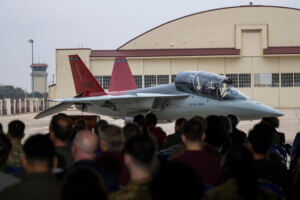 Training Command officially received the first dedicated trainer built in more than six decades. The first Boeing-Saab T-7A Red Hawk arrived at Joint Base San Antonio-Randolph, Texas, last month, but the 99th Flying Training Squadron, assigned to the 12th Flying Training Wing, officially accepted it at an "arrival ceremony" on January 9.
The Red Hawk will eventually replace the aging Northrop T-38C Talon, a trainer that has been in service since the early 1960s and which has seen its service life extended multiple times. However, the Red Hawk isn't just a new trainer, but part of a new training effort, according to the AETC.
"The T-7 isn't simply a modern upgrade," said Lt. Gen. Clark J. Quinn, AETC commander. "It's a generational leap that will be an important part of AETC for decades to come."
A total of 351 trainer aircraft will eventually be delivered to the Air Force under terms of a $9.2 billion contract awarded to Boeing in September 2018.
"The arrival of the T-7A is not the finish line," Quinn said. "It marks the beginning of the work ahead to deliver training that produces ready, capable pilots for the future of the Air Force."
Honoring World War II Aviators
The aircraft, along with simulators and associated ground equipment, will replace the AETC’s T-38C Talon fleet. Each production model Red Hawk is notable for featuring the iconic "Red Tail" symbol used on the aircraft flown by the famed Tuskegee Airmen during the Second World War. The Red Hawk name was even derived from the Curtiss P-40 Warhawk, which was among the fighters flown by those African-American pilots.
The 99th Flying Training Squadron, whose lineage goes back to the Tuskegee Airmen, will lead early operational efforts, the Air Force announced.
Training Next Generation Pilots
Even as it pays homage to the past, the Red Hawk was developed by Boeing and Saab to train U.S. Air Force pilots on fifth- and sixth-generation fighters.
"From day one, students won't just be learning to fly; they'll be learning to manage information, interpret data from advanced sensors, and make critical decisions in a complex environment, all from within the trainer," explained Maj. Gen. Gregory Kreuder, 19th Air Force commander. "This aircraft enables us to close the gap between basic pilot training and the realities of fifth-generation plus warfare, producing more capable, intuitive warfighters right out of the gate."
The Red Hawk is also unique in that it exemplifies model-based engineering, using software design tools to tightly integrate engineering, production, and maintenance of the aircraft. The T-7A was developed through computer modeling that used virtual and augmented reality.
However, there was still a bit of a learning curve.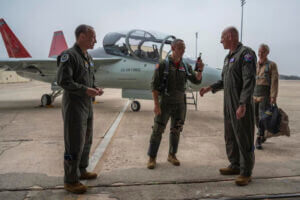
Rather than shortening the aircraft's development timeline, the T-7A faced delays due to issues with its ejection seat design and flight control software. That pushed back the delivery of the first Talon and has led to a delay in its initial operational capability, shifting the target from 2024 to an estimated fiscal year 2027-2028 timeline.
However, the goal of the new aircraft remains the same: preparing the next generation of pilots to fly even more advanced aircraft.
"It is about establishing an enterprise-wide training foundation that other wings will rely on as they develop the next generation of Air Force pilots," said Col. Peter Lee, 12th Flying Training Wing commander.
As it is a digitally designed, modular aircraft, the T-7A can be upgraded to incorporate new technologies far more easily than the Talon. It will also employ Live-Virtual Constructive, enabling training between physical aircraft and simulators.
"The 99th will rewrite what pilot production looks like and shape the future of pilot training for the next generation of warfighters for America," added Lt. Col. Michael Trott, 99th FTW commander.
The T-7's Program of Record calls for the 351 Red Hawks, along with 46 simulators.
https://www.forbes.com/sites/petersuciu/2026/01/12/us-air-force-training-command-has-a-new-aircraft--the-t-7a-red-hawk/
FAA issues reminder about lithium battery fire risk on planes
Items exceeding 160 watt-hours like generators or large power banks are forbidden on planes.
By: Julie Salomone
TAMPA, Fla. — The Federal Aviation Administration (FAA) is reminding passengers about safety when it comes to traveling with lithium batteries.
Cell phones, laptops, vaping devices, mobility aids and other portable rechargeable electronic devices must be in carry-on baggage, not checked luggage.
The FAA said if a fire starts, the cabin crew needs to respond quickly.
"You should immediately get the attention of the cabin crew. They have training. They've practiced this and they know what to do in the event of a lithium battery fire or heat event. They will come assist. If you have trouble getting their attention, stand up, find a way to get their attention, acting quickly is very important," said Ben Supko, FAA's associate administrator for security and hazardous materials safety.
Natalie Lukanik travels with the basics, like a cell phone and a laptop.
"I went through Logan Airport in Boston and they told me to take all my devices and everything that had lithium battery and put it in a separate container to go through security," said Lukanik.
The FAA says items exceeding 160 watt-hours, like generators or large power banks, are forbidden on airplanes. Recently, the FAA has seen an increase in the confiscation of these forbidden items from passengers.
The airports listed below have seen the largest increase:
- Miami International Airport (MIA)
- Newark Liberty International Airport (EWR)
- John F. Kennedy International Airport (JFK)
- Chicago O'Hare International Airport (ORD)
- Austin-Bergstrom International Airport (AUS)
- LaGuardia Airport (LGA)
- Tampa International Airport (TPA)
- Louis Armstrong New Orleans International Airport (MSY)
- Boston Logan International Airport (BOS)
- Pittsburgh International Airport (PIT)
"Most recently, we’ve seen an influx of large lithium battery-powered generators, which have batteries that far exceed the allowable limits, so the answer is no. I mean, you can’t do that, and if you do that, you bring a battery on board in a generator that’s let’s say 500 watt-hours, it will be confiscated, and you will likely face civil and criminal penalties," said Supko.
The FAA provided the following checklist:
- Spare batteries:Must be in carry-on baggage only.
- Installed batteries:Devices like laptops and cell phones should also be in carry-on baggage.
- Protection:Protect spare batteries by keeping them in their original packaging, taping the terminals, or placing them in individual bags to prevent short circuits.
- Damaged batteries:Do not carry any damaged, defective, or recalled lithium batteries.
- Watt-hour limits:There are limits based on watt-hours (Wh).
- 0−100 Wh: Allowed in carry-on. (Ex. laptops, cell phones and most power banks)
- 101−160 Wh: Allowed in carry-on with airline approval and are limited to two per person. (Ex. power tools and medium power banks)
- Above 160 Wh: Forbidden. (Ex. generators, large power banks and power stations)
For more information on lithium batteries and how to pack safely, click here.
Midair Collision PSA Airlines Bombardier CRJ700 Airplane and Sikorsky UH-60 Military Helicopter
The National Transportation Safety Board will hold a public board meeting on Jan. 27 to determine the probable cause of the Jan. 29, 2025 midair collision between a PSA Airlines CRJ700 regional jetliner and a U.S. Army Sikorsky UH-60L Black Hawk helicopter over the Potomac River near Ronald Reagan Washington National Airport.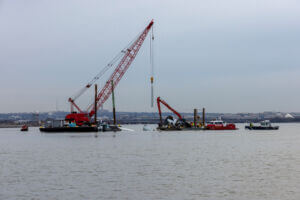
During the meeting, NTSB board members will discuss safety issues related to this crash and vote on the probable cause and safety recommendations designed to prevent similar crashes in the future.
Members of the public and the media can view the webcast of the meeting.
Additional factual information is included in the public docket for the investigation. The docket includes reports, interview transcripts and other investigative materials.
WHAT: A board meeting on Jan. 29, 2025 mid-air collision near Ronald Regan Washington National Airport
WHO: NTSB investigative staff and board members
WHEN: Tuesday, Jan. 27 at 9 a.m. Eastern time
WHERE: NTSB Boardroom and Conference Center, 429 L’Enfant Plaza, SW, Washington, DC. The street entrance to the NTSB Boardroom and Conference Center is located at 420 10th Street SW, running between D Street and Frontage Road, SW, just below the L'Enfant Plaza Promenade. The boardroom is also accessible from L’Enfant Plaza Metro through the food court.
Board Meeting Format and Agenda
NTSB Board meetings follow the following format:
- Call to order and chairwoman’s opening statement.
- Investigator presentations organized by topic that cover facts, analysis, findings and recommendations.
- Discussion rounds in which board members question staff on each topic.
- Staff presentation of all proposed findings, probable cause and recommendations.
- Board member discussion of findings, probable cause and recommendations, followed by voting to approve those items.
- Chairwoman’s closing statement and adjournment.
Security and Arrival
Due to high interest, security screening lines may be long. We encourage media to arrive early. After clearing security, members of the news media should sign in at the media room, just to the left of the entrance to the boardroom. There will be a seating chart, agenda and other materials available at sign-in.
The street entrance to the NTSB Boardroom and Conference Center is located at 42010th Street SW, running between D Street and Frontage Road, SW, just below the L'Enfant Plaza Promenade. The boardroom is also accessible from L’Enfant Plaza Metro through the food court.
Crews with equipment can avoid escalators by accessing the boardroom through the adjacent parking garage. Enter the garage through the Public Parking entrance on 10th Street, using the ramp. The door to access the boardroom lobby is close to the entrance ramp for the garage. Signs painted on the floor will direct you.
Photography Access
Only pool photographers will be allowed in the boardroom for the duration of the meeting. Other photographers will be allowed to access the boardroom in escorted shifts and will be limited to a designated area on risers next to the pool photographers.
https://www.ntsb.gov/news/events/Pages/DCA25MA108-BMG.aspx
NTSB Final Report: Cessna 180G
After Takeoff From A Remote, Wet, Gravel-Covered, Rough And Uneven Airstrip That Was Surrounded By Trees, The Airplane Began To Unexpectedly Descend
Location: Delta Junction, Alaska Accident Number: ANC25LA088
Date & Time: August 19, 2025, 05:30 Local Registration: N4721U
Aircraft: Cessna 180G Aircraft Damage: Substantial
Defining Event: Collision during takeoff/land Injuries: 2 None
Flight Conducted Under: Part 91: General aviation - Personal
Analysis: The pilot reported that, shortly after takeoff from a remote, wet, gravel-covered, rough and uneven airstrip that was surrounded by trees, the airplane began to unexpectedly descend just after becoming airborne. He attempted to recover by applying aft elevator input; however, the airplane settled into an area of tree and vegetation-covered terrain at the departure end of the airstrip. As a result, the airplane sustained substantial damage to the horizontal stabilizer, wings, and fuselage. The pilot reported that there were no preaccident mechanical failures or malfunctions with the airplane that would have precluded normal operation.
Probable Cause and Findings: The National Transportation Safety Board determines the probable cause(s) of this accident to be -- The pilot’s failure to maintain a rate of climb sufficient to clear obstacles during takeoff, resulting in a collision with tree-covered terrain.
FMI: www.ntsb.gov
Today in History
44 Years ago today: On 13 January 1982 Air Florida flight 90, a Boeing 737-200, crashed into the Potomac River shortly after takeoff from Washington-National Airport, DC, USA, killing 74 occupants and 4 persons on the ground; 5 survived the accident.
| Date: | Wednesday 13 January 1982 |
| Time: | 16:01 |
| Type: | Boeing 737-222 |
| Owner/operator: | Air Florida |
| Registration: | N62AF |
| MSN: | 19556/130 |
| Year of manufacture: | 1969 |
| Total airframe hrs: | 23608 hours |
| Cycles: | 29549 flights |
| Engine model: | P&W JT8D-9A |
| Fatalities: | Fatalities: 74 / Occupants: 79 |
| Other fatalities: | 4 |
| Aircraft damage: | Destroyed, written off |
| Category: | Accident |
| Location: | 1,4 km N of Washington-National Airport, DC (DCA) [Potomac River] - United States of America |
| Phase: | Initial climb |
| Nature: | Passenger - Scheduled |
| Departure airport: | Washington-National Airport, DC (DCA/KDCA) |
| Destination airport: | Tampa International Airport, FL (TPA/KTPA) |
| Investigating agency: | NTSB |
| Confidence Rating: | Accident investigation report completed and information captured |
Narrative:
Air Florida flight 90, a Boeing 737-200, crashed into the Potomac River shortly after takeoff from Washington-National Airport, DC, USA, killing 74 occupants and 4 persons on the ground; 5 survived the accident.
Air Florida Flight 90 was scheduled to leave Washington National Airport at 14:15 EST for a flight to Fort Lauderdale International Airport, FL (FLL), with an intermediate stop at the Tampa, FL (TPA).
The aircraft had arrived at gate 12 as Flight 95 from Miami, FL, at 13:29. Because of snowfall, the airport was closed for snow removal from 13:38 to 14:53. At about 14:20 maintenance personnel began de-icing the left side of the fuselage with de-icing fluid Type II because the captain wanted to start the de-icing just before the airport was scheduled to reopen (at 14:30) so that he could get in line for departure. Fluid had been applied to an area of about 10 feet when the captain terminated the operation because the airport was not going to reopen at 14:30. Between 14:45 and 14:50, the captain requested that the de-icing operation be resumed.
The left side of the aircraft was de-iced first. No covers or plugs were installed over the engines or airframe openings during de-icing operations.
At 15:15, the aircraft was closed up and the jet way was retracted and the crew received push-back clearance at 15:23. A combination of ice, snow, and glycol on the ramp and a slight incline prevented the tug, which was not equipped with chains, from moving the aircraft. Then, contrary to flight manual guidance, the flight crew used reverse thrust in an attempt to move the aircraft from the ramp. This resulted in blowing snow which might have adhered to the aircraft. This didn't help either, so the tug was replaced and pushback was done at 15:35. The aircraft finally taxied to runway 36 at 15:38.
Although contrary to flight manual guidance, the crew attempted to deice the aircraft by intentionally positioning the aircraft near the exhaust of the aircraft ahead in line (a New York Air DC-9). This may have contributed to the adherence of ice on the wing leading edges and to the blocking of the engineÂ’s Pt2 probes.
At 15:57:42, after the New York Air aircraft was cleared for takeoff, the captain and first officer proceeded to accomplish the pre-takeoff checklist, including verification of the takeoff engine pressure ratio (EPR) setting of 2.04 and indicated airspeed bug settings. Takeoff clearance was received at 15:58. Although the first officer expressed concern that something was 'not right' to the captain four times during the takeoff, the captain took no action to reject the takeoff. The aircraft accelerated at a lower-than-normal rate during takeoff, requiring 45 seconds and nearly 5,400 feet of runway, 15 seconds and nearly 2,000 feet more than normal, to reach lift-off speed. The aircraft initially achieved a climb, but failed to accelerate after lift-off. The aircraftÂ’s stall warning stick shaker activated almost immediately after lift-off and continued until impact. The aircraft encountered stall buffet and descended to impact at a high angle of attack. At about 16.01, the aircraft struck the heavily congested northbound span of the 14th Street Bridge and plunged into the ice-covered Potomac River. It came to rest on the west end of the bridge 0.75 nmi from the departure end of runway 36. When the aircraft struck the bridge, it struck six occupied automobiles and a boom truck before tearing away a 41-foot section of the bridge wall and 97 feet of the bridge railings. Four persons in vehicles on the bridge were killed; four were injured, one seriously.
PROBABLE CAUSE: " The flight crew's failure to use engine anti-ice during ground operation and takeoff, their decision to take off with snow/ice on the airfoil surfaces of the aircraft, and the captainÂ’s failure to reject the takeoff during the early stage when his attention was called to anomalous engine instrument readings. Contributing to the accident were the prolonged ground delay between de-icing and the receipt of ATC takeoff clearance during which the airplane was exposed to continual precipitation, the known inherent pitch up characteristics of the B-737 aircraft when the leading edge is contaminated with even small amounts of snow or ice, and the limited experience of the flight crew in jet transport winter operations."
