Here are the stories for today...
Be safe out there!
Tom
-
Air India aircraft grounded after engine ingests cargo container; DGCA launches probe
The aircraft was operating a New Delhi–New York flight and returned to Delhi shortly after departure due to Iranian airspace restrictions
By Jagriti Chandra
One of the engines of an Air India A350 on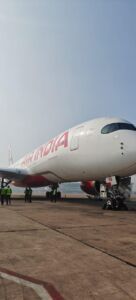 Thursday (January 15, 2025) ingested a ground container while taxiing to the parking bay amid dense fog.
Flight AI101 was operating a New Delhi–New York flight and returned to Delhi shortly after departure due to Iranian airspace restrictions.
The Directorate General of Civil Aviation (DGCA) has launched a probe into the incident to ascertain how a foreign object got lodged inside the engine.
“Air India confirms that Flight AI101, operating from Delhi to New York (JFK), was forced to return to Delhi shortly after takeoff due to the unexpected closure of Iranian airspace, which impacted its planned route. Upon landing in Delhi, the aircraft encountered a foreign object while taxiing in dense fog, resulting in damage to the right engine,” the airline said in a statement.
It, however, did not identify the “foreign object”. “The aircraft was safely positioned at the designated parking stand, ensuring the safety of all passengers and crew on board,” it added in the statement.
The civil aviation ministry, in a statement later in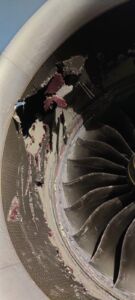 the day, said the aircraft landed safely at Runway 28 and while taxiing to the apron area, at taxiway N/N4 junction, the right engine ingested a cargo container, causing substantial damage to the engine.
“The incident occurred around 05:25 IST. As per the information, the visibility at the time of the incident was marginal. The preliminary investigation has revealed that a BWFS tug transporting a few containers to the Baggage Makeup Area of Terminal 3 crossed this intersection while on the vehicular lane,” the statement said.
“During crossing, one of the containers toppled onto the taxiway intersection. This container got ingested in the No. 2 engine of Air India A350 aircraft,” it further read.
The aircraft was later parked on stand 244.
https://www.thehindu.com/news/national/air-india-aircraft-grounded-after-engine-ingests-container/article70512544.ece
NTSB Prelim: Pitts S1S
Upon Reaching 400 Ft Above Ground Level (AGL), The Engine Lost Power
Location: Carbondale, IL Accident Number: CEN26LA074
Date & Time: December 31, 2025, 16:03 Local Registration: N401MS
Aircraft: Pitts S1S Injuries: 1 Minor
Flight Conducted Under: Part 91: General aviation - Personal
On December 31, 2025, at 1603 central standard time, a Pitts S1S airplane, N401MS, was substantially damaged when it was involved in an accident near Carbondale, Illinois. The pilot received minor injuries. The airplane was operated as a Title 14 Code of Federal Regulations Part 91 personal flight.
The pilot reported that he had completed three touch-and-go landings on runway 36R. He then completed a low approach over runway 18L and began a climb near the departure end of the runway. Upon reaching 400 ft above ground level (agl), the engine lost power. The pilot was able to momentarily restore partial power by manually actuating the emergency fuel pump; however, the engine lost power again. Unable to maintain altitude, the pilot completed a forced landing on an airport perimeter road, then exited the road to the right and struck a power pole.
The left wing separated from the airplane during the impact. The tail mounted video camera captured the accident sequence, and the video was provided for the investigation. The airplane’s engine monitoring system data card and the airplane have been retained for further examination.
FMI: www.ntsb.gov

Today in History
49 Years ago today: On 15 January 1977 Linjeflyg flight 618, a Vickers Viscount, crashed following a loss of control while on approach to Stockholm-Bromma Airport, Sweden, killing all 22 occupants.
| Date: | Saturday 15 January 1977 |
| Time: | 09:05 |
| Type: | Vickers 838 Viscount |
| Owner/operator: | Linjeflyg, lsf Skyline Sweden |
| Registration: | SE-FOZ |
| MSN: | 372 |
| Year of manufacture: | 1961 |
| Total airframe hrs: | 12208 hours |
| Engine model: | Rolls-Royce Dart 525F |
| Fatalities: | Fatalities: 22 / Occupants: 22 |
| Other fatalities: | 0 |
| Aircraft damage: | Destroyed, written off |
| Category: | Accident |
| Location: | 4,5 km NW of Stockholm-Bromma Airport (BMA) - Sweden |
| Phase: | Approach |
| Nature: | Passenger - Scheduled |
| Departure airport: | Jönköping-Axamo Airport (JKG/ESGJ) |
| Destination airport: | Stockholm-Bromma Airport (BMA/ESSB) |
| Investigating agency: | SHK |
| Confidence Rating: | Accident investigation report completed and information captured |
Narrative:
Linjeflyg flight 618, a Vickers Viscount, crashed following a loss of control while on approach to Stockholm-Bromma Airport, Sweden, killing all 22 occupants.
Flight LF618 originated at Kristianstad (KID) with stops at Växjö (VXO) and Jönköping (JKG) en route to Stockholm (BMA) in Sweden. On the final leg of the flight, while on approach to Stockholm-Bromma Airport, the aircraft suddenly pitched down from an altitude of 1150 feet. It went into a vertical dive and crashed on a parking lot in the neighborhood.
Because the no. 2 and no. 3 engines had been running with reduced power for a long time, the anti-ice system temperature was too low.
Probable cause (translated from Swedish):
The accident was caused by the stabilizer stalling due to the air flow around it being disturbed by ice accretion.
The reason why ice was formed is that the de-icing system's temperature had been too low due to insufficient power on engines 2 and 3 for a long time. This can be attributed to deficiencies in the pilot's flight manual regarding the operation of the de-icing system, which, in turn, should be due to deficiencies in the flight manual of the manufacturer's aviation authority. Insufficient information in the pilot's flight manual on the effects of ice formation on the stabilizer may also have affected. The pilots have also not been informed of the occurrence of severe ice formation in the Stockholm area.
