These are your stories for today...
Be safe out there!
Tom
-
Small plane landing goes awry at Altoona-Blair County Airport
by: Bill Shannon
BLAIR COUNTY, Pa. (WTAJ) — An Altoona-Blair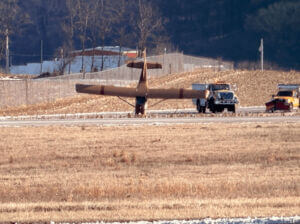 County Airport runway was closed after an incoming plane landed and went off the pavement.
The small plane was trying to land at the airport Tuesday morning, Jan. 20, when it experienced brake issues, according to Chief Morris of the North Woodbury Township Police.
While no injuries were reported, the crash caused damage to the plane, and the runway was closed. Airport officials stated that the FAA was contacted and the crash was reported.
Crews are now waiting for FAA approval to remove the plane and reopen the runway.
https://www.wtaj.com/news/local-news/small-plane-landing-goes-awry-at-altoona-blair-county-airport/
North Shore: Helicopter crash in Havre-Saint-Pierre
Jeremy Bernier
A helicopter crash left at least one person injured in Havre-Saint-Pierre, on the North Shore, Tuesday at noon.
The event occurred shortly before noon near Lake Avion.
The exact circumstances of the crash are not known at this time, but weather conditions and inexperience may have played a role.
According to the Sûreté du Québec (SQ), the pilot of the aircraft was taken back to the hospital to be treated for injuries whose severity is not known.
The condition of the two other passengers in the helicopter is unknown at this time, but no deaths have been reported.
The SQ later clarified, however, that no lives were in danger.
The police force also indicates that there is likely no criminal activity in this case, at first glance.
The Transportation Safety Board of Canada is expected to go to the scene to analyze the situation.
https://www.tvanouvelles.ca/2026/01/20/cote-nord-ecrasement-dhelicoptere-a-havre-saint-pierre
NTSB Final Report: Aeronca 11AC
Pilot Reported That There Was A Total Loss Of Engine Power While 1,200 Feet Above Ground Level
Location: Longmont, Colorado Accident Number: CEN25LA403
Date & Time: September 29, 2025, 12:00 Local Registration: N86326
Aircraft: Aeronca 11AC Aircraft Damage: Substantial
Defining Event: Fuel exhaustion Injuries: 2 None
Flight Conducted Under: Part 91: General aviation - Personal
Analysis: The pilot reported that there was a total loss of engine power while 1,200 feet above ground level and about 6 nautical miles short of his destination. He performed an off-airport landing, in a pasture, with cows at the far end. During short final, the pilot had to maneuver to avoid rough terrain and a fence and then flared the airplane too high and yawed to one side which resulted in a hard landing. The tailwheel collapsed and there was substantial damage to the rudder.
The pilot reported that there were no preaccident mechanical malfunctions or failures that would have precluded normal operation. He stated that a miscalculation of fuel quantity and fuel burn led to the fuel exhaustion.
Probable Cause and Findings: The National Transportation Safety Board determines the probable cause(s) of this accident to be -- The pilot’s inadequate preflight fuel planning, which resulted in a total loss of engine power due to fuel exhaustion and the pilot’s improper landing flare which resulted in a hard landing.
FMI: www.ntsb.gov

Today in History
41 Years ago today: On 21 January 1985 Galaxy Airlines flight 203, a Lockheed L-188 Electra, crashed shortly after takeoff from Reno/Tahoe Airport, NV, USA, killing 70 occupants; 1 survived the accident.
| Date: | Monday 21 January 1985 |
| Time: | 01:04 |
| Type: | Lockheed L-188A Electra |
| Owner/operator: | Galaxy Airlines |
| Registration: | N5532 |
| MSN: | 1121 |
| Year of manufacture: | 1960 |
| Total airframe hrs: | 34148 hours |
| Cycles: | 33285 flights |
| Engine model: | Allison 501-D13 |
| Fatalities: | Fatalities: 70 / Occupants: 71 |
| Other fatalities: | 0 |
| Aircraft damage: | Destroyed, written off |
| Category: | Accident |
| Location: | 3 km SE of Reno/Tahoe International Airport, NV (RNO) - United States of America |
| Phase: | Initial climb |
| Nature: | Passenger - Non-Scheduled/charter/Air Taxi |
| Departure airport: | Reno/Tahoe International Airport, NV (RNO/KRNO) |
| Destination airport: | Minneapolis-St. Paul International Airport, MN (MSP/KMSP) |
| Investigating agency: | NTSB |
| Confidence Rating: | Accident investigation report completed and information captured |
Narrative:
Galaxy Airlines flight 203, a Lockheed L-188 Electra, crashed shortly after takeoff from Reno/Tahoe Airport, NV, USA, killing 70 occupants; 1 survived the accident.
Galaxy Airlines Lockheed L-188A Electra, registration N5532, was scheduled operate flights from Seattle (SEA) to Oakland as Flight 201, from Oakland to Reno (RNO) as Flight 202, from Reno (RNO) to Minneapolis (MSP) as Flight 203 and finally returning to Seattle using flight number 204.
Scheduled departure time for Flight 201 had been 15:30, but had been delayed and the airplane departed Seattle at 20:19 on a ferry flight to Oakland, where it arrived at 22:25. Sixty-five passengers boarded the plane for the flight to Reno. Following ground servicing the ground handler supervisor signalled to the crew that they could commence engine starting. However, after engines one and four were started, he noticed that the other ground handler was unable to disconnect the air start hose. It was stretched taut from the power cart to the airplaneÂ’s air start access panel, located on the underside of the right wing leading edge, close to the fillet area. The supervisor gave the flightcrew an emergency stop signal, left his position, and disconnected the hose. None of the two ground crewmembers remembered closing the air start access door.
At approximately 00:59 the first officer requested taxi instructions Reno tower almost immediately thereafter cleared Galaxy 203 to taxi to runway 16R. The aircraft taxied to the runway and at 01:01:32 the first officer requested takeoff clearance. Four seconds later Galaxy 203 was given clearance to take off from runway 16R. While accellerating through V1 speed, a "thunking" type sound was heard, followed by another one just after V2. Heavy airframe vibration started after liftoff. The captain reacted to the airplaneÂ’s vibration by reducing power significantly in all four engines, indicating that he believed the vibration was caused by the powerplants or propellers. The airplane reached an altitude of about 200-250 feet and started a right hand turn to return to the airport. The Electra then entered an aerodynamic stall buffet because of insufficient engine power to maintain flight. The Electra crashed into a field, bounced, slid into some mobile homes and burst into flames.
Of the 71 occupants, three initially survived the crash. One died on January 29, while the second died of injuries on February 4. The sole survivor, a 17-year-old male, was thrown clear of the airplane onto the adjacent highway.
PROBABLE CAUSE: "The captain's failure to control and the co-pilot's failure to monitor the flight path and airspeed of the aircraft. This breakdown in crew coordination followed the onset of unexpected vibration shortly after takeoff. Contributing to the accident was the failure of ground handlers to properly close an air start access door, which led to the vibration."
