Here is what we have to close out this week...
Couple of things, first off, today is the 44th anniversary of the World Airways DC-10 crash at KBOS. I think there may be a few ARFF folks around that can tell stories of this one.
And.....
For those that will be affected by the big storm here in the States this weekend, be extra careful.
Everyone have a safe weekend!
Tom
-
NTSB Prelim: Holtaway Robert F Velocity V-Twin
On His Third Circuit Of The Traffic Pattern, When Turning To The Downwind Leg, The Airplane “Steepened Its Bank And Nosed Down.”
Location: Nashua, NH Accident Number: ERA26LA070
Date & Time: December 17, 2025, 14:10 Local Registration: N22EU
Aircraft: Holtaway Robert F Velocity V-Twin Injuries: 1 Minor
Flight Conducted Under: Part 91: General aviation - Personal
On December 17, 2025, at 1410 eastern standard time, an experimental amateur-built Velocity V-Twin airplane, N22EU, was substantially damaged when it was involved in an accident near Nashua, New Hampshire. The pilot received minor injuries. The airplane was operated as a Title 14 Code of Federal Regulations Part 91 personal flight.
The pilot was flying the airplane in the airport traffic pattern. On his third circuit of the traffic pattern, when turning to the downwind leg, the airplane “steepened its bank and nosed down.” Even after pushing propeller, mixture, and throttle controls full forward, he was unable to arrest the descent and the airplane impacted a densely populated area. The pilot reported that there were no preimpact mechanical malfunctions or failures of the airplane that would have precluded normal operation.
The airplane struck a house and vehicle and came to rest inverted. Federal Aviation Administration inspectors examined the airplane after the accident and observed that the airplane’s fuselage and wings were substantially damaged. Non-volatile memory cards were recovered from avionics onboard the airplane and were retained for further examination.
FMI: www.ntsb.gov

Today in History
44 Years ago today: On 23 January 1982 World Airways flight 30, a DC-10-30, overran the runway on landing at Boston-Logan International Airport, USA, killing 2 occupants; 210 survived the accident.
| Date: | Saturday 23 January 1982 |
| Time: | 19:36 |
| Type: | McDonnell Douglas DC-10-30CF |
| Owner/operator: | World Airways |
| Registration: | N113WA |
| MSN: | 47821/320 |
| Year of manufacture: | 1980 |
| Total airframe hrs: | 6327 hours |
| Engine model: | General Electric CF6-50C2 |
| Fatalities: | Fatalities: 2 / Occupants: 212 |
| Other fatalities: | 0 |
| Aircraft damage: | Destroyed, written off |
| Category: | Accident |
| Location: | Boston-Logan International Airport, MA (BOS) - United States of America |
| Phase: | Landing |
| Nature: | Passenger - Scheduled |
| Departure airport: | Newark International Airport, NJ (EWR/KEWR) |
| Destination airport: | Boston-Logan International Airport, MA (BOS/KBOS) |
| Investigating agency: | NTSB |
| Confidence Rating: | Accident investigation report completed and information captured |
Narrative:
World Airways flight 30, a DC-10-30, overran the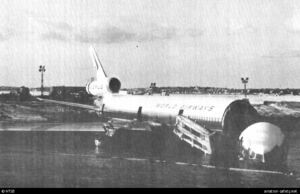 runway on landing at Boston-Logan International Airport, USA, killing 2 occupants; 210 survived the accident.
The DC-10 made a non-precision instrument approach to runway 15R and touched down 2800 feet past the displaced threshold. When the crew sensed that the aircraft couldn't be stopped on the remaining runway, they steered the DC-10 off the side of the runway to avoid the approach light pier, and slid into the shallow water. The nose section separated as the DC-10 came to rest 250 feet past the runway end, 110 feet left of the extended centreline.
PROBABLE CAUSE: "The minimal braking effectiveness on the ice-covered runway; the failure of the Boston-Logan International Airport management to exercise maximum efforts to assess the condition of the runway to assure continued safety of landing operations; the failure of air traffic control to transmit the most recent pilot reports of braking action to the pilot of Flight 30H; and the captain's decision to accept and maintain an excessive airspeed derived from the auto throttle speed control system during the landing approach which caused the aircraft to land about 2,800 feet beyond the runway's displaced threshold.
Contributing to the accident were the inadequacy of the present system of reports to convey reliable braking effectiveness information and the absence of provisions in the Federal Aviation Regulations to require: (1) airport management to measure the slipperiness of the runways using standardised procedures and to use standardised criteria in evaluating and reporting braking effectiveness and in making decisions to close runways. (2) operators to provide flight crews and other personnel with information necessary to correlate braking effectiveness on contaminated runways with aircraft stopping distances, and (3) extended minimum runway lengths for landing on runways which adequately take into consideration the reduction of braking effectiveness due to ice and snow. "
