Your stories for today...
Be safe out there!
Tom
-
Amazon cargo plane makes emergency landing at CVG Airport after bird strike
Emily Sanderson - Digital Media Manager
HEBRON, Ky. —
Emergency crews responded to the tarmac at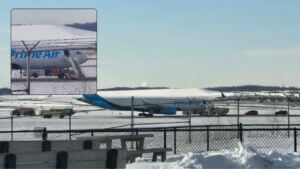 Cincinnati/Northern Kentucky International Airport after an Amazon cargo plane was forced to make an emergency landing.
Photos provided to WLWT show the plane on the tarmac with emergency vehicles nearby.
Another image shows what appears to be smoke coming off the left engine of the plane.
WLWT crews on scene also spotted several emergency vehicles near the cargo plane.
Air Traffic Control audio communication points to what may have happened in the air that prompted the emergency landing.
"Left engine. We took a bird intake, we just want to come back and land," the pilot could be heard saying.
The pilot goes on to say, "we have smoke in the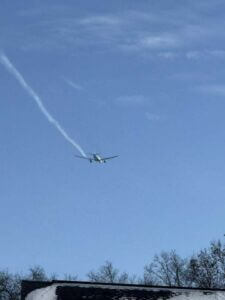 cockpit."
More communications detail what happened next.
"Can they get a ladder up to our either door?"
"The fire was on the left side, the engine failure and possible fire so the right side would be better."
"Earlier today, one of our air carrier partners experienced a bird strike shortly after takeoff from the Cincinnati-Northern Kentucky Airport. Thankfully, no one was hurt and the crew is safe. The aircraft returned to the airport as a precaution, and impact to our customers is expected to be minimal," Amazon spokesperson Terrence Clark said.
https://www.wlwt.com/article/response-cvg-airport-report-amazon-plane-emergency-landing/70177151
Plane crashes in Colombia, killing all 15 on board
Jaroslav Lukiv
A passenger plane has crashed in northern Colombia, killing all 15 people on board, the country's state-run airline Satena confirmed.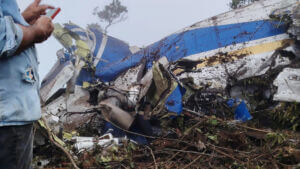
In a statement, it said its aircraft - a Beechcraft 1900 - "suffered a fatal accident", but gave no further details. The wreckage has now been located in a mountainous area.
The official passenger list includes lawmaker Diógenes Quintero Amaya and Carlos Salcedo, a candidate in upcoming congressional elections.
Satena earlier said contact with the plane was lost 11 minutes before it had been scheduled to land in the city of Ocaña, near the Venezuelan border, at 12:05 local time (17:05 GMT) on Wednesday.
According to the airline, Flight NSE 8849 took off from the city of Cúcuta, about 100km (62 miles) north-east from Ocaña, carrying 13 passengers and two crew members.
A search operation has been launched in the mountainous area, and a hotline was set up for the relatives of those who were on the plane.
Speaking to local news outlet Semana, governor of Norte de Santander William Villamizar said seven bodies have been recovered.
Colombia's armed forces have been helping with the search effort in the area where the plane went missing, which has areas controlled by Colombia's ELN guerrilla group.
The country's president Gustavo Petro expressed his condolences to the families of the victims on X, writing "I am deeply sorry for these deaths".
A statement acknowledging Quintero's death has been shared from his Facebook page, describing him as "a man who throughout his life served those who needed it most".
Quintero held one of 16 seats in Colombia's parliament intended to represent victims of conflict between the Marxist rebel army, the Revolutionary Armed Forces of Colombia (Farc), and the Colombian state.
https://www.bbc.com/news/articles/cvgnq54v79xo
No injuries after small plane slides off runway at Ottawa Airport
By Josh Pringle
A small aircraft slid off the runway at the Ottawa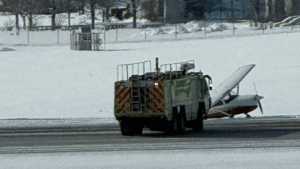 International Airport after experiencing a landing gear problem.
Photos posted on social media showed the small plane sitting in the snow on the edge of the tarmac at the airport Wednesday morning.
A spokesperson for the Ottawa International Airport said the pilot of the aircraft declared an emergency due to landing gear problems.
“The aircraft landed on Runway 14/32; however,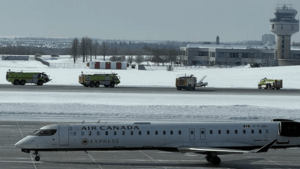 because one landing gear would not lock in place, the aircraft exited the runway, stopping in snow,” airport spokesperson Krista Kealey said in a statement to CTV News Ottawa.
“Fire Service personnel were in place as the aircraft landed, per the Airport Emergency Plan, and they attended to the aircraft’s single occupant with no injuries reported.”
Runway 14/32 will remain closed until the aircraft can be moved.
The Ottawa International Airport says the airport is operating normally.
https://www.ctvnews.ca/ottawa/article/no-injuries-after-small-plane-slides-off-runway-at-ottawa-airport/
NTSB Prelim: Beech K35
Pilot Reported To The Controller That He Was Turning Due To Clouds
Location: Summer Lake, OR Accident Number: WPR26FA068
Date & Time: December 23, 2025, 08:41 Local Registration: N9540R
Aircraft: Beech K35 Injuries: 1 Fatal
Flight Conducted Under: Part 91: General aviation - Personal
On December 23, 2025, about 0841 Pacific standard time, a Beech K35, N9540R, was substantially damaged when it was involved in an accident near Summer Lake, Oregon. The pilot was fatally injured. The airplane was being operated as a Title 14 Code of Federal Regulations Part 91 personal flight.
According to preliminary ADS-B flight track data, the airplane departed Susanville Municipal Airport (SVE), Susanville, California about 0730 and flew northwest. About 0752, the pilot requested visual flight rules (VFR) flight following to McNary Field (SLE), Salem, Oregon, with Seattle Air Route Traffic Control Center (ARTCC). About 0759, the airplane was at an altitude of about 10,600 mean sea level (msl) and turned toward the west-northwest, and the pilot reported to the controller that he was turning due to clouds. The controller subsequently relayed a weather report and pilot report (PIREP) for light rime icing near the accident pilot’s location. The data showed that the airplane continued on a west-northwest heading for about 9 minutes and climbed to about 12,170 ft msl, before it began a left 250° turn to the northeast.
The controller subsequently relayed another PIREP to the pilot for light rime icing in the area. ADS-B data showed that the airplane continued on a northeasterly heading, at altitudes that varied between 11,370 ft msl and 12,500 ft msl for about 19 minutes. About 0827, the airplane began a left turn to the northwest and climbed to about 12,800 ft msl. About 3 minutes later, the airplane turned right, to the north-northeast and climbed to about 13,100 ft msl. At 0833, the airplane entered a descending right turn and the pilot subsequently reported to the ARTCC controller that the engine lost power. The controller advised the pilot of the closest airport, which was about 13 miles northwest of their location. The pilot subsequently reported that he was in the clouds and that ice was accumulating on the airplane. ADS-B data showed that the airplane continued the descending right turn until the end of the flight track data. The last recorded ADS-B target was at 0841, at an altitude of 6,000 ft msl, about 2,300 ft north of the accident site.
An Alert Notice (ALNOT) was issued at 0857 and a ground search was initiated utilizing emergency locator transmitter (ELT) and iPhone crash detection signals being received. The wreckage was located that afternoon by local law enforcement about 13 miles southwest of Summer Lake, Oregon, at an elevation of 5,682 ft msl.
Examination of the accident site revealed that the airplane impacted wooded terrain near the Fremont National Forest. The wreckage debris path was about 135 ft in length and oriented on a magnetic heading of about 245°. The first identified point of contact (FIPC) was an approximately 100 ft tall tree that had been topped, about 80 ft above ground level (AGL), 130 ft from the main wreckage. The right wingtip was located about 37 ft from the FIPC. The left stabilizer and elevator were located about 75 ft from the FIPC. The left wing was suspended in a tree about 20 ft above the ground about 110 ft from the FIPC. The main wreckage came to rest inverted, on a magnetic heading of about 238°. All major structural components of the airplane were located throughout the debris path.
The wreckage was recovered to a secure facility for further examination.
FMI: www.ntsb.gov

Today in History
13 Years ago today: On 29 January 2013 SCAT flight 760, a Canadair CRJ-200, crashed while on approach to Almaty Airport, Kazakhstan, killing all 21 occupants.
| Date: | Tuesday 29 January 2013 |
| Time: | 13:10 |
| Type: | Canadair CL-600-2B19 Regional Jet CRJ-200ER |
| Owner/operator: | SCAT |
| Registration: | UP-CJ006 |
| MSN: | 7413 |
| Year of manufacture: | 2000 |
| Total airframe hrs: | 25707 hours |
| Cycles: | 22975 flights |
| Engine model: | General Electric CF34-3B1 |
| Fatalities: | Fatalities: 21 / Occupants: 21 |
| Other fatalities: | 0 |
| Aircraft damage: | Destroyed, written off |
| Category: | Accident |
| Location: | 1,6 km NE of Almaty Airport (ALA) - Kazakhstan |
| Phase: | Approach |
| Nature: | Passenger - Scheduled |
| Departure airport: | Kokshetau Airport (KOV/UACK) |
| Destination airport: | Almaty Airport (ALA/UAAA) |
| Investigating agency: | MAK |
| Confidence Rating: | Accident investigation report completed and information captured |
Narrative:
SCAT flight 760, a Canadair CRJ-200, crashed while on approach to Almaty Airport, Kazakhstan, killing all 21 occupants.
Flight DV760 operated on a domestic flight from Kokshetau Airport (KOV) to Almaty (ALA).
Weather forecast obtained by the crew before departure showed a visibility of 800 m at Almaty with a vertical visibility of 90 m, and temporary reduced visibility to 200 meters. The flight took off at 11:19 hours local time. The captain was Pilot Flying.
At 12:00 the flight contacted Almaty Control and received the current weather conditions which showed a limited visibility for runway 23R of 200 m. At 12:40 the flight was cleared to descend to FL80. By then visibility had decreased to 175 m. The captain decided to continue descent and prepare for an approach to decision height. The captain became increasingly stressed by the poor weather conditions. After reaching FL80 the crew were told to remain at that altitude because of another flight in the area.
This provoked a strong emotional reaction from the captain.
At 12:57 the flight was then cleared down to 1600 m. During the descent the lack of improvement of weather conditions caused a greater and greater irritation on the part of the captain. When turning to finals the runway visual range (RVR) for the first, mid and last part of runway 23R was reported as 275-250-225 m in freezing fog with a vertical visibility of 40 meters. With continuing visibility updates the flight crew kept descending until it was clear that a landing was impossible given the lack of visual contact with the ground.
A missed approach was initiated at 13:10 from a height of 180 m. The autopilot was disconnected and the TO/GA button was pushed. Engine power increased and the flaps were raised to 8°. In the four seconds after pressing to TO/GA button there were no control inputs. Then the captain pushed the control column forward, causing the aircraft to descend. The EGPWS warning sounded as the pitch changed to -9. The observer pilot tried to draw attention on the EGPWS warning but there was no response on the controls by the flight crew. Pitch angle further increased to -16° and vertical speed was -20 to -30 m/sec. The aircraft impacted the ground at high speed and a -20° pitch angle and broke up.
CONCLUSION: (translated from Russian):
The accident with aircraft CRJ-200 UP-CJ006 occurred during the execution of a go-around, in instrument meteorological conditions, without the possibility of visual contact with ground reference points (vertical visibility in the fog did not exceed 40 m), the necessity of which was caused by the mismatch between the actual weather conditions and the minimum conditions for which the crew was certified to land. As a result, the deflection of the elevator towards a dive of the aircraft caused a descent and collision with the ground. It was not possible to uniquely identify the causes of the aircraft's transfer to a dive from the available data. The Commission did not find evidence of failures of aviation equipment, as well as external to the aircraft (icing, wind shear, wake turbulence) when trying to perform a go-around.
The most likely factors that led to the accident, were:
- partial loss performance of the pilot in command, which at the time of aircraft impact with the ground was not in a working position;
- the lack of CRM levels in the crew, and violation of the Fly-Navigate-Communicate principle, which manifested itself in diverting attention by the co-pilot to conduct external radio communication and lack of control of the flight instrument parameters;
- the lack of response to the EGPWS and the actions required;
- the impact somatographic illusions of perception of the pitch angle (a nose-up illusion);
- increased emotional stress by the crew members associated with the unjustified expectations of improved weather conditions at the time of landing;
- failure to comply with the requirements for health examination of flight personnel, which led to the pilot in command flying without the rehabilitation period and without assessment of his health status after undergoing surgery.
