We close out the week and the month with these stories...
Have a safe weekend!
Tom
-
Pilot injured after small plane flips over in Baldwin County, authorities say
By WALA Digital Staff
SUMMERDALE, Ala. (WALA) - The pilot of a plane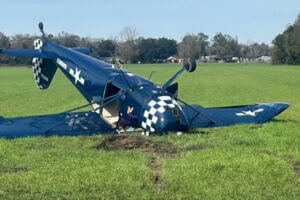 suffered minor injuries when the aircraft flipped over during a takeoff attempt today in Baldwin County, authorities said.
The pilot of the 1948 Cessna 170 was trying to take off but was unable to gain enough speed and overshot the end of a private runway on Sanborne Road in Summerdale. The place hit a dip in the field and flipped over, authorities said.
A passenger on board the plane was uninjured, authorities said.
Authorities respond to Alpine plane crash
SVI Staff
Bonneville County Sheriff’s Deputies responded to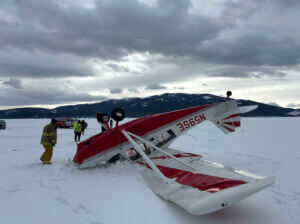 a plane crash this afternoon at the Palisades Reservoir about a quarter mile from the Alpine Airport. At approximately 2:30pm a caller reported seeing a small single engine plane upside down in the snow out in the reservoir lake bed. Emergency Personnel from Alpine Search and Rescue, Star Valley Fire and Ambulance also responded to the area.
Deputies arrived on scene and made contact with the pilot and only occupant, a 74 year old man from Alpine Wyoming, who advised he was flying low just past the end of the runway when his wing caught the ground during a turn causing the plane to flip over and land upside down in the snow. The pilot suffered minor injuries that did not require medical attention.
Those on the scene clarified that the plane was on top of snow in the dry portion of the reservoir, not on top of frozen ice.
The FAA and NTSB were notified of the incident for their investigation. No further information is available at this time.
4 injured after helicopter crashes in the Meramec River
By First Alert 4 Staff
SULLIVAN, Mo. (First Alert 4) - Three Missouri state park team members and a private pilot suffered minor injuries on Thursday after a helicopter crashed into the Meramec River in the Meramec State Park in Franklin County.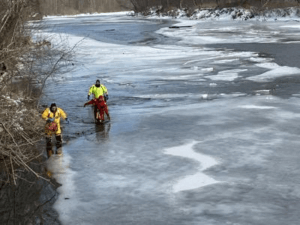
According to the Missouri State Highway Patrol, a helicopter went down at Meramec State Park before 1:30 p.m. The Sullivan Fire Protection District also responded to the scene to assist in any rescue efforts, including sending in rescue swimmers.
The Franklin County Sheriff’s Office told First Alert 4 that those who were on the helicopter at the time of the crash suffered minor injuries.
“All four members had minor injuries, thank goodness, and they self-rescued themselves out of the crashed helicopter,” Col. Josh Campbell with the Missouri State Park Rangers said. “Made their way up to a roadway, were picked up by a passerby and transported here to the visitors center, where they awaited ambulances.”
According to the Missouri Department of Natural Resources, three of the four people on the helicopter were state park team members who were conducting an aerial ecological survey of the Meramec State Park. The fourth person was a private pilot.
DNR says the helicopter may have struck a power line, causing the crash.
Col. Campbell told First Alert 4 the FAA will be at the scene Friday morning.
https://www.firstalert4.com/2026/01/29/helicopter-crashes-meramec-river/
NTSB Prelim: Cessna 560XL
Both Pilots Were Unable To Arrest The Climb, Climbing To 9,500 Ft, Which Was Well Above Their Assigned Altitude Of 2000 Ft Mean Sea Level
Location: Oakland Park, FL Accident Number: ERA25LA301
Date & Time: August 14, 2025, 17:15 Local Registration: N802TD
Aircraft: Cessna 560XL Injuries: 2 None
Flight Conducted Under: Part 91: General aviation - Business
On August 14, 2025, about 1715 eastern daylight time, a Cessna 560XL, N802TD, was substantially damaged when it was involved in an accident near Oakland Park, Florida. The airline transport pilot and commercial pilot were not injured. The airplane was operated as a Title 14?Code of Federal Regulations Part 91 business flight.
The pilot and the commercial pilot arrived at Fort Lauderdale Executive Airport (KFXE), Fort Lauderdale, Florida, about 1100, with the intent to fly the airplane to Orlando Executive Airport (ORL), Orlando, Florida, with an estimated departure time of 1400. The airplane was at FXE to be painted; however, shop personnel informed them upon their arrival that the airplane was not ready to be released, and their 1400 departure time would have to be pushed back. The pilot said he utilized this time to perform a quick walk around the airplane, he adjusted the seat and rudder pedals and made plans to do a final operational check once the airplane was towed to a different location on the airport to be fueled.
The pilot said that when the airplane was ready, he performed an external pre-flight check of the airplane and arranged to add 3,500 pounds of fuel. Personnel from the paint shop arrived at the airplane, and he and the commercial pilot assisted them with multiple operational checks which included engine runs, manipulation of the control column to check flight control positioning, and cycling of the flaps from 0 to 35 degrees (five cycles). During this time, the pilot noticed that the control column seemed a bit closer than he remembered when it was full forward as compared to a different airplane of the same make and model. Otherwise, the controls seemed to move as normal with no unusual binding or limitations.
The pilot said that he and the commercial pilot completed normal pre-engine start checks, started the engines and taxied to the active runway, held short, then taxied onto the runway after receiving takeoff clearance. After taxiing onto the runway, the pilot gave the controls to the commercial pilot. The pilot said the takeoff roll was uneventful but once he retracted the landing gear, he noticed that the airplane was at an unusually high pitch and requested that the commercial pilot to lower the nose. He said, it became immediately obvious that she was unable to do this, so he assumed command of the airplane and placed full available forward pressure on the control column. An emergency was declared and a 180° left turn was made in an attempt to return, but both pilots were unable to arrest the climb, climbing to 9,500 ft, which was well above their assigned altitude of 2000 ft mean sea level. The tower controller asked them if they could see the runway and we were unable to see it due to the uncommanded steep climb. The tower controller then asked them to change to a Miami Air Route Traffic Control Center frequency, but he and the commercial pilot had both arms pressing forward on the control column in an attempt to prevent a stall.
Over the next several minutes, the crew attempted to maintain control of the airplane during a series of radical pitch up events into one or more stalls followed by an uncommaded steep pitch down event. The flight then proceeded towards Fort Lauderdale/Hollywood International Airport for landing on runway 10L, where the pilot performed a 360° turn to reduce airspeed. With the throttles at idle power and the speed brakes deployed, he was able to lose about 120 kts of airspeed in the 360° turn but was still about 30 knots above normal approach speed. The pilot continued towards the runway and when in ground effect, the airplane pitched up again uncommanded. The pilot was able to correct that condition and landed on the last 1/4 of the runway before he brought the airplane to a full stop. The pilots then taxied the airplane after receiving approval from emergency personnel.
Postaccident examination of the airplane revealed an elevator pushrod was bent with evidence of contact with an adjacent structural member.
FMI: www.ntsb.gov

Today in History
26 Years ago today: On 30 January 2000 Kenya Airways flight 431, an Airbus A310, crashed into the sea after takeoff from Abidjan Airport, Ivory Coast, killing 169 occupants; 10 survived the accident.
| Date: | Sunday 30 January 2000 |
| Time: | 21:09 |
| Type: | Airbus A310-304 |
| Owner/operator: | Kenya Airways |
| Registration: | 5Y-BEN |
| MSN: | 426 |
| Year of manufacture: | 1986 |
| Total airframe hrs: | 58115 hours |
| Cycles: | 15026 flights |
| Engine model: | GE CF6-80C2A2 |
| Fatalities: | Fatalities: 169 / Occupants: 179 |
| Other fatalities: | 0 |
| Aircraft damage: | Destroyed, written off |
| Category: | Accident |
| Location: | 2,8 km S off Abidjan-Felix Houphouet Boigny Airport (ABJ) - Cote d'Ivoire |
| Phase: | Initial climb |
| Nature: | Passenger - Scheduled |
| Departure airport: | Abidjan-Felix Houphouet Boigny Airport (ABJ/DIAP) |
| Destination airport: | Lagos-Murtala Muhammed International Airport (LOS/DNMM) |
| Investigating agency: | CoI Ivory Coast |
| Confidence Rating: | Accident investigation report completed and information captured |
Narrative:
Kenya Airways flight 431, an Airbus A310, crashed into the sea after takeoff from Abidjan Airport, Ivory Coast, killing 169 occupants; 10 survived the accident.
Flight KQ430 departed from Nairobi for a flight to Lagos and Abidjan. Due to the harmattan, a dusty seasonal wind from the deserts of north Africa, the flight continued directly to Abidjan. The aircraft, named "Harambee Star", landed there at 15:15 local time.
The Airbus was prepared for the return flight, KQ431, to Lagos and Nairobi that evening. Shortly after 21:00 the crew received clearance to taxy to runway 21 for departure. The trim was set at 0.9 nose up, slats and flaps at 15 degrees. The airplane began to taxi at 21:07, the tower controller informed the crew of the latest wind, cleared them to take off and asked the crew the call back when they reached flight level 40. At 21:08:18, the captain, who was pilot non flying, applied takeoff power and announced "thrust, SRS, and runway" then, nine seconds later "100 knots". Flight 431 took off and at 21:08:57, the copilot announced "Positive rate of climb, gear up". Less than two seconds later, at a height of around 300 feet, the stall warning sounded. The gear was not retracted. The copilot, who was the pilot flying, pushed forward on the control column in reaction to the stall warnings. At 21:09:07, the copilot asked, "What's the problem?" The aircraft descended and less than a second before passing through 100 feet in descent, the copilot ordered the aural stall warning alarm to be disconnected. The GPWS sounded briefly, followed by the CRC (Continuous Repetitive Chime), which corresponds to a master warning of over-speed with flaps extended, immediately followed by an order from the captain "Go up!". The airplane's speed at this point was at least 210 knots, the maximum speed limit for a configuration with slats/flaps at 15°/15°. At 21:09:24 the airplane contacted the sea and broke up. The wreckage came to rest on the sandy seabed at a depth of 40-50 metres.
Just ten of the 179 occupants survived the accident.
CAUSES OF THE ACCIDENT:
"The Commission of Inquiry concluded that the cause of the accident to flight KQ 431 on 30 January 2000 was a collision with the sea that resulted from the pilot flying applying one part of the procedure, by pushing forward on the control column to stop the stick shaker, following the initiation of a stall warning on rotation, while the airplane was not in a true stall situation. In fact, the FCOM used by the airline states that whenever a stall warning is encountered at low altitude (stick shaker activation), it should be considered as an immediate threat to the maintenance of a safe flight path. It specifies that at the first sign of an imminent stall or at the time of a stick shaker activation, the following actions must be undertaken simultaneously: thrust levers in TOGA position, reduction of pitch attitude, wings level, check that speed brakes are retracted. The investigation showed that the pilot flying reduced the pitch attitude but did not apply TOGA thrust on the engines. The investigation was unable to determine if the crew performed the other two actions: leveling the wings and checking that the speed brakes were retracted. The following elements contributed to the accident:
- the pilot flying's action on the control column put the airplane into a descent without the crew realizing it, despite the radio altimeter callouts;
- the GPWS warnings that could have alerted the crew to an imminent contact with the sea were masked by the priority stall and overspeed warnings, in accordance with the rules on the prioritization of warnings;
- the conditions for a takeoff performed towards the sea and at night provided no external visual references that would have allowed the crew to be aware of the direct proximity of the sea."
