Here is what I have for today...
Be safe out there!
Tom
-
One hospitalized in critical condition after Hurricane helicopter crash
by: Ava Hart, Amelia Hobson
HURRICANE, Utah (ABC4) — A helicopter crash in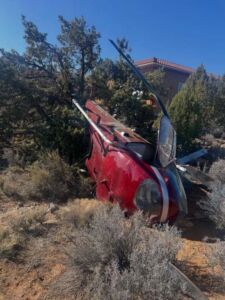 Hurricane has sent one to the hospital in critical but stable condition.
At approximately 1 p.m. on Monday, crews were dispatched to reports of a helicopter crash in the Silver Reef area. Upon arrival, crews observed two occupants, one of whom was critically injured.
“We got on scene along with Hurricane Valley Fire, determined that there was an approximately 85-year-old male and a female in her mid-50s that had been involved in a helicopter crash back behind the residence,” Sergeant Jacob Paul, with the Washington County Sheriff’s Office, said.
Pual says that the male, who was the pilot, was pinned, but they were able to get him out and transport him to the hospital via ambulance. The female passenger was treated on scene for minor injuries and then transported herself to the hospital
At this time, the cause of the crash is reportedly under investigation and Paul says that the National Transportation Safety Board is going to be doing an investigation into what happened.
https://www.abc4.com/news/southern-utah/one-hospitalized-critical-helicopter-crash/
NTSB Prelim: Piper PA-28-140
The Airplane Struck Numerous Pine Trees Along The Impact Path
Location: Holly Springs, MS Accident Number: CEN26FA093
Date & Time: January 18, 2026, 16:40 Local Registration: N6711J
Aircraft: Piper PA-28-140 Injuries: 2 Fatal
Flight Conducted Under: Part 91: General aviation - Instructional
On January 18, 2026, about 1640 central standard time, a Piper PA28-140 airplane, N6711J, was destroyed when it was involved in an accident near Holly Springs, Mississippi. The flight instructor and student pilot were fatally injured. The airplane was operated as a Title 14 Code of Federal Regulations Part 91 instructional flight.
According to the airport manager, the airplane had departed Holly Springs-Marshall County Airport (M41), Holly Springs, Mississippi, after doing several touch and go landings. There was no ADS-B data available for the accident flight. The airplane impacted terrain in a wooded area about 693 ft east of the departure end of runway 18 at M41. The first identified impact point was a pine tree about 185 ft south of the main wreckage. The airplane struck numerous pine trees along the impact path. Five branches were located at the site varying from .75 to 2 in diameter with clean cut marks and black paint transfer consistent with the airplane’s propeller. No ground impact marks were found at the accident site. A post-impact fire consumed a large portion of the airframe. The flight instruments and flight controls were thermally damaged or destroyed. The manual flap selector was thermally damaged and was found in the full flap (40 degree) position. The fuel selector valve was selected to the right fuel tank position and functioned normally when tested with low-pressure air.
Flight control continuity was confirmed for the flight controls. The stabilator trim cables were continuous from the empennage to the forward cabin location. The stabilator trim actuator control rod was extended 1.6 in on the top side of the actuator, which was consistent with a partial nose up trim position. The airplane was equipped with a Lycoming O-320-E3D reciprocating engine. The engine remained attached to the engine mount. The propeller assembly was partially embedded in soft dirt. Engine control cable continuity was confirmed from the firewall forward to both the mixture and throttle arms of the engine’s carburetor.
The mixture was found halfway between lean and rich while the throttle arm was found at a partial power setting. The engine primer control was found within the wreckage in the forward and locked position. The spark plugs were removed from their respective cylinders. The spark plugs had normal wear patterns, and the coloration was consistent with normal engine operation. The lower plugs on cylinder Nos. 1 and 2 were oil soaked consistent with the oil drained from each cylinder upon removal. The lower spark plug for cylinder No. 3 was found impact fractured below the ignition harness nut. Examination of each cylinder was completed with a borescope with no anomalies found. Thumb suction and compression was confirmed on all cylinders by rotating the propeller in the direction of engine rotation. With all rocker box covers removed, all rocker arms moved freely and through their full range of motion with no anomalies found.
The oil lines to the oil cooler were found attached. The oil filter was found attached to the accessory section and safety wired but thermally damaged. The filter was removed, cut open, and inspected. The filter element had burned, but no metallic particles were noted between the remains of the filter pleats. The oil suction screen plug was found tight and secured to the oil sump with safety wire. Once removed, the screen was found free and clear of any debris. The oil filler neck was consumed by fire with only the metal dipstick remaining within the engine case. Oil was present in the oil sump, but total quantity was not determined.
Both magnetos were present, secure, and exhibited varying degrees of thermal damage to their aluminum housing. The magnetos were removed and an attempt to rotate them by hand was made. During the attempt, friction was present and both magnetos would bind during rotation. The left-hand magneto was disassembled, and thermal damage was noted internally. The right-hand magneto suffered a higher degree of thermal damage to its aluminum housing and was not disassembled.
The engine driven fuel pump was found attached to the rear accessory section of the engine and exhibited thermal damage. All fuel lines were found attached, but the aluminum housing showed signs of melting and deformation. During disassembly of the engine driven fuel pump, the gaskets and diaphragms were found thermally damaged. The fuel pump activation rod was found present within the accessory case and moved freely with rotation of the engine’s crankshaft.
The airplane was equipped with a Power Flow Systems Exhaust. The exhaust system was cut free from the engine at each cylinder and checked for blockage. The exhaust system was found free of any blockages or anomalies. All intake pipes were removed and found free and clear of blockage or debris.
The carburetor remained attached to the lower side of the engine. The airbox and air duct hoses were found impact or thermally separated. The carburetor was removed from the engine and examined. The float bowl was removed from the carburetor, and no fuel or fluid was found in the bowl. No sediment was present and the brass floats were free of damage or deformation. The needle and seat were present. The seat was free and clear of any damage but showed discoloration consistent with thermal damage. The needle tip was deformed consistent with exposure to the post impact fire.
The propeller assembly was found partially embedded in the ground. Both blades remained attached to the propeller hub and the propeller was largely intact. The propellor exhibited slight thermal discoloration to one blade on the cambered side. No observable bending or deformation was noted to either blade. Slight chordwise scratches and smears were noted and consistent with cut pine branches found at the accident site.
The wreckage was retained for further examination.
FMI: www.ntsb.gov

Today in History
67 Years ago today: On 3 February 1959 American Airlines flight AA320, a Lockheed L-188 Electra, crashed into the sea while on approach to New York-La Guardia Airport, NY, USA, killing 65 occupants; 8 survived the accident.
| Date: | Tuesday 3 February 1959 |
| Time: | 23:56 |
| Type: | Lockheed L-188A Electra |
| Owner/operator: | American Airlines |
| Registration: | N6101A |
| MSN: | 1015 |
| Year of manufacture: | 1958 |
| Total airframe hrs: | 302 hours |
| Engine model: | Allison 501-D13 |
| Fatalities: | Fatalities: 65 / Occupants: 73 |
| Other fatalities: | 0 |
| Aircraft damage: | Destroyed, written off |
| Category: | Accident |
| Location: | 1,5 km NE off New York-La Guardia Airport, NY (LGA) - United States of America |
| Phase: | Approach |
| Nature: | Passenger - Scheduled |
| Departure airport: | Chicago-Midway Airport, IL (MDW/KMDW) |
| Destination airport: | New York-La Guardia Airport, NY (LGA/KLGA) |
| Investigating agency: | CAB |
| Confidence Rating: | Accident investigation report completed and information captured |
Narrative:
American Airlines flight AA320, a Lockheed L-188 Electra, crashed into the sea while on approach to New York-La Guardia Airport, NY, USA, killing 65 occupants; 8 survived the accident.
Flight AA320 was a scheduled service from Chicago-Midway Airport, Illinois, USA to New York-La Guardia Airport, New York. The aircraft, a Lockheed L-188A Electra, was off the ground at 21:43 hours and estimated one hour and forty-two minutes en route to New York.
At 23:27, Flight 320 made its first radio contact with La Guardia approach control. Nearing La Guardia Airport, the flight was given vectors for an ILS backcourse approach to runway 22.
Weather was reported to the crew as follows: "four hundred overcast; two miles visibility, light rain and fog".
At 23:53, the flight contacted La Guardia tower, stating they had passed New Rochelle. The flight was subsequently cleared to continue its approach to runway 22. Last radio contact was at 23:55:27 when the flight confirmed clearance to land. The Lockheed Electra aircraft descended until it struck the water seven seconds later, some 5000 feet short of the runway and 600 feet to the right of the extended centreline. Ground speed on impact was 150 mph and undercarriage and flaps were extended. The wreckage sank 10 m deep in the water of the East River.
The investigation board noted that American Airlines requested certification of their L-188A Electra aircraft for flight below 25,000 feet under which limitation it was unnecessary to install flight recorders. This was done in view of the cost of procurement, installation, and maintenance of flight recorders at the time.
The board stated: "a flight recorder in this aircraft would have enabled us to identify the causal factors involved in this accident with far greater precision".
PROBABLE CAUSE: "The Board determines the probable cause of this accident was premature descent below landing minimums which was the result of preoccupation of the crew on particular aspects of the aircraft and its environment to the neglect of essential flight instrument references for attitude and height above the approach surface.
Contributing factors were:
1. Limited experience of the crew with the aircraft type;
2. Faulty approach technique in which the autopilot was used in the heading mode to or almost to the surface;
3. Erroneous setting of the captain's altimeter;
4. Marginal weather in the approach area;
5. Possible misinterpretation of altimeter and rate of descent indicator; and
6. Sensory illusion with respect to height and attitude resulting from visual reference to the few lights existing in the approach area."
