We close out this week with the following stories...
Have a safe weekend!
Tom
-
Pilot unharmed in single-engine plane crash at Houston County Airport
A plane crash at Houston County Airport in Crockett caused a brief grass fire but left the sole pilot unharmed. The FAA is investigating the incident.
Author: Zak Wellerman
HOUSTON COUNTY, Texas — No one was injured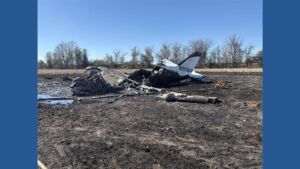 after a plane crash in Houston County Thursday afternoon.
Heath Murff, Houston County Office of Emergency Management and fire marshal, confirmed a plane crash at the Houston County Airport in Crockett. He said the pilot was the only one onboard the single engine plane. After being checked out by EMS, it was determined that he was not injured.
Murff said the plane went off the runway, causing a grass fire, which has been contained. The Federal Aviation Administration is leading the investigation.
“We are OK, but something went terribly wrong”: pilots realised just in time that they were wrong during a “very exceptional” incident at Brussels Airport
Nieuwsblad
Zaventem: All 165 passengers on a flight to Copenhagen were evacuated Thursday evening after an incident at Brussels Airport. The pilot mistakenly took the taxiway instead of the runway and reached a speed of over 200 kilometers per hour before the plane could come to a stop – just in time. "This could have had disastrous consequences," says aviation expert Luk De Wilde.
- The incident occurred on Thursday evening
 around 10 p.m.
 - Flight SK2590, an SAS flight from Brussels to Copenhagen, was scheduled to depart from Brussels Airport with a 1.5-hour delay .
- There were 165 passengers on board.
- Pilots mistakenly took taxiway instead of runway .
- The error was only noticed when the aircraft had already reached a speed of over 200 kilometres per hour .
- The plane came to a stop just in time , near some kerosene tanks.
- An investigation has been launched.
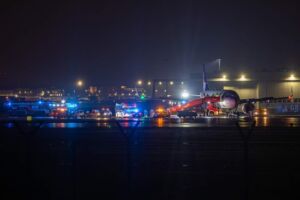 around 10 p.m.
"The takeoff of a Scandinavian Airlines plane was interrupted," said Brussels Airport spokeswoman Ariane Goossens. "The plane had started its takeoff from the taxiway instead of the runway. The taxiway is only used to move aircraft between the terminal and the runway."
The plane was scheduled to take off for Copenhagen at 8:30 PM, but instead departed from the Netherlands with an hour and a half delay, heading for the Danish capital. At 10:04 PM, during takeoff, things went wrong.
The aircraft was already reaching a speed of over 200 kilometers per hour on the taxiway. Fortunately, the crew was able to bring the Airbus A320neo to a safe and timely stop. The aircraft eventually came to a stop just a stone's throw from the airport's kerosene tanks, which are highly flammable.
“Very exceptional”
How could this have happened? "That's a mystery to me too, because this is extremely unusual," says aviation expert Luk De Wilde. "This happens a maximum of 25 to 30 times a year, worldwide. Everything points to a mistake by both pilots, the captain and the co-pilot. This could have had very disastrous consequences."
On each flight, two pilots fly "separately." "It's agreed in advance who flies and who monitors," says De Wilde. "One actually flies and operates the controls, while the other maintains contact with air traffic control and follows the maps and flight paths. That neither of them noticed they were on the taxiway, not the runway, is truly remarkable and exceptional."
We are OK
According to the specialized website Flightlevel.be,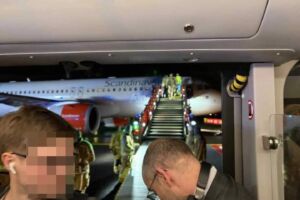 Thursday evening's radio traffic shows that the pilots themselves noticed their mistake just in time. About 40 seconds after receiving takeoff clearance and immediately after aborting takeoff, the crew told the air traffic controller: "We are OK, but something went very wrong." In other words: "We are OK, but something went very wrong," after which the pilot added that they had no indication of a fire in the plane.
Little used runway
According to De Wilde, the fact that the plane was already delayed and only had a short "window" for departure, as suggested online by people claiming to have been on the plane, should not influence the decisions made in the cockpit. "However, the runway where it happened isn't used very often. '25 Right' is usually used for takeoff, but in recent days and weeks, it's been '07 Right' more often, due to the easterly wind. An aircraft must always depart into the wind. Were the pilots unfamiliar with this runway and therefore made a mistake? Given the delay, did time pressure also play a role? The investigation will now have to determine that. My estimate is that both pilots will be suspended during the investigation. Neither of them will be allowed back in the cockpit tomorrow or next week. This is a serious incident."
Investigation started
The Air Accident Investigation Unit (AAIU), an independent body of the Directorate General for Civil Aviation (DGLV), has launched an investigation into the incident, the FPS Mobility confirmed to our editors.
"How the incident could have happened is currently being investigated as part of an official safety investigation," says Thomas De Spiegelaere, spokesperson for the Federal Public Service Mobility. "The goal of this investigation is to formulate safety recommendations that should contribute to improving aviation safety and preventing similar incidents in the future. The investigation is not aimed at determining administrative, civil, or criminal liabilities."
To arrive at the necessary recommendations, the AAIU collects and analyzes all relevant data, such as radar images, audio recordings, technical and meteorological information, and witness statements. "Afterward, the agency publishes a final report with conclusions on the causes and contributing factors of the incident. This report and any safety recommendations are then provided to the operator, the DGLV, and other relevant authorities."
The Federal Public Service Mobility cannot provide any further information at this time, given the ongoing investigation. Air traffic controller Skeyes has also launched an investigation to determine the true cause of the incident.
“This must not happen again”
Kurt Ryon, mayor of Steenokkerzeel, expects "a serious investigation." "We want to be kept informed of the outcome. We don't want to cause panic, but this can't happen again. Our hamlet of Humelgem is an extension of that taxiway... I've never heard or experienced this before. Pilots tell me they don't understand it, precisely because, especially in the dark, you can clearly see the difference between a taxiway and a runway."
Point of no return
By the time the error was noticed, the plane had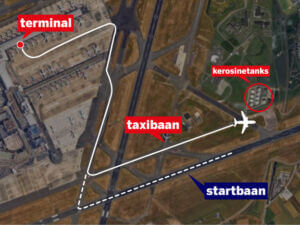 already reached a speed of 200 to 205 kilometers per hour. "Once a plane reaches 'V1,' it has to take off. That's the point of no return," says De Wilde. "Usually, that V1 is around 270 to 280 kilometers per hour. In this case, it would have taken a maximum of 3 to 4 seconds to reach that speed. Then the plane would have had to take off, although I think the taxiway is a bit too short for that. In that case, the plane would probably have veered into the shoulder or crashed into an obstacle. If they had become airborne, I don't think there would have been any obstacles left. It's not like they would have collided with another plane in that case."
There are several fuel tanks near the taxiway, full of kerosene to supply the aircraft. The plane came to a stop near these tanks. "But fortunately, those fuel tanks aren't in line with the taxiway. The plane would have had to swerve to avoid hitting them."
Psychological assistance
To be on the safe side, the airport fire department was immediately dispatched, and all 165 passengers were evacuated. "The federal police also arrived on the scene, including to provide psychological support," said Ariane Goossens of Brussels Airport overnight. "There were no injuries."
The incident had no impact on airport operations. "There were no consequences for other scheduled flights, and there will be no consequences for Friday morning either," the spokeswoman said. Only the flight to Copenhagen was canceled.
Pilots' Association: "Don't speculate about possible causes"
The Belgian Cockpit Association (BeCA) calls the incident "serious" and "understands that this event can be shocking," but also urges "not to speculate on the possible causes." "A technical investigation has been launched, and we are convinced that its conclusions will help prevent a similar incident from occurring in the future," BeCA said.
https://www.nieuwsblad.be/regio/vlaams-brabant/halle-vilvoorde/steenokkerzeel/we-are-ok-maar-er-is-iets-heel-ergs-fout-gegaan-piloten-hadden-net-op-tijd-door-dat-ze-fout-zaten-tijdens-zeer-uitzonderlijk-incident-op-brussels-airport/129610689.html
NTSB Prelim: Beech K35
Controller Subsequently Relayed A Weather Report And Pilot Report (PIREP) For Light Rime Icing Near The Accident Pilot’s Location
Location: Summer Lake, OR Accident Number: WPR26FA068
Date & Time: December 23, 2025, 08:41 Local Registration: N9540R
Aircraft: Beech K35 Injuries: 1 Fatal
Flight Conducted Under: Part 91: General aviation - Personal
On December 23, 2025, about 0841 Pacific standard time, a Beech K35, N9540R, was substantially damaged when it was involved in an accident near Summer Lake, Oregon. The pilot was fatally injured. The airplane was being operated as a Title 14 Code of Federal Regulations Part 91 personal flight.
According to preliminary ADS-B flight track data, the airplane departed Susanville Municipal Airport (SVE), Susanville, California about 0730 and flew northwest. About 0752, the pilot requested visual flight rules (VFR) flight following to McNary Field (SLE), Salem, Oregon, with Seattle Air Route Traffic Control Center (ARTCC). About 0759, the airplane was at an altitude of about 10,600 mean sea level (msl) and turned toward the west-northwest, and the pilot reported to the controller that he was turning due to clouds. The controller subsequently relayed a weather report and pilot report (PIREP) for light rime icing near the accident pilot’s location. The data showed that the airplane continued on a west-northwest heading for about 9 minutes and climbed to about 12,170 ft msl, before it began a left 250° turn to the northeast.
The controller subsequently relayed another PIREP to the pilot for light rime icing in the area. ADS-B data showed that the airplane continued on a northeasterly heading, at altitudes that varied between 11,370 ft msl and 12,500 ft msl for about 19 minutes. About 0827, the airplane began a left turn to the northwest and climbed to about 12,800 ft msl. About 3 minutes later, the airplane turned right, to the north-northeast and climbed to about 13,100 ft msl. At 0833, the airplane entered a descending right turn and the pilot subsequently reported to the ARTCC controller that the engine lost power. The controller advised the pilot of the closest airport, which was about 13 miles northwest of their location. The pilot subsequently reported that he was in the clouds and that ice was accumulating on the airplane. ADS-B data showed that the airplane continued the descending right turn until the end of the flight track data. The last recorded ADS-B target was at 0841, at an altitude of 6,000 ft msl, about 2,300 ft north of the accident site.
An Alert Notice (ALNOT) was issued at 0857 and a ground search was initiated utilizing emergency locator transmitter (ELT) and iPhone crash detection signals being received. The wreckage was located that afternoon by local law enforcement about 13 miles southwest of Summer Lake, Oregon, at an elevation of 5,682 ft msl.
Examination of the accident site revealed that the airplane impacted wooded terrain near the Fremont National Forest. The wreckage debris path was about 135 ft in length and oriented on a magnetic heading of about 245°. The first identified point of contact (FIPC) was an approximately 100 ft tall tree that had been topped, about 80 ft above ground level (AGL), 130 ft from the main wreckage. The right wingtip was located about 37 ft from the FIPC. The left stabilizer and elevator were located about 75 ft from the FIPC. The left wing was suspended in a tree about 20 ft above the ground about 110 ft from the FIPC. The main wreckage came to rest inverted, on a magnetic heading of about 238°. All major structural components of the airplane were located throughout the debris path.
The wreckage was recovered to a secure facility for further examination.
FMI: www.ntsb.gov
Today in History
30 Years ago today: On 6 February 1996 Birgenair flight 301, a Boeing 757, crashed into the sea off Puerto Plata, Dominican Republic, following a loss of control, killing all 189 occupants.
| Date: | Tuesday 6 February 1996 |
| Time: | 23:47 |
| Type: | Boeing 757-225 |
| Owner/operator: | Alas Nacionales, lsf Birgenair |
| Registration: | TC-GEN |
| MSN: | 22206/31 |
| Year of manufacture: | 1984 |
| Total airframe hrs: | 29269 hours |
| Cycles: | 13499 flights |
| Engine model: | Rolls-Royce RB211-535E4 |
| Fatalities: | Fatalities: 189 / Occupants: 189 |
| Other fatalities: | 0 |
| Aircraft damage: | Destroyed, written off |
| Category: | Accident |
| Location: | 26 km NE off Puerto Plata, Dominican Republic - Atlantic Ocean |
| Phase: | En route |
| Nature: | Passenger - Non-Scheduled/charter/Air Taxi |
| Departure airport: | Puerto Plata-La Union International Airport (POP/MDPP) |
| Destination airport: | Gander Airport, NL (YQX/CYQX) |
| Investigating agency: | DGAC Dom. Rep. |
| Confidence Rating: | Accident investigation report completed and information captured |
Narrative:
Birgenair flight 301, a Boeing 757, crashed into the sea off Puerto Plata, Dominican Republic, following a loss of control, killing all 189 occupants.
Alas Nacionales flight 301 departed Puerto Plata for a charter flight to Frankfurt via Gander and Berlin at 23:42 LT. At 80 knots on takeoff the captain found out that his air speed indicator (ASI) wasn't working properly. The co-pilot's indicator seemed to work fine. While climbing through 4700 feet the captain's ASI read 350 knots (real speed was about 220 kts); this resulted in an autopilot/autothrottle reaction to increase the pitch-up attitude and a power reduction in order to lower the airspeed. At that time the crew got 'Rudder ratio' and 'Mach airspeed' advisory warnings. Both pilots got confused when the co-pilot stated that his ASI read 200 knots decreasing while getting an excessive speed-warning, followed by a stick shaker warning. This led the pilots to believe that both ASIs were unreliable.
Finally realizing that they were losing speed and altitude they disconnected the autopilot. The autopilot, fed by the captain's faulty ASI, had reduced the speed close to the stall speed. Full thrust was then applied. At 23:47:17 an aural GPWS warning sounded. Eight seconds later the aircraft struck the ocean.
The incorrect ASI readings were probably caused by the obstruction of the pitot system by mud and/or debris from a small insect that was introduced in the pitot tube during the time the aircraft was on the ground. The aircraft was not flown for 20 days before the crash and was returned for service without a verification of the pitot-static system as recommended by Boeing.
PROBABLE CAUSE: "The crew's failure to recognize the activation of the stick shaker as a warning of imminent entrance to the stall, and the failure of the crew to execute the procedures for recovery from the onset of loss of control."
