These are your stories for today...
Be safe out there!
Tom
-
Small plane crashes into vehicles during emergency landing in Gainesville, just north of Atlanta
By Christopher Harris, CBS News Atlanta Digital Team
A small plane made an emergency landing on a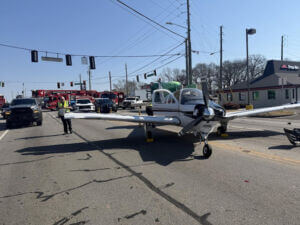 busy Gainesville roadway Monday, crashing into multiple vehicles and shutting down a major intersection, police said.
According to the Gainesville Police Department, a single-engine aircraft landed near Browns Bridge Road and Pearl Nix Parkway, in front of a Golden Corral, after the pilot reported mechanical issues. The plane struck several vehicles while attempting to land in the roadway.
Police said the pilot and one passenger on board the plane were not injured. Two people, both drivers of separate vehicles involved in the crash, were taken to a nearby hospital as a precaution.
Gainesville Fire and Rescue Public Information Officer Josh Sheridan said the pilot told investigators the plane was experiencing mechanical problems and that he attempted to land in the safest location possible. Authorities have not confirmed where the plane was coming from or where it was headed.
The intersection remains closed while crews wait for a specialized rollback truck capable of removing the aircraft from the roadway. Drivers are being warned to expect extended traffic delays in the area.
The Federal Aviation Administration and the Gainesville Police Department are handling the investigation. No further details have been released.
Plane Carrying 50 Passengers Crashes After Taking Off in Somalia
by Jason Ndunyu
An aircraft carrying 50 passengers has crashed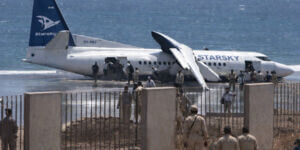 shortly after departing an airport in Mogadishu, Somalia.
Preliminary reports indicate the plane took off from the Aden Adde International Airport on Tuesday, February 10, before encountering difficulties approximately 15 minutes into the flight.
The Starsky-operated aircraft was bound for Guriel, the second-largest city in the central Galguduud region of Somalia, located in Galmudug state.
It is reported to have come down along the Indian Ocean shoreline near the airport’s perimeter wall.
Videos shared online, seen by The Kenya Times, showed passengers exiting the aircraft. The surrounding area includes a perimeter fence and a clear coastal backdrop.
Passenger aircraft crashes in Somalia
Several people, including uniformed personnel and civilians, are gathered around the aircraft near an open exit door, while others walk away from the scene.
It was not immediately clear whether anyone was injured, but preliminary reports indicate that all the passengers and five crew members have been safely evacuated.
Starsky is one of the leading Airlines and tourism companies in Somalia, offering full-service travel and tourism to business and leisure clients.
In a follow-up statement, the Director of the Somali Civil Aviation Authority (SCAA), Ahmed Moallim Hassan, confirmed to State media, Somali National Television (SNTV), that all 55 people on board were safely evacuated and that the plane experienced technical difficulties shortly after takeoff.
According to Hassan, the pilot decided to return to the airport but couldn’t control the plane and veered off the runway.
“The priority was ensuring there was no post-impact fire, given the proximity to the water,” an airport official said. “We are relieved to report that everyone on board was evacuated safely.”
SCAA also confirmed the crash occurred in a coastal area just outside the airport’s western perimeter, adding all crew members and 55 passengers had survived the incident.
The authority has since launched a formal investigation into the cause of the crash. Aden Adde Airport was temporarily closed to allow emergency services to reach the shoreline, but has since resumed its usual operations.
Cargo plane crashes
The incident comes nearly a year after another fatal aviation accident involving a Kenya-registered aircraft in Somalia that claimed five lives.
The cargo plane went down near Mogadishu on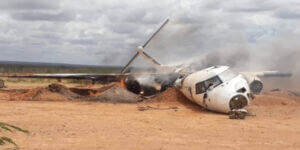 Saturday, March 22, at about 5:43 p.m. local time after completing a supply mission to African Union forces in Dhobley town, Lower Juba region.
SCAA at the time confirmed the aircraft crashed roughly 24 kilometres southwest of Mogadishu while en route back to Aden Abdulle International Airport.
The aircraft, a DHC-5D Buffalo with registration 5Y-RBA and serial number 109, was operated by Trident Aviation Ltd. Authorities reported that all five people on board died in the crash.
Preliminary findings indicated the plane had earlier developed mechanical problems while in Dhobley, though it was reportedly repaired before departure.
The incident followed another accident in January 2024, when a pilot was killed after a cargo aircraft crash-landed near El Barde Airstrip in the country’s Southwest State.
The aircraft, owned by Jetways Airlines and registered as 5Y-JWG, had been contracted by the United Nations to transport humanitarian supplies for the World Food Programme.
According to the United Nations Assistance Mission in Somalia (UNSOM), the plane veered off the runway during landing, leaving one person dead and two others injured, prompting investigations by the UN, the airline, and Somali authorities.
https://thekenyatimes.com/accidents/plane-carrying-50-passengers-crashes-after-taking-off-in-somalia/
NTSB Prelim: Wag Aero Cuby
While Turning From The Downwind To The Base Leg Of The Traffic Pattern, The Engine Suffered An Instantaneous, Total Loss Of Power
Location: Wimberley, TX Accident Number: CEN26LA082
Date & Time: December 26, 2025, 16:30 Local Registration: N437WT
Aircraft: Wag Aero Cuby Injuries: 1 None
Flight Conducted Under: Part 91: General aviation - Personal
On December 26, 2025, about 1630 central standard time, a Wag Aero Cuby airplane, N437WT, was substantially damaged when it was involved in an accident near Wimberley, Texas. The airplane was operated as a Title 14 Code of Federal Regulations Part 91 personal flight. The pilot stated that while turning from the downwind to the base leg of the traffic pattern, the engine suffered an instantaneous, total loss of power. No indications or abnormalities were observed before the total loss of engine power. The pilot pitched the airplane for the best glide airspeed and set up for a forced landing. He verified that the fuel selectors were both in the “ON” position, the mixture lever was in the full rich position, the carburetor heat was “ON,” and the magneto positions were cycled. The pilot attempted to restart the engine, and engine power was restored for about 3 to 5 seconds before the engine lost total power again.
The pilot stated that the airplane did not have enough altitude to reach the first intended landing point and elected a new landing area. He executed the forced landing in a clearing with small cedar trees. The airplane came to rest upright after impacting several trees, resulting in substantial damage to the left wing.
Both fuel tanks remained intact with no observed fuel leakage, and there was about 1/3 capacity of fuel in each tank.
Flight data logs were recovered from the airplane’s avionics, and the wreckage was retained for further examination.
FMI: www.ntsb.gov

Today in History
22 Years ago today: On 10 February 2004 Kish Air flight IRK7170, a Fokker 50, crashed following a loss of control while on approach to Sharjah Airport, United Arab Emirates, killing 43 occupants; 3 survived the accident.
| Date: | Tuesday 10 February 2004 |
| Time: | 11:38 |
| Type: | Fokker 50 |
| Owner/operator: | Kish Air |
| Registration: | EP-LCA |
| MSN: | 20273 |
| Year of manufacture: | 1993 |
| Total airframe hrs: | 20466 hours |
| Cycles: | 19845 flights |
| Engine model: | P&W Canada PW125B |
| Fatalities: | Fatalities: 43 / Occupants: 46 |
| Other fatalities: | 0 |
| Aircraft damage: | Destroyed, written off |
| Category: | Accident |
| Location: | 3 km NW of Sharjah Airport (SHJ) - United Arab Emirates |
| Phase: | Approach |
| Nature: | Passenger - Scheduled |
| Departure airport: | Kish Island Airport (KIH/OIBK) |
| Destination airport: | Sharjah Airport (SHJ/OMSJ) |
| Investigating agency: | GCAA |
| Confidence Rating: | Accident investigation report completed and information captured |
Narrative:
Kish Air flight IRK7170, a Fokker 50, crashed following a loss of control while on approach to Sharjah Airport, United Arab Emirates, killing 43 occupants; 3 survived the accident.
A Fokker 50 passenger plane, operated by Kish Air, was destroyed when it crashed near Sharjah Airport (SHJ), United Arab Emirates. All six crew members and 37 of the 40 passengers were killed.
The aircraft was operating as a scheduled flight from Kish Island, Iran to Sharjah, UAE with the captain initially as the pilot flying (PF).
During the cruise and just prior to descent, the captain unexpectedly handed over control of the aircraft to the First Officer prior to the approach to Sharjah. The first officer did not accept this willingly and stated that he was not confident of his ability to conduct a VOR/DME approach into Sharjah. This statement was not consistent with his previous experience and could indicate either a cultural or professional issue. The captain insisted the first officer fly the aircraft and encouraged and instructed him during the approach.
At 11:24 hours local time, the aircraft contacted Dubai Arrivals and was cleared from 9000 ft to 5000 ft and instructed to expect a VOR/DME approach to runway 12 at Sharjah International Airport. At 11:29 hours the aircraft was further cleared to 2500 ft and cleared for the approach. The aircraft was under its own navigation and the daylight conditions were fine with excellent visibility. At 11:35 hours the aircraft was instructed to contact Sharjah Tower and the pilot reported that the aircraft was established on the VOR final approach for runway 12. The Tower cleared IRK7170 to land and advised that the wind was calm.
At that point the aircraft was slightly above the approach profile. The initial speed for the approach was at least 50 kt high at approximately 190 kt with no flap and no landing gear. The aircraft should have been configured with landing gear down and flap 10° during the approach and stabilized at 130 kt prior to the MDA. Approaching the MDA at flight idle setting, the auto-pilot was disengaged and the first Officer called for flap 10 at 186 kt (limiting speed of 180 kt) and flap 25 was selected by the Captain, a setting uncalled for by the Pilot Flying at 183 kt (limiting speed of 160 kt), and the landing gear was called for and selected at approximately 185 kt (limiting speed of 170 kt). The captain then took control of the aircraft and shortly afterwards the ground range selectors were heard by Cockpit Voice Recorder to be lifted and the power levers moved from the flight idle stop into the ground control range.
The left propeller then went to full reverse whilst the right propeller remained in positive pitch within the ground control range. The aircraft descended in an extreme nose low left bank attitude until impact. The aircraft crashed 2.6 nm from the runway onto an unprepared sandy area adjacent to a road and residential buildings. The aircraft broke apart on impact and a fire started immediately.
Cause:
The power levers were moved by a pilot from the flight idle position into the ground control range, which led to an irreversible loss of flight control.
Contributory Causes:
1. By suddenly insisting the First Officer fly the final approach, the pilot in command created an environment, which led to a breakdown of crew resource management processes, the non observance of the operators standard operating procedures and a resultant excessive high approach speed.
2. An attempt to rectify this excessive high approach speed most likely resulted in the non compliance with the Standard Operating Procedures and the movement of the power levers below flight idle.
3. The unmodified version of the Skid Control Unit failed to provide adequate protection at the time of the event.
