Here are your stories for today...
Of note, check out the "Today in History" piece, specifically item #8 in the "Conclusions (Findings)" section. This happened in 1978, 48 years ago......
Be safe out there!
Tom
-
Arik Air plane makes emergency landing in Benin, 80 escape unhurt
By Olasunkanmi Akinlotan
An Arik Air Boeing 737-700 operating a Lagos–Port Harcourt flight made an emergency diversion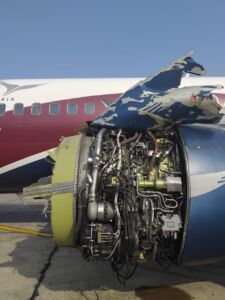 to Benin Airport on Wednesday after the crew detected what the airline described as a loud bang in one of the aircraft’s engines.
The Nigerian Safety Investigation Bureau later described the incident as involving “significant damage” to the affected engine.
The airline’s spokesperson, Adebanjo Ola, said in a statement that the aircraft, with registration 5N-MJF, was operating flight W3 740 from the Murtala Muhammed Airport, Lagos, to the Port Harcourt International Airport, Omagwa, when the incident occurred.
He said the crew heard a loud bang from the left engine while the aircraft was descending into Port Harcourt, prompting them to take precautionary action.
He said, “The aircraft was on its descent to Port Harcourt when the operating crew heard a loud bang on the left engine. As a precautionary measure, the crew made a safe diversion to Benin.”
Arik Air said all 80 passengers and crew members on board were safely evacuated after the aircraft landed in Benin, adding that no injuries were recorded.
“There were no injuries to passengers and crew as all 80 passengers on board were safely disembarked. Arrangements have been made to transport the affected passengers to their final destination,” the statement added.
The airline apologised for the disruption, assuring passengers that safety remained its priority.
“We sincerely apologise to the affected Port Harcourt passengers whose journey has been disrupted. The safety and well-being of passengers is always our priority at Arik Air,” he said.
Confirming the incident, the Director of Public Affairs and Family Assistance at the NSIB, Mrs Bimbo Oladeji, said the aircraft experienced an in-flight engine anomaly.
She said abnormal indications were detected on one of the engines during the flight, prompting a precautionary engine shutdown and diversion to Benin, where the aircraft landed without incident.
“In accordance with established safety procedures, the flight crew conducted a precautionary engine shutdown and diverted to the nearest suitable airport, Benin.
“The aircraft landed without incident, and all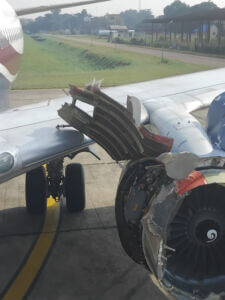 passengers and crew disembarked normally. No injuries have been reported,” she stated.
The bureau added that it had commenced a full investigation in line with its statutory mandate and international standards under ICAO Annex 13.
“Preliminary observations at the diversion airport indicate significant damage to the affected engine based on initial visual assessment,” the statement noted.
According to the NSIB, a preliminary assessment team has been deployed to Benin to secure the aircraft, document evidence, interview relevant personnel and witnesses, and recover flight data and cockpit voice recorder information.
“A preliminary assessment team is en route to Benin to secure the aircraft, document evidence, interview relevant personnel and witnesses, and recover flight data and cockpit voice recorder information,” the Bureau stated.
The bureau said a preliminary report would be issued within 30 days, while a final report would be released at the conclusion of the investigation.
American Airlines flight makes emergency landing in Barbados after takeoff incident
Emmanuel Joseph
An American Airlines flight bound for Miami was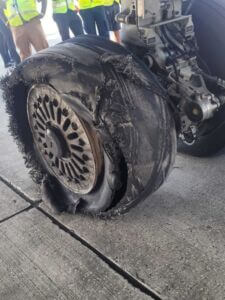 forced to make an emergency landing at the airport on Tuesday morning after one of its tyres blew out shortly after takeoff, airport officials confirmed.
No one was injured aboard flight AA1284, said airport management, who were alerted that the aircraft, a Boeing 737-823, with 134 passengers on board, had experienced tyre failure shortly after its 7:00 am takeoff.
“The aircraft was held overhead, while various checks were undertaken on the runway and the debris cleared. Emergency personnel were activated, along with the airport operational personnel and our security detail,” Chief Executive Officer (CEO) of Grantley Adams International Airport (GAIA) Inc., Hadley Bourne, told Barbados TODAY.
“The aircraft landed safely, and the passengers are now safely back in the terminal. There were no injuries to report.”
In an update later in the afternoon, Bourne disclosed that the AA plane was undergoing maintenance repairs here.
Initial reports said the flight experienced landing gear-related issues shortly after departing. Flight-tracking data showed the aircraft circling off the island before returning to the airport.
Director-General of the Civil Aviation Authority (CAA), Tracey Forde-Bailey told Barbados TODAY her department is waiting to get further word on the situation from the airline.
“I don’t have any further update other than the preliminary report, that the aircraft returned to the Grantley Adams International Airport.”
“We are now,” she added, “awaiting word from the technical personnel from the airline, but the aircraft is still on the ground.”
https://barbadostoday.bb/2026/02/10/american-airlines-flight-makes-emergency-landing-in-barbados-after-takeoff-incident/amp/
NTSB Prelim: Piper PA-22-150
Shortly After Takeoff From Runway 34, The Airplane Experienced A Loss Of Engine Power
Location: Anchorage, AK Accident Number: ANC26LA013
Date & Time: January 31, 2026, 19:21 Local Registration: N3263Z
Aircraft: Piper PA-22-150 Injuries: 1 Serious, 1 None
Flight Conducted Under: Part 91: General aviation - Personal
On January 31, 2026, about 1921 Alaska standard time, a Piper PA-22-150 airplane, N3263Z, was substantially damaged when it was involved in an accident near Anchorage, Alaska. The pilot was uninjured, and the passenger was transported to the hospital with potentially serious injuries. The airplane was operated as a Title 14 Code of Federal Regulations Part 91 personal flight.
According to the pilot, earlier in the evening, he and the passenger departed Kenai Municipal Airport (ENA), Kenai, for a personal flight to Merrill Field Airport (MRI), Anchorage, with about 36 gallons of 100LL aviation fuel onboard. The flight to Anchorage was uneventful. After parking in the transient area, the pilot and passenger left for dinner and later returned to the airplane. The pilot conducted an engine run-up at transient parking and then taxied to Runway 34, where he was instructed to expect a Campbell Departure to the south. Shortly after takeoff from Runway 34, the airplane experienced a loss of engine power. The pilot maneuvered the airplane in a right-banking turn back toward the runway environment, and the airplane impacted the airport ramp before coming to rest on Taxiway Alpha, about 950 ft northeast of the departure end of Runway 34.
The outboard right wing, beyond the lift strut, and right aileron exhibited spanwise deformation consistent with impact damage. The right main gear collapsed and folded backwards against the fuselage. The nose gear collapsed and folded laterally towards the left side of the fuselage. One propeller blade was curled backwards and had left witness marks on the left side of the cowling.
A security camera at the airport captured video and audio of the airplane’s taxi and takeoff roll. Shortly after the airplane exited the camera frame, the engine can be heard sputtering, followed by a loss of power. Engine power is then momentarily restored before the airplane impacts the ramp area.
An investigator from the National Transportation Safety Board’s (NTSB) Alaska Regional Office responded to the accident site and documented the airplane wreckage. During the on-scene examination, the investigator recovered a data card containing flightpath and engine monitoring data.
The wreckage will be recovered to a secure facility for further examination.
FMI: www.ntsb.gov
Today in History
48 Years ago today: On 11 February 1978 Pacific Western Airlines flight 314, a Boeing 737-200, crashed following a collision with a snow removal vehicle at Cranbrook Airport, BC, Canada, killing 42 occupants; 7 survived the accident.
| Date: | Saturday 11 February 1978 |
| Time: | 12:55 |
| Type: | Boeing 737-275 |
| Owner/operator: | Pacific Western Airlines |
| Registration: | C-FPWC |
| MSN: | 20142/253 |
| Year of manufacture: | 1970 |
| Engine model: | P&W JT8D-9A |
| Fatalities: | Fatalities: 42 / Occupants: 49 |
| Other fatalities: | 0 |
| Aircraft damage: | Destroyed, written off |
| Category: | Accident |
| Location: | Cranbrook Airport, BC (YXC) - Canada |
| Phase: | Landing |
| Nature: | Passenger - Scheduled |
| Departure airport: | Calgary International Airport, AB (YYC/CYYC) |
| Destination airport: | Cranbrook Airport, BC (YXC/CYXC) |
| Confidence Rating: | Accident investigation report completed and information captured |
Narrative:
Pacific Western Airlines flight 314, a Boeing 737-200, crashed following a collision with a snow removal vehicle at Cranbrook Airport, BC, Canada, killing 42 occupants; 7 survived the accident.
Pacific Western flight 314 was a scheduled service from Edmonton, AB (YEG) to Castlegar Airport, BC (YCG) with stops at Calgary, AB (YYC) and Cranbrook (YXC). The flight departed Calgary at 12:32 in the afternoon. The Boeing 737-200 climbed to FL200 which was reached at 12:38. Calgary ATC then reported to the Cranbrook Aeradio station that flight 314 was underway with an ETA of 13:05. At Cranbrook it was snowing with visibility reported as 3/4 of a mile. A radio equipped snow removal vehicle was sweeping the runway at the time. The Aeradio operator at Cranbrook alerted the driver of the vehicle about the incoming aircraft and gave him the ETA of 13:05; they both expected the flight would report by the "Skookum Beacon" on a straight-in approach to runway 16, thus giving the vehicle operator about seven minutes to get off the runway. At 12:46, while descending out of FL180, flight 314 contacted Cranbrook Aeradio. One minute later the crew were advised that snow removal was in progress. No further transmissions were received from the flight by Aeradio. The aircraft passed the Skookum beacon inbound on a straight-in instrument approach, and flew the ILS for runway 16 to touchdown. The aircraft touched down at 12:55 some 800 feet from the threshold and reverse thrust was selected. Suddenly the crew noticed a snow plough on the runway. A go-around was initiated immediately. However one of the thrust-reversers didn't fully re-stow because hydraulic power was automatically cut off at lift-off.
The aircraft became airborne prior to the 2000 foot mark, and flew down the runway at a height of 50 to 70 feet, flying over the snow plough. The left engine thrust reverser doors then deployed and the crew rapidly selected the flaps up from 40deg to 15deg. The airplane climbed to 300-400 feet, banked steeply to the left, lost height and side-slipped into the ground to the left of the runway. The aircraft broke up and caught fire.
CONCLUSIONS (FINDINGS):
1. The estimated time of arrival of the aircraft at Cranbrook, calculated by Calgary ATC, and used by Aeradio for advisory purposes was considerably in error and resulted in a traffic conftict between the arriving aircraft and a vehicle working on the runway.
2. The flight crew did not report by the Skookum beacon on final approach, as was the normal practice at Cranbrook, thereby allowing the incorrect ETA to remain undetected.
3. Regulatory provisions concerning mandatory pilot position reporting during instrument approaches were inadequate.
4. The interfaces between the organizations providing Air Traffic Services, Telecommunications (Aeradio) and Airports Services were not well enough developed to provide a reliable fail-safe flight information service.
5. The pilots lost control of the aircraft consequent upon the left engine thrust reverser deploying in flight when the aircraft was at low speed, and in a high drag configuration.
6. The FAA design standards under which the Boeing 737 was constructed did not adequatety provide for the possibility of an aborted landing after touchdown and thrust reverser initiation.
7. The lack of a suitable national system of incident reporting, investigation, and follow-up corrective action allowed operational problems to remain uncorrected.
8. Rescue efforts at the accident scene were hampered due to lack of a fire fighting vehicle capable of negotiating deep snow and shortage of trained rescue personnel.
