Here's what I have to close out the week...
Have a safe weekend!
Tom
-
Plane leaving Yampa Valley Regional Airport blew a tire during takeoff
SteamBoatRadio1
A private plane leaving Yampa Valley Regional Airport - HDN blew a tire during takeoff today.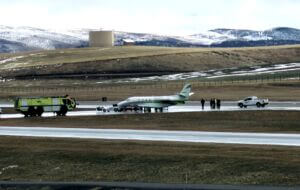 Airport Director Tinneal Gerber says the flight crew was able to stop and exit the runway via a nearby taxiway connector.
During the process, one main landing gear tire failed and the other had smoke and flames. Gerber says, “Airport Aircraft Rescue and Firefighting (ARFF) personnel responded within seconds and fully extinguished the fire with water.”
The two people on board were not hurt. The airport’s primary runway was closed for about two hours so the plane could be removed for inspection and repairs.
“Airport administration has been actively coordinating with the Federal Aviation Administration (FAA) and the National Transportation Safety Board (NTSB). Airport operations and public areas remained safe, and there was no risk to passengers, staff, or the community,” said Gerber.
Courtesy photo from YVRA.
https://www.facebook.com/SteamboatRadio1/posts/a-private-plane-leaving-yampa-valley-regional-airport-hdn-blew-a-tire-during-tak/1342560151245102/
NTSB Final Report: Cirrus SR22
Shortly After Retracting The Flaps, The Primary Flight Display (PFD) Reportedly “Blinked Off”
Location: Martinsville, Virginia Accident Number: ERA24LA007
Date & Time: October 11, 2023, 22:47 Local Registration: N253BC
Aircraft: Cirrus SR22 Aircraft Damage: Substantial
Defining Event: Collision during takeoff/land Injuries: 4 None
Flight Conducted Under: Part 91: General aviation - Personal
Analysis: The pilot had just refueled the airplane and planned to fly a night, visual flight rules, crosscountry flight. The pilot used 50% flaps for the normal takeoff; after he established a positive rate of climb, the pilot retracted the flaps. Shortly after retracting the flaps, the primary flight display (PFD) reportedly “blinked off” momentarily and then reappeared with a “Taxiway! Taxiway!” alert, and the multifunction display (MFD) screen was orange, which confused the pilot. He then looked up, saw a large pine tree ahead, and attempted to avoid the tree; however, the airplane impacted trees, resulting in substantial damage to the airplane. After the tree impact, the pilot was able to maintain control of the airplane, return to the departure airport, and land uneventfully.
Examination of the PFD and MFD databases revealed no anomalies that would have resulted in a PFD malfunction. Postaccident examination of the airplane and avionics revealed no malfunctions or failures that would have precluded normal operation. Review of onboard data revealed that after retracting the flaps from 50%, the airplane began to descend despite no change in engine power. The descent continued until the recorded airspeed decreased to 0 kts and became unreliable, likely as a result of tree impact damage to the pitot tube. The data further revealed that there was no recorded electrical power loss or loss of engine power throughout the flight.
Recorded data revealed that the airplane was over its maximum gross weight at the time of the accident, which likely led to a longer takeoff distance and reduced climb performance. The airplane’s avionics display was capable of providing terrain warnings and alerts. During the accident flight, the airplane was operated within the performance envelope that would trigger a “Too Low, Terrain” caution message, and the terrain would be illuminated amber. The system was also capable of alerting the pilot when the system detected that the airplane was taking off or landing on a non-runway. These alerts will provide a voice alert of “Taxiway” and a visual annunciation of “TWY TAKEOFF” or “TWY LANDING,” respectively. It is likely that when the pilot allowed the airplane to descend, the MFD terrain turned amber in color to alert the pilot of being too low, and the system calculated that the pilot was landing on a non-runway, which then triggered the “TWY LANDING” visual and aural alert. Although the terrain alerting function appears to have operated as designed, the pilot’s lack of understanding of the alerts likely distracted him and led him to interpret their display as an avionics failure.
Probable Cause and Findings: The National Transportation Safety Board determines the probable cause(s) of this accident to be -- The pilot’s failure to maintain a positive climb rate after takeoff while distracted by primary flight display anomaly and terrain alerts. Contributing to the accident was the pilot’s decision to take off with the airplane over its maximum gross weight, which reduced its initial climb performance.
FMI: www.ntsb.gov

Today in History
71 Years ago today: On 13 February 1955 Sabena flight 503, a Douglas DC-6, hit Monte Terminillo in Italy, killing all 29 occupants.
| Date: | Sunday 13 February 1955 |
| Time: | 19:53 |
| Type: | Douglas DC-6 |
| Owner/operator: | Sabena |
| Registration: | OO-SDB |
| MSN: | 43063/60 |
| Year of manufacture: | 1947 |
| Fatalities: | Fatalities: 29 / Occupants: 29 |
| Other fatalities: | 0 |
| Aircraft damage: | Destroyed, written off |
| Category: | Accident |
| Location: | Monte Terminillo - Italy |
| Phase: | En route |
| Nature: | Passenger - Scheduled |
| Departure airport: | Brussel-Haren Airport |
| Destination airport: | Roma-Ciampino Airport (CIA/LIRA) |
| Confidence Rating: | Accident investigation report completed and information captured |
Narrative:
Sabena flight 503, a Douglas DC-6, hit Monte Terminillo in Italy, killing all 29 occupants.
The Sabena DC-6 departed Brussels (BRU), Belgium at 17:17 on a scheduled flight to Rome-Ciampino (Italy), Kano (Nigeria) and Léopoldville (now Kinshasa, D.R.Congo).
Contact with Ciampino ACC was initiated according to plan at 19:29 , at which time the aircraft had passed over Florence at 17500 feet. At 19:48 Ciampino control asked the aircraft whether it had passed over Viterbo. Instead of answering this question directly, the crew inquired whether the Viterbo NDB was on full power. The controller replied that another aircraft had overflown the Viterbo NDB shortly before and had found it to be operating properly.
At 19:51 GMT the aircraft stated that it had passed over Viterbo NDB one minute previously and requested clearance to descend to 5500 feet ; this was granted . One minute later it inquired whether the Ciampino ILS were operating and received an affirmative reply. At 19:53, OO-SDB called Rome control but communication was suddenly cut off.
The airplane hit the slope of the Costone dell'Acquasanta at a height of 1700 metres.
PROBABLE CAUSE: "The navigation was conducted without making use of all such radio aids as would have permitted checking, and consequently correcting the drift of the aircraft whereas the crew actually remained unaware of the drift. In fact, instead of making sure they were over the Viterbo beacon, they merely held that conviction, and therefore the approach procedure to the Rome terminal area (which prescribes overflight of the Viterbo beacon) was erroneously applied. The following contributing causes may be taken into consideration, 1) crosswind to the route stronger than forecast; 2) weather conditions particularly unfavourable to radio reception in MF."
