Here's all we have for today...
Be safe out there!
Tom
-
Aircraft makes emergency landing near Pharr International Bridge
By Tania Castillo
Pharr, Texas.-
An aircraft made an emergency landing on the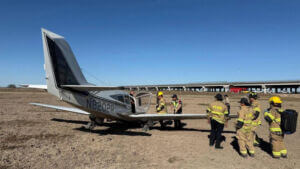 afternoon of February 15 near the Pharr International Bridge, after experiencing suspected mechanical failures.
The incident occurred around 3:12 p.m., generating an immediate mobilization of emergency services in the border area.
The Pharr city emergency team arrived at the scene, reinforced by firefighters, police, medical services, the Texas Department of Public Safety (DPS) and Border Patrol agents, who secured the perimeter and coordinated the response efforts.
It was reported that the two occupants of the aircraft were unharmed, despite the incident.
Authorities conducted the necessary inspections to determine the causes of the mechanical failure and ensure safety in the area.
NTSB Final Report: Piper PA-18-150
Pilot Reported That He Landed In A Harvested Soybean Field And Tapped The Breaks “A Little Too Hard.”
Location: Chaseley, North Dakota Accident Number: CEN26LA013
Date & Time: October 2, 2025, 17:00 Local Registration: N91042
Aircraft: Piper PA-18-150 Aircraft Damage: Substantial
Defining Event: Nose over/nose down Injuries: 1 None
Flight Conducted Under: Part 91: General aviation - Personal
Analysis: The pilot reported that he landed in a harvested soybean field and tapped the breaks “a little too hard.”
The airplane nosed over and came to rest inverted. The airplane sustained substantial damage to the wings, right wing strut, rudder, and fuselage. The pilot reported that there were no preaccident mechanical malfunctions or failures with the airplane that would have precluded normal operation.
The pilot further reported that the accident could have been prevented by “rolling out a little longer” and being “gentle” on the brakes during the landing roll.
Probable Cause and Findings: The National Transportation Safety Board determines the probable cause(s) of this accident to be -- The pilot’s excessive braking during the landing roll, which resulted in a nose over.
FMI: www.ntsb.gov
Today in History
67 Years ago today: On 17 February 1959 A THY Vickers Viscount crashed while on approach to London Airport, United Kingdom , killing 14 occupants; 10 survived the accident.
| Date: | Tuesday 17 February 1959 |
| Time: | 16:47 |
| Type: | Vickers 794D Viscount |
| Owner/operator: | Türk Hava Yollari - THY |
| Registration: | TC-SEV |
| MSN: | 429 |
| Year of manufacture: | 1958 |
| Total airframe hrs: | 548 hours |
| Engine model: | Rolls-Royce Dart 510 |
| Fatalities: | Fatalities: 14 / Occupants: 24 |
| Other fatalities: | 0 |
| Aircraft damage: | Destroyed, written off |
| Category: | Accident |
| Location: | 5,2 km W of London-Gatwick Airport (LGW) - United Kingdom |
| Phase: | Approach |
| Nature: | Passenger - Non-Scheduled/charter/Air Taxi |
| Departure airport: | Roma-Ciampino Airport (CIA/LIRA) |
| Destination airport: | London Airport (LHR/EGLL) |
| Confidence Rating: | Accident investigation report completed and information captured |
Narrative:
A THY Vickers Viscount crashed while on approach to London Airport, United Kingdom , killing 14 occupants; 10 survived the accident.
The aircraft was on a special flight from Ankara to London via Rome with Adnan Menderes the Prime Minister of Turkey and a party of Turkish Government officials on board. The aircraft left Rome at 13:02. TC-SEV called London Airways at 15:56 after passing Abbeville and was cleared by ATC to the Epsom Radio Range station, the holding point for London Airport. Because of poor visibility at destination London (Heathrow) Airport, the London Airport Commandant decided to inform the Turkish captain that he should divert to Gatwick. At 16:21 hrs the aircraft reported over the Epsom range and was given diversion instructions. At 16:27 it left Epsom for Mayfield, the holding point for Gatwick, where it was informed by Gatwick Approach Control that it would be positioned by radar for an ILS approach to runway 09. The latest weather report for Gatwick was given as wind calm, visibility 1.1 nm, mist, cloud 3 oktas at 600 feet, QFE 1036 mb. Over the Mayfield NDB at 4,000 feet the flight was instructed to steer a course of 280 and to descend to 2,000 feet. This was acknowledged. A further descent clearance was given to 1500 feet. The aircraft overshot the centre line slightly as it turned on to the ILS approach path. At 5nm from touchdown, the aircraft affirmed that it could continue on the ILS. TC-SEV was then asked to change to tower frequency and this request was acknowledged. This was the last communication with the aircraft. At a position of some 5 km from the runway threshold and 550 feet to the north of the approach path centre line, the aircraft contacted tops of trees 390 feet amsl at the edge of Jordan's Wood. The aircraft began to disintegrate as it descended through the trees at an angle of about 6 degrees from the horizontal until the wheels made contact with the ground. After rising again slightly the main part of the wreckage came to rest about 100 yards further on and then caught fire.
PROBABLE CAUSE: "The evidence is insufficient to establish the cause of the accident. There is no indication however that this can be associated either with a technical failure of the aircraft or with a failure of the ground services."
