These are the stories to start the new week...
Be safe out there!
Tom
-
Jet veers off runway and crashes into embankment while landing at Jundiaí airport.
The aircraft had taken off from Bragança Paulista Airport; no one was injured.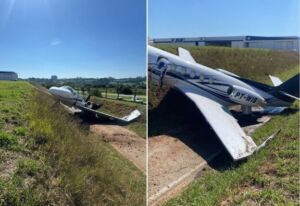
A jet plane went off the runway after landing at Comandante Rolim Adolfo Amaro State Airport, in Jundiaí, in the interior of São Paulo, on Sunday morning (15). No one was injured.
According to Rede VOA, the concessionaire responsible for the airport, the Cessna Citation 550 jet aircraft, registration PT-WIB, had taken off from Bragança Paulista Airport bound for Jundiaí.
At the time of the accident, there was a runway excursion during landing. The plane ended up colliding with the embankment at the vehicle entrance to the TAM airline hangar. The incident was recorded by airport cameras.
According to the concessionaire, no injuries were reported. The pilot managed to leave the aircraft without major complications and is doing well.
SERIPA IV, the investigative body of the Center for Investigation and Prevention of Aeronautical Accidents (CENIPA), responsible for the entire state of São Paulo, has already gone to the site and will conduct the accident investigation.
The Fire Department was also called around 9:45 am. Approximately six teams were sent to the airport to respond to the incident.
According to firefighters, there was only a fuel leak after the accident, which resulted in the temporary closure of the airport.
https://sbtnews.sbt.com.br/noticia/brasil/video-jato-sai-da-pista-e-colide-contra-barranco-ao-pousar-em-aeroporto-de-jundiai
Firefighters Respond to Gyrocopter Crash in Santa Ynez Valley
The gyrocopter’s single occupant had minor injuries and was transported to the hospital
by Janene Scully
Emergency crews responded to a reported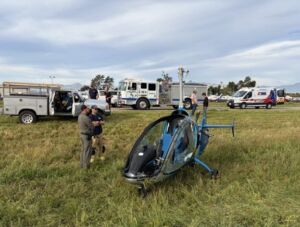 aircraft crash in the Santa Ynez Valley on Friday afternoon.
At approximately 5 p.m., personnel from the Santa Barbara County Fire Department and the Sheriff’s Office were dispatched to the 900 block of Airport Road at the Santa Ynez Airport.
A gyrocopter with a single occupant crashed, according to emergency dispatch reports.
The pilot, whose name wasn’t released, reportedly was walking around at the scene.
Santa Barbara County Fire Department spokesperson Karen Cruz-Orduña said the single occupant had minor injuries and was transported to the hospital by American Medical Response ambulance.
The airport temporarily shut down following the collision and reopened just before 7 p.m., according to Cruz-Orduña.
Federal Aviation Administration records listed the aircraft as experimental and under the homebuilt category. The agency issued the certificate on Feb. 28, 2025 with the expiration set for 2032.
John Easterling, Olivia Newton-John‘s widower, is named as the manufacturer of the rotorcraft on an FAA database.The aircraft’s registered owner is a Jupiter, Florida company with ties to Easterling, according to government records.
The gyrocopter came from a kit model known as Kallithea and manufactured by Niki Rotor Aviation in Bulgaria.
https://www.noozhawk.com/firefighters-responding-to-aircraft-crash-in-santa-ynez-valley/
Small plane makes emergency belly landing at Athens airport
By WSBTV.com News Staff
ATHENS, Ga. — A small plane was forced to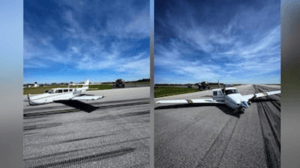 make an emergency landing Saturday at the Athens airport, according to officials.
Athens-Clarke County Fire Department said they responded to the Athens-Ben Epps Airport after reports of an emergency plane landing.
Earlier in the day, a plane experienced a landing gear malfunction and had to make a belly landing on the runway, according to the ACCFD.
Officials say there were two people on board the plane at the time.
Despite the emergency landing, authorities say no fire broke out and no injuries were reported.
Fire officials praised responding crews for their quick response.
Just yesterday, a pilot landed a small plane on Highway 74 in Peachtree City after the engine failed.
Channel 2’s Cory James talked to the plane’s owner, who said both the pilot and student on board landed the plane without damaging it or hurting anyone, including themselves.
Vape fire on plane triggers emergency response at Melbourne Airport
By Sarah Swain
A vape has caught fire on a flight from Brisbane to Melbourne, causing a mid-air call for help.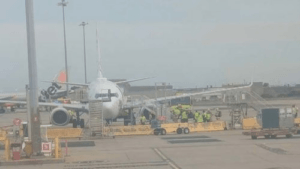
Virgin Australia flight VA328 from Brisbane made an urgent call after the vape ignited, the airline said this evening.
Emergency services were put on standby as the plane landed in Melbourne.
"The Boeing 737 aircraft landed safely and taxied to the gate where passengers were able to disembark normally," a statement from Melbourne Airport said.
Virgin Australia said Aviation Rescue Firefighters followed the aircraft "as a precaution" and "removed the device from the aircraft."
A PAN call means possible assistance needed and signals an urgent call for help but not an emergency.
The flight took off from Brisbane just before 1pm (2pm AEDT) and landed safely in Melbourne just before 4.30pm.
Passengers disembarked normally.
https://www.9news.com.au/national/virgin-australia-flight-emergency-fire-melbourne/0596bd86-adb7-4a58-a2b6-0d0c663cc0b6
NTSB Final Report: Sukhoi SU-26MX
Pilot Reported That He Might Have Attempted The Takeoff With The Tailwheel In The Unlocked Position
Location: Longmont, Colorado Accident Number: CEN25LA405
Date & Time: September 30, 2025, 11:00 Local Registration: N25SU
Aircraft: Sukhoi SU-26MX Aircraft Damage: Substantial
Defining Event: Loss of control on ground Injuries: 1 Minor
Flight Conducted Under: Part 91: General aviation - Personal
Analysis: The pilot reported that during the takeoff roll about 50 mph, the airplane veered to the left of the runway centerline.
The pilot attempted to correct back to the right; however, the airplane continued to the left, exited the left side of the runway, and then momentarily became airborne.
Subsequently, the left wing struck the ground which resulted in substantial damage to the left wing. The pilot reported that he might have attempted the takeoff with the tailwheel in the unlocked position.
Probable Cause and Findings: The National Transportation Safety Board determines the probable cause(s) of this accident to be -- The pilot's failure to maintain directional control during takeoff.
FMI: www.ntsb.gov
NTSB Preliminary Report Issued On Bombardier 650 Crash In Bangor, Maine
Aircraft Exceeded Maximum Holdover Time After Anti-Icing Application
The NTSB preliminary report on the Jan. 25, 2026, Bombardier Challenger 650 crash in Bangor, Maine, indicates the aircraft took off about 16-17 minutes after anti-icing fluid application, exceeding the 2-9-minute maximum holdover time for the weather conditions.
The pilot, copilot, and 4 passengers were killed. Investigators said in the report that the plane barely made it off the ground before crashing and causing multiple explosions. According to the report, the plane finished de-icing at 7:27 p.m., and at 7:44 p.m., the copilot told the tower controller that they were ready for takeoff. "Holdover time is the estimated period for which deicing or anti-icing fluid will prevent the accumulation of ice, snow or frost on an aircraft. According to the FAA Holdover Time Guidelines for Winter 2025-2026, the corrected snowfall intensity associated with 3/4 statute-mile visibility at night and an outside temperature at or below -1°C was considered "moderate." Additionally, a "moderate" snowfall intensity and a -16°C outside temperature resulted in a maximum holdover time of nine minutes from the start of the anti-ice application," the preliminary NTSB report says.
"According to FBO documentation, about 41 gallons of Type I de-ice fluid (Inland Technologies SafeTemp ES Plus) were used to de-ice the airplane. CCTV footage showed the application of Type IV anti-ice started at 1927:43 and concluded at 1930:55. According to FBO documentation, about 28 gallons of Type IV anti-ice fluid (Dow Chemical Inc. UCAR FLIGHTGUARD AD-49) were dispensed during the anti-ice process. "Following the anti-icing application, the airplane sat for 4 minutes 51 seconds before it taxied from the de-ice pad at 1935:46. At that time, about 8 minutes 3 seconds had elapsed since the start of the anti-icing application.
"According to a preliminary review of the cockpit voice recorder, the flight crew discussed holdover times during the taxi to runway 33. The pilot commented that it was "standard" to have 14-18 minutes and that if the wait was more than 30 minutes, they would return to the ramp to de-ice again. The copilot concurred with the pilot. "A preliminary review of the FDR data did not reveal any evidence of a flight-control malfunction or failure, and both engines continued to develop takeoff power until the FDR recording stopped," the NTSB report says.
FMI: www.ntsb.gov
NTSB Final Report: Vans RV9
After A Brief Stopover, The Engine Failed To Start Due To A Dead Battery, And The Pilot Elected To Hand Prop The Engine
Location: Stephenville, Texas Accident Number: CEN25LA399
Date & Time: September 27, 2025, 19:15 Local Registration: N26AJ
Aircraft: Vans RV9 Aircraft Damage: Substantial
Defining Event: Ground collision Injuries: 1 Minor, 1 None
Flight Conducted Under: Part 91: General aviation - Personal
Analysis: After a brief stopover, the engine failed to start due to a dead battery, and the pilot elected to hand prop the engine. The non-certificated passenger was instructed to apply the brakes, and the pilot successfully started the engine. However, when the engine started, the canopy inadvertently closed, which caused a headset to fall. The headset impacted the engine throttle control pushing it forward, and the engine power increased. The airplane subsequently moved uncontrolled across the ramp with the passenger onboard and impacted the terminal building.
The airplane came to rest upright, and the right wing sustained substantial damage. The pilot reported that there were no preaccident mechanical failures or malfunctions with the airplane that would have precluded normal operation.
Probable Cause and Findings: The National Transportation Safety Board determines the probable cause(s) of this accident to be -- The pilot’s failure to ensure the canopy and the cockpit were properly secured during the hand prop sequence.
FMI: www.ntsb.gov
NTSB Prelim: Pipistrel TAURUS 503
Motorglider Continued To The West A “Few Hundred Feet” Before Banking To The Right; The Right Wing Dropped, And The Glider Descended In A Nose-Low Attitude
Location: Boynton Beach, FL Accident Number: ERA26FA110
Date & Time: February 9, 2026, 15:14 Local Registration: N414HG
Aircraft: Pipistrel TAURUS 503 Injuries: 1 Serious
Flight Conducted Under: Part 91: General aviation - Personal
On February 9, 2026, about 1514 eastern standard time, a Pipistrel Taurus 503 motorglider, N414HG, was substantially damaged when it was involved in an accident at Willis Gliderport (FA44), Boynton Beach, Florida. The pilot was seriously injured. The motorglider was operated as a Title 14 Code of Federal Regulations Part 91 personal flight.
Video with audio from a Ring camera captured the motorglider taxiing to the west end of the gliderport where it stopped facing east with the engine running for about 2 minutes and 10 seconds. The audio captured the sound of the engine rpm increasing followed by the motorglider beginning the takeoff roll. The video captured the motorglider rotating about 570 ft down the runway, the motorglider exited the camera’s field of view but the audio continued to record.
A pilot rated witness located inside his residence on the north side of the gliderport about 1,900 ft east of the western edge of the runway reported hearing the motorglider depart. When the motorglider was past his house he heard the engine quit. He went outside and observed it flying in a westerly direction about 350 ft south of the runway at an altitude of between 200 and 300 ft. He noted the engine was extended but was not running. The motorglider continued to the west a “few hundred feet” before banking to the right; the right wing dropped, and the glider descended in a nose-low attitude while rotating to the right. The motorglider impacted the ground in a near vertical position and fell back, coming to rest upright.
Postaccident examination of the motorglider which was equipped with an airframe rescue parachute revealed it was not deployed and a safety pin was in the emergency parachute release handle.
The wreckage was retained for further examination.
FMI: www.ntsb.gov

Today in History
64 Years ago today: On 16 March 1962 A Flying Tiger Line Lockheed L-1049H Super Constellation, crashed into the Pacific Ocean on a flight between Guam and Angeles City, killing all 107 occupants.
| Date: | Friday 16 March 1962 |
| Time: | 01:30 |
| Type: | Lockheed L-1049H Super Constellation |
| Owner/operator: | Flying Tiger Line |
| Registration: | N6921C |
| MSN: | 4817 |
| Year of manufacture: | 1957 |
| Total airframe hrs: | 17224 hours |
| Engine model: | Wright R-3350 (988TC18EA3) |
| Fatalities: | Fatalities: 107 / Occupants: 107 |
| Other fatalities: | 0 |
| Aircraft damage: | Aircraft missing, written off |
| Category: | Accident |
| Location: | between Guam and Angeles City - Pacific Ocean |
| Phase: | En route |
| Nature: | Passenger - Non-Scheduled/charter/Air Taxi |
| Departure airport: | Guam-Agana NAS (NGM) |
| Destination airport: | Angeles City-Clark Air Base (CRK/RPMK) |
| Confidence Rating: | Accident investigation report completed and information captured |
Narrative:
A Flying Tiger Line Lockheed L-1049H Super Constellation, crashed into the Pacific Ocean on a flight between Guam and Angeles City, killing all 107 occupants.
Flying Tiger Line Flight 7815/13, operating as Military Air Transport Service (MATS) Charter flight 739/14, originated at Travis AFB with refueling stops at Honolulu, Wake Island, Guam, Clark AFB and was to terminate at Saigon. The flight arrived at Guam at 11:14 GMT with the only irregularities on the way being minor maintenance on the ignition systems of engines no. 1 and 3 at Honolulu, a 30 min delay at Honolulu because of stewardess complaints of inadequate rest facilities aboard, and minor maintenance at Wake Island (discrepancies in the no. 1 and 3 engine ignition systems). The flight departed Guam at 12:57 GMT for an IFR flight to Clark AFB, Philippine Islands with an ETA of 19:16 GMT.
The flight climbed to a cruising altitude of 18000 feet and reported being at position 13 40'N and 140 00'E at 14:22. The crew expected to reach position 14 00'N 135 00'E at 15:30. At 15:33 Guam IFSS was experiencing communication difficulties caused by heavy radio static and at 15:39 the operator attempted to contact N6921C to obtain its position report. No radio contact could be established.
Search and rescue operations were instituted at 19:43. It appeared that at 15:30 GMT (01:30 local time) the crew of the SS TL Lenzen supertanker had sighted a midair explosion from their position at 13 44'N and 134 49'E.
The subsequent search covered 144000 sq miles using 48 aircraft and 8 surface vessels, but nothing was found.
PROBABLE CAUSE: "The Board is unable to determine the probable cause of this accident from the evidence now available."
