Tragic news tonight from KLGA in New York City where there are reports that a an Air Canada CRJ has collided with a Port Authority firetruck leaving four firefighters critically injured...
Keep our Brothers and Sisters in your prayers!
Tom
-
4 firefighters critially injured as Air Canada flight, firetruck collide at LaGuardia: sources
By Joe Marino, Reuven Fenton and Zoe Hussain
An Air Canada flight arriving at LaGuardia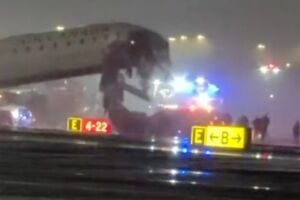 Airport crashed into a firetruck on Sunday night — leaving four firefighters critically injured, according to sources.
Emergency vehicles swarmed Runway 4 at the Queens airport after a regional jet heading from Montreal hit the fire truck just before 11:40 p.m., according to the FDNY and footage captured by the Citizen App.
Images showed the front of the commuter plane smashed and tilting in the air. The injured firefighters are from the Port Authority Police Department, sources said.
One hundred passengers were on the jet — a Bombardier CRJ-900 — and their conditions are being evaluated. Sources said the plane was carrying a group of Orthodox Jews from the New York area.
The collision happened as the plane, operated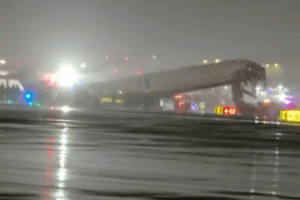 by regional carrier Jazz Airlines, was. was heading to a gate, as heavy weather hit the area, according to ColLive.
LaGuardia Airport issued an alert late Sunday warning that rainy and cloudy weather could disrupt operations at the travel hub.
The airport is now closed, and the FAA has issued a ground stop due to an aircraft emergency.
The FAA, Port Authority, and Air Canada did not immediately respond to The Post’s request for comment.
This is a developing story. Please check back for updates.
https://nypost.com/2026/03/23/us-news/air-canada-flight-firetruck-collide-at-laguardia-reports/
Passenger Plane Crash-Lands at Wilson Airport
By Jason Ndunyu
A passenger plane has crash-landed at Wilson Airport in Nairobi, triggering an emergency response.
Preliminary reports indicate that the aircraft that crashed on Friday, March 20, in the evening, registered as 5Y-BXI, and operated by Aircraft Leasing Services (ALS), was flying from Kisumu.
ALS is known for operating flights on behalf of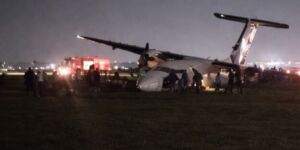 humanitarian agencies, including the United Nations World Food Programme (WFP) and the International Committee of the Red Cross (ICRC). It also operates flights on behalf of regional airlines in Kenya, such as Safarilink Aviation.
Videos circulating on social media and seen by The Kenya Times show the Dash 8-100 aircraft grounded on the airstrip, with visible signs of distress as emergency teams rush to the scene.
First responders were also seen at the site working to evacuate passengers from the plane, with rescue operations underway moments after the crash-landing.
The Kenya Airports Authority (KAA) later issued an official statement regarding the crash, noting that the aircraft had 39 passengers on board, all of whom were rescued along with the crew.
According to KAA, the plane veered off the runway after arriving at Wilson from the Kisumu International Airport.
“This evening at 2055HRS an aircraft with thirty nine (39) passengers on board arriving from Kisumu International Airport veered off the runway at Wilson Airport.
We wish to confirm that all passengers and crew are safe, with no injuries reported. The aircraft remains on site, and recovery efforts are currently underway. Airport operations at Wilson Airport remains normal.
The Kenya Airports Authority (KAA) remains fully committed to the highest standards of safety at all our airports.”
Regional airline Safarilink Aviation later confirmed in a statement that the aircraft involved in the incident was operated by ALS on its behalf.
The airline noted that the flight was carrying a total of 34 passengers and 5 crew members.
“Passengers and crew have since been safely evacuated, and support services are being provided as needed,” Safarilink said.
Wilson Airport incidents
Wilson Airport, one of the busiest airports in East Africa for domestic and light aircraft operations.
It primarily serves domestic and regional flights, with around 90% of operations connecting to safari destinations such as the Masai Mara, Mombasa, Diani, Lamu, Amboseli, and Nanyuki.
Founded in 1928, the airport provides a faster alternative to Jomo Kenyatta International Airport (JKIA) for private charters, light aircraft, and government operations.
Wilson Airport has in the past handled emergency incidents. On August 7, 2025, an AMREF Flying Doctors Cessna Citation XLS (5Y-FDM) crashed into a residential building in Mwihoko, Kiambu, shortly after takeoff from the airport. Six people were killed, including four on board and two on the ground.
On December 28, 2024, an ALS Dash 8 (5Y-MRE) experienced a landing mishap when its main tyres burst, temporarily closing the runway. No injuries were reported in that incident.
A particularly serious mid-air collision occurred on March 5, 2024, when a Safarilink Dash 8-300 collided with a Cessna 172 shortly after takeoff over the Nairobi National Park.
The Cessna crashed, killing the student pilot and instructor, while the Dash 8 returned safely to Wilson Airport. Previous minor incidents include runway overruns and emergency landings in September 2022 and October 2019, which caused damage but no fatalities.
Wilson Airport has also experienced challenges with helicopter operations. Kenya Police Mi-17 helicopters have a documented history of mechanical issues, including crash-landings at the airport in 2019 and 2025.
The incident comes after the late Emurua Dikirr Member of Parliament Johana Ng’eno was killed in a helicopter crash in Nandi County, along with five other people on board.
The crash occurred on Saturday, February 28, 2026, at approximately 4:45 p.m. in a forested area of Chepkiep, Nandi North.
Reports indicated that the helicopter (an Airbus AS350 B3e) made an emergency landing earlier in the afternoon due to poor weather. After assessing the situation for about 10 minutes, the pilot attempted to take off again despite heavy mist and rain.
Witnesses stated the aircraft lost stability shortly after takeoff, hit trees, and burst into flames upon impact.
Haiti / Les Cayes: IBC plane crashes on landing, no casualties reported
by Rezo Nodwes
One of the members of the interim municipal council of Les Cayes, Pétuel Mentor, blames the deteriorating weather conditions to explain the plane crash upon landing at Antoine-Simon International Airport.
In a brief interview with Rezo Nòdwès, Pétuel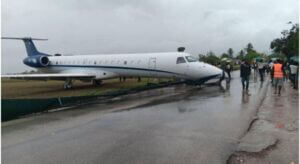 Mentor, a member of the Interim Municipal Commission, confirmed the crash that occurred this Friday at Antoine-Simon Airport in Les Cayes.
He reported an accident attributable to deteriorating weather conditions, due to the heavy rains that have been falling on the southern metropolis for the past three days. At this stage, it is impossible to discuss any potential victims, according to the mayor, who emphasized that a delegation from the mayor's office was en route to assess the situation.
In detail, the IBC airline plane failed to take off before crashing into a runway fence. After the aircraft came to a stop, passengers disembarked, visibly shaken. Pétuel Mentor lamented the recurring plane crashes in Les Cayes, noting that three cases have been recorded in less than a year.
1 dead after small plane crash in Whiteside County
By Laura Neuzil and KWQC Staff
ROCK FALLS, Ill. (WIFR/KWQC) - One person is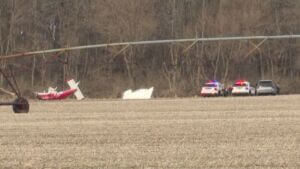 dead following a small plane crash Friday afternoon in Whiteside County, according to state police.
Authorities said the plane crashed around 3 p.m. March 20 in the area of Thome and McNiel roads near Route 40 in Rock Falls. The intersection is about a half-mile south of the Whiteside County Airport.
According to the Federal Aviation Administration, the plane was a Piper PA28 and only the pilot was on board.
Illinois State Police said there are no road closures related to the incident and the investigation is ongoing.
The FAA says it and the National Transportation Safety Board are handling the investigation, with the NTSB being the lead agency.
https://www.wifr.com/2026/03/20/1-dead-after-small-plane-crash-whiteside-county/
Plane crashes during takeoff in Upper Captiva; no injuries reported
Reporter: Lauren Halpern
UPPER CAPTIVA, Fla. (WINK) — A small single-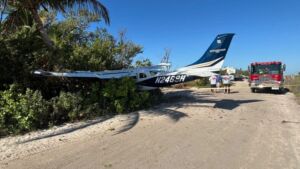 engine Cessna plane crashed while taking off on Upper Captiva Island, and all five people on board survived.
WINK News reporter Lauren Halpern was on the scene and spoke with a witness who was right under the plane as it came down. The plane was taking off on a grass runway when its right wing clipped a fence, causing it to spin off to the right and crash about 20 feet from the fence.
Peter Raby was traveling on a nearby road on his golf cart when the plane started getting too close.
"As he was catching up to pass me, he got close to the fence and only about six inches of his wing got clipped off because of the fence, and then it went back into the field, and then jumped over the top of me, and it all happened like this," Raby said.
Raby said there was a moment of silence before he realized there were children on board—a 3-month-old and a 4-year-old.
"Once I got the door open, they handed them out to me, and it was good, because they were both alive," Raby said. "But you know, for her to be frozen, she was frozen. And it's not screaming like the 3-month-old."
Raby said first responders from Upper Captiva arrived almost instantly. At first, they thought he might have been the one trapped inside.
"He said, 'You're not going anywhere. Sit here'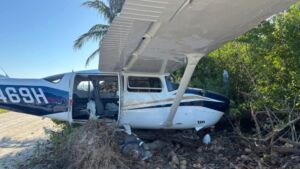 because I was freaking, and they got the kids out, or maneuvered the kids, the adults gradually got out of the plane, and they were all safe," Raby said. "So everybody could walk. Everybody was, you know, and the kids especially were handled well."
he Lee County Sheriff's Office confirmed five people were on board. Remarkably, no one was hurt.
"It isn't a movie, and it's not TV," Raby said. "It was real life, and it was happening."
The FAA is now leading the investigation into what happened during takeoff.
Plane landed at the Vernon Airport Saturday without its front landing gear
By Darren Handschuh
UPDATE: 5:10 p.m.
Vernon Airport reported that at approximately 1:30 p.m. Saturday, a privately registered twin-engine aircraft notified officials of a mechanical issue involving its nose landing gear.
''As a safety precaution, emergency response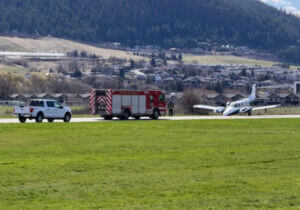 teams were dispatched for the standby. The aircraft, with one person on board, landed safely at approximately 1:48 p.m,'' said Jessica Hewitt, manager of communications for the City of Vernon.
Vernon Fire Rescue Services, RCMP, and BC EHS attended the scene.
The airport was briefly closed to air traffic but has since reopened.
ORIGINAL: 3:18 p.m.
There were some scary moments Saturday when a twin-engine airplane made an emergency landing at the Vernon Airport.
The aircraft landed without the front landing gear of the plane engaged. The plane came to rest on the tarmac fully intact and did not sustain too much damage.
It is not known how many people were on the plane or if anyone was injured.
Ryan Cecchini, who is a pilot himself, said he saw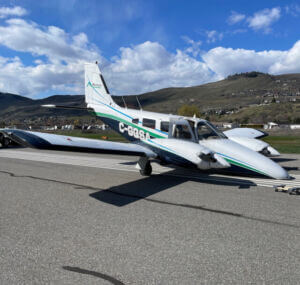 the plane fly over the area.
“He was flying over the Foothills when I realized the nose gear was not down enough,” Cecchini said. “It was kind of odd what he was doing over the hills. He was buffeting the plane in an attempt to knock it free.”
Cecchini then made his way to the airport where he saw the plane on the runway along with a fire truck and another white truck.
Castanet has reached out out to the city and Vernon Fire Rescue Services for comment.
NTSB Final Report: Lockwood Air Cam
Outboard Section Of The Left Wing Was Separated From The Airplane, With Witness Marks Showing Impact On Both The Tower Mast And Top Guy Wire
Location: Ranchitos Las Lomas, Texas Accident Number: CEN24FA101
Date & Time: January 29, 2024, 14:41 Local Registration: N315GW
Aircraft: Lockwood Air Cam Aircraft Damage: Substantial
Defining Event: Low altitude operation/event Injuries: 2 Fatal
Flight Conducted Under: Part 91: General aviation - Personal
Analysis: The pilot was flying low over his ranch when the airplane impacted a 197-ft marked meteorological evaluation tower (MET) about 192 ft above ground level (agl). The outboard section of the left wing was separated from the airplane, with witness marks showing impact on both the tower mast and top guy wire. The airplane impacted terrain in an inverted attitude about 238 ft from the tower.
A review of the airplane instruments revealed that the altimeter setting was 30.36 inches of mercury (inHg). The nearest automated weather station reported an altimeter setting of 30.25 inHg about 25 minutes after the accident. The difference between the two settings would have placed the airplane 110 ft below the indicated altitude on the altimeter. The pilot had accumulated about 95 hours in the accident airplane since he completed building it in September 2023.
Postaccident examination of the airplane revealed no mechanical failures or malfunctions that would have precluded normal operation. The pilot’s postmortem toxicology testing detected one metabolite of delta-8- tetrahydrocannabinol (delta-8 THC); the non-psychoactive metabolite carboxy-delta-8-THC was present in cavity blood and liver specimens tested. Testing also detected gabapentin in the cavity blood and liver specimens, and alprazolam in the liver specimen.
Gabapentin is used to treat nerve pain and certain types of seizures. It can cause sedation and dizziness and can impair coordination and performance of tasks such as driving and operating heavy machinery. Gabapentin typically carries a warning that the drug may interact with alcohol or other sedating medications to worsen sleepiness and dizziness. Alprazolam, sometimes marketed as Xanax, is a high-potency benzodiazepine drug available as a prescription oral medication commonly used to treat anxiety and panic disorder. In addition to medicinal use, alprazolam commonly is misused. Alprazolam can cause sedation and psychomotor impairment, with adverse effects on tracking, attention, and reaction speed. Alprazolam typically carries a warning against engaging in hazardous occupations requiring mental alertness such as operating machinery or driving a motor vehicle.
The FAA considers gabapentin and alprazolam to be “Do Not Issue/Do Not Fly” medications, and regular use of either drug for any reason is disqualifying for pilot medical certification. The pilot’s use of cannabis, alprazolam, and/or gabapentin may have affected his judgement.
However, based solely on the postmortem toxicology testing results and the accident circumstances, the level of the pilot’s possible impairment, if any, could not be determined.
Probable Cause and Findings: The National Transportation Safety Board determines the probable cause(s) of this accident to be -- The pilot's failure to maintain clearance from a meteorological evaluation tower.
FMI: www.ntsb.gov
NTSB Final Report: Davis DA-3
The Airplane Came To Rest Adjacent To A Large Tree About 1.4 Miles South-Southwest Of The Departure Airport
Location: Antlers, Oklahoma Accident Number: CEN24FA148
Date & Time: April 4, 2024, 16:33 Local Registration: N88DT
Aircraft: Davis DA-3 Aircraft Damage: Destroyed
Defining Event: Unknown or undetermined Injuries: 3 Fatal
Flight Conducted Under: Part 91: General aviation - Personal
Analysis: The private pilot and two passengers departed in the experimental airplane into day visual flight rules conditions for a local personal flight. A witness reported that the airplane departed to the south, and that the takeoff seemed routine and there were no obvious anomalies with the airplane.
About 15 to 20 minutes later, local authorities received a report of an explosion. Upon arriving at the site, first responders observed the airplane with an active fire. There were no known witnesses to the accident itself, and no ADS-B data related to the accident flight was located. The airplane came to rest adjacent to a large tree about 1.4 miles south-southwest of the departure airport. A post-impact fire consumed portions of the fuselage and charred the large tree and low brush in the surrounding area.
The airplane exhibited impact and postimpact fire damage. Portions of the fuselage and both wings were consumed by fire. Flight control continuity was confirmed from each control surface to the cockpit area. The engine was separated from the airframe and rested inverted on the ground near the fuselage. An examination did not identify any anomalies attributable to a preimpact failure or malfunction. The propeller was consumed by the postimpact fire; however, the retaining plates and propeller attachment bolts were intact. No evidence of an inflight failure or separation of the propeller was observed.
Although the extent of the postimpact fire limited the scope of the wreckage examinations, no evidence of an in-flight structural failure, flight control system anomaly, or inability of the engine and propeller to provide rated thrust were observed. The pilot’s coronary artery disease was associated with increased risk of an impairing or incapacitating cardiovascular event; however, there was no autopsy evidence that such an event had occurred.
The pilot’s postmortem toxicology results indicated use of the sedating antihistamine medication diphenhydramine, but the level in his postmortem heart blood was low. Detected norchlorcyclizine indicated the pilot also likely used another antihistamine medication long enough before the accident that the medication itself was no longer detectable in his blood.
Based on these results, there was no evidence that the pilot was experiencing any significant impairing effects at the time of the accident.
Probable Cause and Findings: The National Transportation Safety Board determines the probable cause(s) of this accident to be -- Impact with terrain for reasons that could not be determined.
FMI: www.ntsb.gov
NTSB Final Report: Seamax Aircraft LTDA Seamax M-22
After Three Aborted Upwind Water Takeoff Attempts Due To Water Washing Over The Cockpit Area And Obstructing The View, The Pilot Attempted A Downwind Takeoff
Location: Dahlgren Center, Virginia Accident Number: ERA25LA203
Date & Time: May 17, 2025, 16:00 Local Registration: N154RL
Aircraft: Seamax Aircraft LTDA Seamax M-22 Aircraft Damage: Substantial
Defining Event: Loss of control in flight Injuries: 1 Serious
Flight Conducted Under: Part 91: General aviation - Personal
Analysis: After three aborted upwind water takeoff attempts due to water washing over the cockpit area and obstructing the view, the pilot attempted a downwind takeoff that prevented the water from cresting over the cockpit. Video footage showed that, after what appeared to be a normal takeoff run, the airplane rotated and lifted off; however, during the initial climb the airplane appeared to struggle to ascend. The wings rocked back and forth as the airplane climbed to about 200 ft above the water surface. The pilot then made a left turn; shortly after, the left wing dropped, and the airplane abruptly descended in a left spiral until it impacted the water.
On-board engine parameter data showed normal engine operation until the moment of impact. Postaccident airframe and engine examination did not reveal any preimpact malfunction or anomaly that would preclude normal operation or performance. While taking off with a tailwind and during the subsequent climb, the pilot likely failed to maintain adequate airspeed during the turn, which resulted in the exceedance of the airplane’s critical angle of attack and an aerodynamic stall.
The airplane’s low altitude prevented recovery.
Probable Cause and Findings: The National Transportation Safety Board determines the probable cause(s) of this accident to be -- The pilot’s failure to maintain adequate airspeed and his exceedance of the airplane’s critical angle of attack during the initial climb, which resulted in an aerodynamic stall. Contributing to the accident was the pilot’s decision to take off with a known tailwind.
FMI: www.ntsb.gov
Today in History
32 Years ago today: On 23 March 1994 Aeroflot flight 593, an Airbus A310, crashed following a loss of control near Mezhduretshensk, Russia, killing all 75 occupants.
| Date: | Wednesday 23 March 1994 |
| Time: | 00:57 |
| Type: | Airbus A310-304 |
| Owner/operator: | Aeroflot Russian International Airlines |
| Registration: | F-OGQS |
| MSN: | 596 |
| Year of manufacture: | 1991 |
| Total airframe hrs: | 5375 hours |
| Cycles: | 846 flights |
| Engine model: | GE CF6-80C2A2 |
| Fatalities: | Fatalities: 75 / Occupants: 75 |
| Other fatalities: | 0 |
| Aircraft damage: | Destroyed, written off |
| Category: | Accident |
| Location: | near Mezhduretshensk - Russia |
| Phase: | En route |
| Nature: | Passenger - Scheduled |
| Departure airport: | Moskva-Sheremetyevo Airport (SVO/UUEE) |
| Destination airport: | Hong Kong-Kai Tak International Airport (HKG/VHHH) |
| Investigating agency: | MAK |
| Confidence Rating: | Accident investigation report completed and information captured |
Narrative:
Aeroflot flight 593, an Airbus A310, crashed following a loss of control near Mezhduretshensk, Russia, killing all 75 occupants.
The aircraft was en route from Moscow to Hong Kong at 10100 m when, approaching the Novokuznetsk reporting point, the captain's daughter entered the cockpit. She was allowed to sit the left-hand seat while the captain demonstrated some autopilot features, using HDG/S and NAV submodes to alter the heading. The captain's son then took the left front seat. The captain intended to demonstrate the same manoeuvre when his son asked if he could turn the control wheel. He then turned the wheel slightly (applying a force of between 8-10 kg) and held it in that position for a few seconds before returning the wheel to the neutral position. The captain then demonstrated the same features as he did to his daughter and ended by using the NAV submode to bring the aircraft back on course. As the autopilot attempted to level the aircraft at its programmed heading, it came in conflict with the inputs from the control wheel which was blocked in a neutral position. Forces on the control wheel increased to 12-13 kg until the torque limiter activated by disconnecting the autopilot servo from the aileron control linkage. The autopilot remained engaged however. The aircraft then started to bank to the right at 2,5deg/sec, reaching 45deg. when the autopilot wasn't able to maintain altitude. The A310 started buffeting, which caught the attention of the captain who told the co-pilot to take control while he was trying to regain his seat. The seat of the co-pilot was fully aft, so it took him an additional 2-3 seconds to get to the control wheel. The bank continued to 90 degrees, the aircraft pitched up steeply with +4,8g accelerations, stalled and entered a spin. Two minutes and six seconds later the aircraft struck the ground.
CONCLUSIONS
The A310 disaster was caused by a stall, spin and impact with the ground resulting from a combination of the following factors:
1. The decision by the PIC to allow an unqualified and unauthorized outsider (his son) to occupy his duty station and intervene in the flying of the aeroplane.
2. The execution of demonstration manoeuvres that were not anticipated in the flight plan or flight situation, with the PIC operating the autopilot while not at his duty station.
3. Application by the outsider and the co-pilot of control forces that interfered with the functioning of the roll channel of the autopilot (and are not recommended in the A310 flight manual), thus overriding the autopilot and disconnecting it from the aileron control linkage.
4. The co-pilot and PIC failed to detect the fact that the autopilot had become disconnected from the aileron control linkage, probably because:
- The A310 instrumentation has no declutch warning. The provision of signals in accordance with the requirements of Airworthiness Standard NLGS-3, para. 8.2.7.3., and international recommended practices, could have enabled the crew to detect the disengaged autopilot in a timely manner.
- The co-pilot and PIC may have been unaware of the peculiarities of the declutching function and the actions to be taken in such a situation because of a lack of appropriate information in the flight manual and crew training programme;
- It was difficult for the co-pilot to detect the disengagement of the autopilot by feel, either because of the small forces on his control column or because he took changing forces to be the result of Eldar's actions;
- The PIC was away from his position and distracted by the conversation with his daughter.
5. A slight, unintentional further turn of the control wheel(s) following disengagement of the autopilot caused a right roll to develop.
6. The PIC and co-pilot failed to detect the excessive right bank angle, which exceeded operating limits, and were late in re-entering the aircraft control loop because their attention was focussed on determining why the aircraft had banked to the right, a manoeuvre they interpreted as entry into a holding area with either no course line or with a new (false) course line generated on the navigational display.
A strong signal indicating that the aeroplane had exceeded the allowable operating bank angle, taking account of the delay in recognizing and assessing the situation and making a decision, could in this situation have attracted the crew's attention and enabled them to detect the bank at an earlier stage.
7. The aeroplane was subjected to buffeting and high angles of attack because the autopilot continued to perform its height-keeping function even after the actuator declutched and as the right roll developed, until the pilot disconnected it by overriding its longitudinal channel.
8. Inappropriate and ineffective action on the part of the co-pilot, who failed to disconnect the autopilot and to push the control column forward when the buffeting occurred and the aeroplane entered an unusual attitude (high angles of attack and pitch). These actions, which caused the aeroplane to stall and spin, could have resulted from:
- the presence of an outsider in the left-hand pilot's seat and the resulting delay before the PIC re-entered the aeroplane control loop;
- the less-than-optimum working posture of the co-pilot, whose seat was pushed back to its rearmost position;
- the occurrence, 2 seconds following the onset of buffeting, of an unintentional pitching up of the aeroplane, which sharply increased the angle of attack and reduced lateral controllability;
- unpreparedness of the crew to act in this situation because of lack of appropriate drills in the training programme;
- temporary loss of spatial orientation in night conditions.
