Here's what I have for today...
Be safe out there!
Tom
-
UPDATE: NY Crash Fire Truck Transponder Issue, Swiss Cheese, Survey
All,
Some interesting statements came out of this afternoon's update from NTSB. Their preliminary investigation into the fatal runway collision at LaGuardia Airport in New York late Sunday night suggests it was caused by an overlapping series of failures that stemmed from seemingly predictable problems with staffing and technology.
(Google: Swiss Cheese Model - SEE IMAGE BELOW)
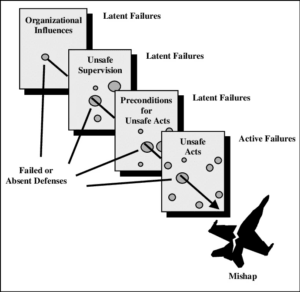
The Port Authority crash fire truck that got into that fatal crash with an Air Canada jet landing at LaGuardia Airport did not have transponders installed that could have helped air traffic controllers better track its movements, per the NTSB today.
While radio transmissions made it clear the fire truck and several other emergency vehicles were approaching the runway and were cleared by ATC, "transponders on all equipment would have allowed controllers in the tower to also see them on their instruments," NTSB chair Jennifer Homendy stated.
LaGuardia has a runway safety system allowing air traffic controllers to track surface movement of planes and vehicles, but that system "did not alert." Apparently, none of the emergency vehicles on the tarmac had tracking systems installed, including that Port Authority fire truck that was struck.
The NTSB analysis found that the system did not generate an alert due to the proximity of vehicles merging and unmerging near the runway, resulting in the inability to create a track of high confidence.
“The controllers should have all the tools they need to do their job,” she said at a press briefing at LaGuardia Airport this afternoon. “Whether it’s aircraft or vehicles moving in the taxiways, they should have it all.”
NTSB investigators have yet to interview the Port Authority Police Sergeant and Officer who were in the fire truck involved in the crash. The Sergeant was expected to be released from the hospital today, and the officer was released yesterday.
RELATED VIDEO & AUDIO FROM THE LAGUARDIA INCIDENT:
RADIO w/TOWER & FIRE APPARATUS:
https://www.youtube.com/shorts/GtkFA3IGibU
https://www.youtube.com/shorts/Chogd1quSmo
TODAY'S NTSB BRIEFING:
https://www.youtube.com/watch?v=SxDklYVkioU
REMINDER:
If you have a moment, please help out with this survey-THANKS!
https://www.surveymonkey.com/r/2026WFW
Questions are short and quick, asking you about issues such as:
-How often are your firefighters training?
-Is that training realistic and relevant?
The details shared through this survey will be posted and shared when complete.
Take Care. Be Careful. Pass It On.
BillyG
The Secret List 3/24/2026-1558 Hours

NTSB Prelim: Stinson 108-3
According To The Pilot, The Engine “Coughed/Sputtered” After He Rapidly Increased The Throttle
Location: Gypsum, CO Accident Number: CEN26LA087
Date & Time: January 11, 2026, 14:08 Local Registration: N6725M
Aircraft: Stinson 108-3 Injuries: 1 Minor
Flight Conducted Under: Part 91: General aviation - Personal
On January 11, 2026, at 1408 mountain standard time, a Stinson 108-3 airplane, N6725M, sustained substantial damage when it was involved in an accident near Gypsum, Colorado. The pilot sustained minor injuries. The airplane was operated as a Title 14 Code of Federal Regulations Part 91 personal flight.
According to the pilot, before the flight the airplane’s fuel system contained about 17 gallons that was evenly distributed between the left and right fuel tanks. He intended to takeoff and conduct a full stop landing at the unnamed private airstrip before continuing to Mc Elroy Airfield (20V), Kremling, Colorado.
The pilot reported that the takeoff was to the southeast and he flew a teardrop pattern to return to land toward the northwest. As he maneuvered the airplane back toward the airstrip, he selected carburetor heat on, propeller control full forward, and kept the mixture setting leaned for the high-altitude engine operation. He subsequently turned off the carburetor heat when the airplane was on final approach and the landing was assured.
The pilot increased the throttle a couple times after the airplane entered an area of sinking air associated with the canyons beneath the airplane’s flight path. He noted that these throttle responses were normal. However, during short final approach, about 25 ft above the ground, the airplane encountered additional sinking air and he “sharply” increased the throttle from near idle to an intermediate position. According to the pilot, the engine “coughed/sputtered” after he rapidly increased the throttle.
The pilot reported that due to the low altitude of the airplane and its proximity to the runway, he continued at a higher-than-normal rate of descent toward the runway. The pilot attempted to flare the airplane as it approached the runway threshold, but it “pancaked” onto the runway and slid to a stop in a nose down pitch attitude.
Based on law enforcement photos, the airplane contacted tree tops and then dispersed broken tree branches beneath the airplane’s flight path about 30 yards from where the airplane came to rest on the runway.
The airplane’s welded steel-tube fuselage and engine mount sustained substantial damage during the hard landing. Both propeller blades exhibited impact-related damage consistent with propeller rotation at impact.
A review of the airplane’s digital engine monitor data did not reveal any evidence of an engine malfunction during the 2 minute 36 second flight. However, due to the device’s 6-second recording interval there was insufficient data to confirm a loss of engine power before the hard landing and interruption of electrical power.
The airplane wreckage was recovered to a secure storage facility for further examination.
FMI: www.ntsb.gov
Today in History
48 Years ago today: On 25 March 1978 A Burma Airways Fokker F-27 Friendship crashed shortly after takeoff from Yangon-Mingaladon Airport, Myanmar , killing all 48 occupants.
| Date: | Saturday 25 March 1978 |
| Time: | 06:58 |
| Type: | Fokker F-27 Friendship 200 |
| Owner/operator: | Burma Airways |
| Registration: | XY-ADK |
| MSN: | 10235 |
| Year of manufacture: | 1963 |
| Total airframe hrs: | 28634 hours |
| Cycles: | 30355 flights |
| Fatalities: | Fatalities: 48 / Occupants: 48 |
| Other fatalities: | 0 |
| Aircraft damage: | Destroyed, written off |
| Category: | Accident |
| Location: | ca 16 km N of Yangon-Mingaladon Airport (RGN) - Myanmar |
| Phase: | Initial climb |
| Nature: | Passenger - Scheduled |
| Departure airport: | Yangon-Mingaladon Airport (RGN/VYYY) |
| Destination airport: | Myitkyina Airport (MYT/VYMK) |
| Confidence Rating: | Information is only available from news, social media or unofficial sources |
Narrative:
A Burma Airways Fokker F-27 Friendship crashed shortly after takeoff from Yangon-Mingaladon Airport, Myanmar , killing all 48 occupants.
The aircraft lost height following takeoff from runway 06 and struck trees located 400 feet right of the extended centreline. Control was lost and the aircraft crashed in a paddy field bursting into flames.
