We close out the week with these stories...
Have a safe weekend!
Tom
-
3 dead after helicopter crash at Kalalau Beach on Kauai
by: Trent Unebasami
HANALEI, Kauai (KHON2) — Three people have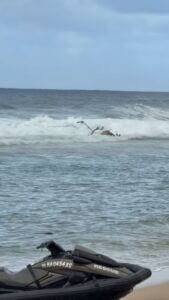 died after a helicopter crash at Kalalau Beach.
Officials said it happened around 3:45 p.m. on Thursday, March 26.
Fire officials, the United States Coast Guard and the Department of Land and Natural Resources responded to the incident.
Officials said that the helicopter was carrying one pilot and four passengers. Kauai County confirmed that three people died as a result of the crash, while two others are being treated at a hospital.
“First and foremost, I’d like to remind everybody to keep everyone involved in their thoughts and prayers a priority,” said Mayor Derek Kawakami. “Details on that are still coming in. All efforts are to focus on making sure everybody is safe.”
Kauai County said that preliminary reports indicate the helicopter belongs to Airborne Aviation. KHON2 has reached out to the company and is waiting to hear back.
https://www.khon2.com/kauai-news/helicopter-crash-kauai-beach/
Advisory Circulars Update Notification
The following advisory circular has recently been added/updated.
150/5210-13D - Draft AC 150/5210-13D, Airport Water Rescue Plans and Equipment

Williston appoints airport director, fire chief
MDN STAFF
WILLISTON – The City of Williston has announced Ryan O’Rear as airport director for Williston Basin International Airport (XWA) and Corey Johnson as fire chief for the Williston Fire Department following the recent appointment approvals by the Williston City Commission.
O’Rear was selected following a comprehensive recruitment and interview process that included a strong pool of applicants from both within and outside the region. He has most recently served as interim airport director after holding the role of assistant airport director.
With more than a decade of aviation experience, including service with the City of Williston since 2013, O’Rear brings an understanding of the Williston airport’s operations, regulatory environment and strategic direction. His background includes prior experience as an airport manager and operational experience at a large commercial service airport.
“Ryan has been instrumental in the success and stability of the airport, particularly during this transition,” said City Administrator Shawn Wenko. “His knowledge of the operation, strong relationships within the aviation community and forward-thinking approach make him well-suited to lead XWA into the future.”
“It is a privilege to step into this role and continue serving the community I’ve been a part of for many years,” O’Rear said. “XWA plays an important role in connecting our region to the rest of the country, and I look forward to working with our team and partners to keep improving the travel experience here in Williston.”
O’Rear holds a Bachelor of Science degree in aviation technology/management and maintains multiple professional certifications through the American Association of Airport Executives. He also has been recognized at the national level as a recipient of the National Business Aviation Association’s “40 Under 40” award.
Johnson was selected following a months-long recruitment and interview process that included several qualified candidates. He has been serving as interim fire chief and previously held the position of assistant chief of Operations. He brings more than 18 years of fire service and emergency medical experience, including a decade of service with the City of Williston, where he has progressed through the ranks from firefighter to battalion chief and into executive leadership.
“I am deeply honored to be selected to lead the men and women of the Williston Fire Department. Having spent the last decade growing alongside this department, I have a profound respect for our mission and the community we serve. As chief, I remain committed to the safety of our residents and the well-being of our firefighters. My focus moving forward will be on fostering a culture of continuous improvement and ensuring our department remains a leader in public safety for years to come,” Johnson said.
“Corey has earned the respect of his peers and leadership through his work ethic, professionalism and ability to lead in challenging situations,” said Commissioner James Bervig. “He understands this department from the ground up and has shown he can bring people together while keeping the focus on service, safety and accountability.”
Johnson holds a Bachelor of Science degree in fire administration and maintains numerous professional certifications. He is also actively involved at the state and national levels as a fire service instructor and advocate for public safety initiatives.
NTSB Final Report: ELA ELA10
It Is Likely That The Pilot Did Not Have Sufficient Rotor To Avoid Rotor Flap During The Takeoff Roll...
Location: Morris, Illinois Accident Number: CEN26LA081
Date & Time: December 23, 2025, 13:36 Local Registration: N396S
Aircraft: ELA ELA10 Aircraft Damage: Substantial
Defining Event: Miscellaneous/other Injuries: 1 None
Flight Conducted Under: Part 91: General aviation - Unknown
Analysis: The pilot taxied to the runway with the rotor still spinning from his previous landing, maintaining above a 100 rotor rpm on his gyroplane. As he taxied onto the runway, he noted his rotor rpm at 117 and he began to accelerate to build rotor speed, pitching back slightly. The pilot heard a loud pop and thinking he may have blown a tire on his right main landing gear, he glanced over to visually confirm it.
He then checked his rotor rpm and found it had decreased to 80. At that same time, the gyroplane began to shake and then quickly turned over on its right side and came to rest on the left side of the runway, which resulted in substantial damage to the empennage and main rotor. According to the manufacturer’s pilot operating handbook (POH), when taxiing the rotor is to be aligned with the gyroplane (stationary).
The rotor pre-rotation procedure instructs the pilot to “increase engine power slowly until reaching 220 rotor rpm” and has a caution message that states, “CAUTION Start the take-off with the rotor between 150-200 rpm requires a high skill. It is forbidden to proceed with take-off operations if the rotor is under 150 rpm.” It is likely that the pilot did not have sufficient rotor rpm to avoid rotor flap during the takeoff roll based on his statement. Whether the flat tire occurred during the takeoff or as a result of the gyroplane rolling over on its side was not determined.
Probable Cause and Findings: The National Transportation Safety Board determines the probable cause(s) of this accident to be -- The pilot’s failure obtain the proper rotor rpm before applying power for the takeoff roll which resulted in a loss of control.
FMI: www.ntsb.gov
Today in History
49 Years ago today: On 27 March 1977 KLM flight KL4805, a Boeing 747-200, and Pan Am flight PA1736, a Boeing 747-100, collided on the runway at Tenerife-Los Rodeos International Airport, killing all 248 occupants on the KLM aircraft and 335 occupants on the Pan Am flight.
| Date: | Sunday 27 March 1977 |
| Time: | 17:06 |
| Type: | Boeing 747-206B |
| Owner/operator: | KLM Royal Dutch Airlines |
| Registration: | PH-BUF |
| MSN: | 20400/157 |
| Year of manufacture: | 1971 |
| Total airframe hrs: | 21195 hours |
| Cycles: | 5202 flights |
| Engine model: | P&W JT9D-7W |
| Fatalities: | Fatalities: 248 / Occupants: 248 |
| Other fatalities: | 335 |
| Aircraft damage: | Destroyed, written off |
| Category: | Accident |
| Location: | Tenerife-Los Rodeos International Airport (TCI) - Spain |
| Phase: | Take off |
| Nature: | Passenger - Non-Scheduled/charter/Air Taxi |
| Departure airport: | Tenerife-Los Rodeos International Airport (TCI/GCXO) |
| Destination airport: | Las Palmas-Airport de Gran Canaria (LPA/GCLP) |
| Investigating agency: | CIAIAC |
| Confidence Rating: | Accident investigation report completed and information captured |
Narrative:
KLM flight KL4805, a Boeing 747-200, and Pan Am flight PA1736, a Boeing 747-100, collided on the runway at Tenerife-Los Rodeos International Airport, killing all 248 occupants on the KLM aircraft and 335 occupants on the Pan Am flight.
On March 27, 1977, at 12:30 local time a bomb exploded in the Las Palmas passenger terminal. Because of warnings of a possible second bomb, the airport was closed. A large number of flights were diverted to Tenerife, a.o. KLM Flight 4805 from Amsterdam and PanAm Flight 1736 (coming from Los Angeles and New York). Both aircraft were parked on a crowded apron until Las Palmas Airport opened to traffic again at 15:00.
Because the PanAm passengers had remained on aboard, it was possible to leave Tenerife immediately. However, the taxiways were congested by other aircraft. This meant the PanAm crew had to backtrack on runway 12 for takeoff on runway 30. The entrance to runway 12 however, was blocked by the KLM Boeing. The PanAm flight had to wait for almost two hours before all KLM passengers (except 1) had reboarded and refueling had taken place.
The KLM flight was then cleared to backtrack runway 12 and make a 180 degree turn at the end. Three minutes later (at 17:02) Pan Am 1736 was cleared to follow the KLM aircraft and backtrack runway 12. The PanAm crew were told to leave the runway at the third taxiway and report leaving the runway. At 17:05:44 KLM 4805 reported ready for takeoff and was given instructions for a Papa beacon departure. The KLM crew repeated the instructions and added "We are now at takeoff". The brakes were released and KLM 4805 started the takeoff roll.
Tenerife tower, knowing that Pan Am 1736 was still taxiing down the runway replied "OK ...... Stand by for takeoff, I will call you." This message coincided with the PanAm crew's transmission "No ... uh we're still taxiing down the runway, the Clipper 1736". These communications caused a shrill noise in the KLM cockpit, lasting approx. 3.74 seconds.
Tenerife tower replied: "Papa Alpha 1736 report runway clear.", whereupon the PanAm crew replied: "OK, will report when we're clear". This caused some concerns with the KLM flight engineer asking the captain: "Is he not clear then?" After repeating his question the captain answers emphatically: "Oh, yes".
A number of second before impact the KLM crew saw the PanAm Boeing still taxiing down the runway. The crew tried to climb away and became airborne after a 65 feet tail drag in an excessive rotation.
The PanAm crew immediately turned the aircraft to the left and applied full power. The KLM aircraft was airborne, but the fuselage skidded over the PanAm's aft fuselage, destroying it and shearing off the tail. The KLM aircraft flew on and crashed out of control 150 m further on, sliding another 300 m while bursting into flames.
PROBABLE CAUSE: "The KLM aircraft had taken off without take-off clearance, in the absolute conviction that this clearance had been obtained, which was the result of a misunderstanding between the tower and the KLM aircraft.
This misunderstanding had arisen from the mutual use of usual terminology which, however, gave rise to misinterpretation. In combination with a number of other coinciding circumstances, the premature take-off of the KLM aircraft resulted in a collision with the Pan Am aircraft, because the latter was still on the runway since it had missed the correct intersection."
