We kick off the new week with the following stories...
Of note, the story about Albuquerque police officers suing the federal government after a 2024 F-35 crash response exposed them to hazardous chemicals and caused ongoing medical issues....
Be safe out there!
Tom
-
Delta flight DL104 makes emergency landing in Brazil with engine fire: Here's what we know
After suffering a catastrophic engine failure, a Delta Airbus A330-300 bound for Atlanta returned to São Paulo. Burning fragments of the aircraft sparked a brush fire inside the airport.
Pablo Diaz (Diazpez)
A Delta Air Lines Airbus A330-300 suffered a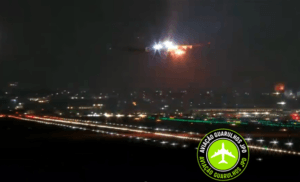 catastrophic failure in its left engine moments after rotating at Guarulhos International Airport (GRU) in São Paulo. The incident, which occurred on Sunday night, caused incandescent debris to fall onto vegetation alongside the runway, resulting in a brush fire within the airport grounds.
The aircraft, registration N813NW , was operating flight DL104 to Hartsfield-Jackson Atlanta International Airport. According to our partner Aeroin , the plane was carrying 288 people at the time of the incident. Witnesses on the ground and residents of the areas surrounding the runway reported multiple explosions followed by intense flames emanating from the engine.
Air traffic control immediately alerted the crew after spotting the fire from the tower. "Delta, you have a fire on your wings," the controller reported, to which the pilot responded by confirming the emergency and requesting an immediate return to the terminal. The aircraft aborted its climb at 4,500 feet to begin emergency approach procedures.
Technical details and operational response
The Airbus A330-300 involved is equipped with Pratt & Whitney PW4168A engines . These types of failures, which can be caused by foreign object ingestion ( FOD ) or a bird strike , usually activate the fire suppression systems integrated into the engine nacelle, which use Halon bottles to smother the combustion internally.
Because runway 10R/28L was closed for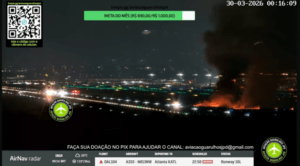 scheduled maintenance, the aircraft had to land on runway 10L , the same runway from which it had taken off just ten minutes earlier. The presence of metal debris on the runway and a fire in the adjacent grass forced airport management to temporarily suspend operations , affecting the schedules of other international flights.
Local context and security in Cumbica
The incident caused alarm in the outlying neighborhoods of Guarulhos and the northern part of São Paulo, densely populated areas located along Cumbica 's departure path . The rapid intervention of the airport firefighters was crucial not only in assisting the aircraft after landing but also in containing the grass fire, preventing smoke from affecting visibility for other ongoing operations.
Delta Air Lines will now have to coordinate the transfer of passengers and the technical inspection of the aircraft, which remains out of service on one of the taxiways. The investigation will be handled by CENIPA (Center for Research and Prevention of Aeronautical Accidents) of Brazil, which will analyze whether it was indeed a bird strike, a possibility that had already been reported by another aircraft minutes before the takeoff of flight DL104.
FBI responds after disruptive customer forces American Airlines flight diversion to DTW
By Nathan Vicar
The Brief
-
- American Airlines Flight 2819, en route from New York JFK to Chicago O’Hare, was diverted to Detroit Metropolitan Wayne County Airport (DTW) due to a disruptive passenger.
-
- FBI and airport police investigated the situation; authorities confirmed there was no public danger.
-
- Passengers deplaned safely, the aircraft was cleared, and the flight is expected to depart later Sunday afternoon.
ROMULUS, Mich. (FOX 2) - The FBI and airport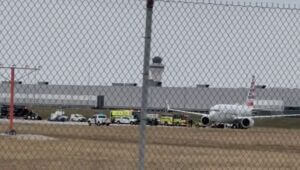 police responded Sunday afternoon after an American Airlines flight was diverted to Detroit Metropolitan Wayne County Airport (DTW) due to a disruptive customer, according to multiple spokespersons.
The backstory:
An American Airlines spokesperson confirmed Flight 2819 was diverted because of a disruptive customer.
After landing, the plane was removed from the runway, per airport procedure, and isolated while FBI agents and airport police vehicles surrounded the aircraft during an investigation near Middlebelt Road.
Officials said customers deplaned and waited in the terminal while law enforcement completed — and later cleared — a search of the aircraft out of an abundance of caution. The FBI confirmed in a statement that there is no threat to the public.
"We appreciate our customers for their patience and thank our crew for their professionalism," the airline said in a statement.
American Airlines expects the flight to depart DTW later Sunday afternoon.
Timeline:
According to FlightAware, the plane departed New York’s John F. Kennedy International Airport on Sunday morning bound for Chicago’s O’Hare International Airport before diverting to Detroit shortly after 11 a.m.
What we don't know:
It remains unclear what occurred onboard that prompted the diversion.
https://www.livenowfox.com/news/american-airlines-flight-diverted-detroit-metro-airport-fbi-investigating-disturbance?link_source=ta_first_comment&taid=69c984e60915a0000194d80a
First responders file lawsuit over chemical exposure during F-35 crash
By KOB
ALBUQUERQUE, N.M. – Eight Albuquerque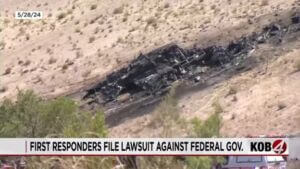 police first responders are suing the federal government, saying an F-35 crash response exposed them to hazardous chemicals and caused ongoing medical issues.
According to the claim, the Albuquerque Police Department officers responded after an F-35 fighter jet crashed in May 2024 just south of the Sunport after refueling at Kirtland Air Force Base.
The officers claim they were among the first people at the scene and were not told they needed to stay farther away.
They also claim no one told them they needed protective equipment while they responded to the crash site.
The lawsuit seeks damages for what the officers describe as ongoing medical issues tied to that exposure.
https://www.kob.com/new-mexico/first-responders-file-lawsuit-over-chemical-exposure-during-f-35-crash/
NTSB Prelim: Vans Aircraft RV-8
Witnesses Stated That The Pilot Appeared To Attempt To Recover From The Roll, And That The Airplane Was In A Wings Level Attitude Before It Impacted Terrain
Location: Hurricane, UT Accident Number: WPR26FA108
Date & Time: February 28, 2026, 10:05 Local Registration: N80AR
Aircraft: Vans Aircraft RV-8 Injuries: 1 Fatal
Flight Conducted Under: Part 91: General aviation - Personal
On February 28, 2026, at about 1005 mountain standard time, an experimental amateur-built, Vans Aircraft, RV-8, N80AR, was substantially damaged when it was involved in an accident near Hurricane, Utah. The pilot was fatally injured. The airplane was operated as a Title 14 Code of Federal Regulations Part 91 personal flight.
Pilot rated witnesses reported that the pilot was participating in a formation flying event, which was staged out of Saint George Regional Airport (SGU), Saint George, Utah. During the accident flight, the accident airplane was number two position of a flight of five. The pilot rated witnesses stated that they were flying about 500 ft above ground level (agl), at an airspeed of about 130 mph in an extended trail formation with about 800-1,000 ft of spacing between the airplanes.
The pilots who were in trail of the accident airplane reported that they observed the airplane pitch upward and roll to the left. The witnesses stated that the pilot appeared to attempt to recover from the roll, and that the airplane was in a wings level attitude before it impacted terrain.
Examination of the accident site revealed that the airplane impacted gradual up sloping desert terrain on a heading of 200° magnetic, at an elevation of 4,538 ft mean sea level. The first identified point of contact (FIPC) was a ground scar, about 30 ft in length and 15 ft wide, which contained propeller blades, engine cowling, and fragments of the rudder. The debris path was about 247 ft in length, and about 70 ft wide, oriented on a heading of about 200° magnetic from the FIPC to the main wreckage.
The second ground disturbance, about 6 ft by 4 ft in diameter, was about 176 ft from the FIPC and contained various non-secured items from inside the airplane. A third ground disturbance, which consisted of an area of displaced dirt, was observed about 199 ft from the FIPC and extended to the main wreckage.
The fuselage came to rest inverted on a heading of about 175° magnetic. The instrument panel, engine, and engine mount, were located in an upright position. All major structural components of the airplane were accounted for at the accident site. The airplane was recovered to a secure location for further examination.
FMI: www.ntsb.gov
NTSB Prelim: Piper PA-12
Student Was On His Last Day Of Tailwheel Endorsement Training, And They Were Conducting Two And Three-Point Takeoff And Landings
Location: Lockhart, TX Accident Number: CEN26LA137
Date & Time: March 7, 2026, 13:23 Local Registration: N2511M
Aircraft: Piper PA-12 Injuries: 2 Minor
Flight Conducted Under: Part 91: General aviation - Instructional
On March 7, 2026, about 1323 central standard time, a Piper PA-12, N2511M, was substantially damaged when it was involved in an accident near Lockhart, Texas. The pilot and passenger sustained minor injuries. The airplane was operated as a Title 14 Code of Federal Regulations Part 91 instructional flight.
The flight instructor reported that the airplane had about 25 gallons of fuel on board and the weight of the airplane was about 1,700 pounds. His student was on his last day of tailwheel endorsement training, and they were conducting two and three-point takeoff and landings. The instructor had checked the weather at Austin-Bergstrom International Airport (KAUS), Austin, Texas, and noticed the winds were coming from the north. He stated winds were calm at Lockhart after looking at the windsock. They had made a full stop landing to the south on the grassy area between runway 18 and the taxiway. After the full stop landing, the instructor estimated that they had 900-1,000 feet of runway remaining. The instructor stated the airplane routinely takes off in 700-800 feet of runway.
He opted to have the student perform the takeoff from this location. During the takeoff they heard a loud bang right after rotation. The airplane “wobbled” to the right and dipped down and the instructor pulled back. They did a three-point landing but collided with a fence and a tree resulting in substantial damage to the wings and fuselage.
A review of recorded winds from a privately operated weather station in Lockhart, TX, showed the wind was out of the south but shifted to the west and then the north close to the time of the accident. The wind from the north was 10-15 knots with gusts between 15-20 knots. The airplane was equipped with a Lycoming O-320-A2B engine, tundra tires, and a Sensenich propeller.
The airplane was also equipped with two video cameras. One mounted on the right wing looking towards the cockpit and one mounted in the upper right corner of the windscreen looking at the two pilots. The video provided shows the landing before the accident and the takeoff accident itself. The video was retained by the NTSB and will be reviewed in further detail.
FMI: www.ntsb.gov
NTSB Final Report: Kolb Company Firestar KXP
The Pilot’s Toxicology Results Identified Multiple Potentially Impairing Substances Including Diphenhydramine, Gabapentin, And Venlafaxine
Location: Cave Junction, Oregon Accident Number: WPR24FA104
Date & Time: March 7, 2024, 11:24 Local Registration: N4443G
Aircraft: Kolb Company Firestar KXP Aircraft Damage: Substantial
Defining Event: Aerodynamic stall/spin Injuries: 1 Fatal
Flight Conducted Under: Part 91: General aviation - Personal
Analysis: The pilot had recently installed an overhauled engine and decided to depart for a local flight. Witnesses observed that the pilot was in good spirits and that, after takeoff, the airplane turned left to the northwest, about 500 ft above ground level (agl). The airplane continued to turn left back towards the airport environment on a 30° to 40° bank angle (to the southeast). The witnesses stated that they saw the airplane descend about 100 ft in a slightly nose-down pitch attitude and subsequently entered a 90° nose-down attitude toward the ground. The airplane impacted the ground and came to rest in an open field, sustaining substantial damage to the fuselage and wings. Multiple witnesses confirmed that the engine was producing power. Examination of the wreckage did not reveal any mechanical anomalies to the airframe or engine.
The pilot’s toxicology results identified multiple potentially impairing substances including diphenhydramine, gabapentin, and venlafaxine, all of which may adversely and unpredictably interact with one another to cause sedation, decreased reaction time, and impaired cognition. Venlafaxine may induce mania in people with bipolar disorder if used on its own to treat depression without an additional mood stabilizing medication. Based on information obtained from the patient’s family, the pilot had severe depression and bipolar disorder. The details of the pilot’s illness and his response to treatment are unknown. An episode documented by law enforcement the night before the accident was consistent with the pilot experiencing acute behavioral symptoms at that time. In people with bipolar disorder, the occurrence of acute symptoms decreases the threshold for further episodes, making the episodes occur more frequently if medical intervention is not provided. Additionally, bipolar disorder in people over 50 years of age increases the risk of cognitive defects including decreased executive function, impaired information processing speed, and impaired memory.
Additionally, bipolar disorder is a disqualifying psychiatric condition that is required to be evaluated by a Federal Air Surgeon. The pilot never reapplied for a medical after he allowed it to lapse in 2002 and there are no records he was evaluated. With the available evidence, it is not possible to discern to what degree the effects of the medications used, as opposed to the pilot’s bipolar disorder, contributed to the accident. The pilot’s coronary artery disease placed him at some increased risk of a sudden impairing or incapacitating cardiac event, such as angina, arrhythmia, or heart attack, but there was no autopsy evidence that such an event occurred. However, such an event does not leave reliable autopsy evidence if it occurs immediately before death. Thus, whether the pilot's coronary artery disease contributed to the crash cannot be determined. The pilot's use of multiple potentially impairing substances and his bipolar disorder likely would have contributed to a diminished state of health during any attempts to recover the airplane after control was lost, given the pilot's experience with the airplane and the circumstances of the accident. The airplane was likely in an uncoordinated left turn (skid) as it turned back toward the airport. The lower (left) wing entered an aerodynamic stall initially during this skidding left turn, resulting in a nose-down pitch attitude, as is typical of straight-wing airplanes. The FAA suggests a margin of at least 1,500 ft agl for single-engine airplanes to recover from a full stall. Although the pilot was a certificated flight instructor and experienced pilot, his use of potentially impairing substances and medical history likely influenced his reaction time to recover from the stall at 500 ft agl. There was insufficient evidence to ascertain the specific recovery inputs the pilot implemented.
Probable Cause and Findings: The National Transportation Safety Board determines the probable cause(s) of this accident to be -- The pilot's exceedance of the airplane's critical angle of attack during a turn, which resulted in an aerodynamic stall. Contributing to the accident was the pilot's use of potentially impairing substances with bipolar disorder, which resulted in a decreased reaction time during a stall recovery at a low altitude.
FMI: www.ntsb.gov

Today in History
59 Years ago today: On 30 March 1967 Delta Air Lines flight 9877, a Douglas DC-8-50, crashed following a loss of control in New Orleans, Louisiana, USA, killing all 6 crew members and 13 persons on the ground.
| Date: | Thursday 30 March 1967 |
| Time: | 00:50 |
| Type: | Douglas DC-8-51 |
| Owner/operator: | Delta Air Lines |
| Registration: | N802E |
| MSN: | 45409/19 |
| Year of manufacture: | 1959 |
| Total airframe hrs: | 23391 hours |
| Engine model: | P&W JT3D-1 |
| Fatalities: | Fatalities: 6 / Occupants: 6 |
| Other fatalities: | 13 |
| Aircraft damage: | Destroyed, written off |
| Category: | Accident |
| Location: | New Orleans, LA - United States of America |
| Phase: | Approach |
| Nature: | Training |
| Departure airport: | New Orleans International Airport, LA (MSY/KMSY) |
| Destination airport: | New Orleans International Airport, LA (MSY/KMSY) |
| Investigating agency: | NTSB |
| Confidence Rating: | Accident investigation report completed and information captured |
Narrative:
Delta Air Lines flight 9877, a Douglas DC-8-50, crashed following a loss of control in New Orleans, Louisiana, USA, killing all 6 crew members and 13 persons on the ground.
Delta Air Lines DC-8-51 N802E was scheduled as Flight DL9877, to provide crew training for a captain-trainee and a flight engineer-trainee. In addition the flight engineer-instructor was being given a routine proficiency check.
At 23:14 a weather briefing was given to the instructor pilot, indicating, "... the only significant weather was a restriction in visibility which was expected to reduce to about two miles in fog and smoke near 0600...".
The flight departed the ramp at 00:40 with the captain-trainee in the left seat and the check captain in the right seat. At 00:43 the crew advised the tower they were ready for takeoff and would "...like to circle and land on one (runway 1)." The tower controller then cleared them as requested. The aircraft was observed to make what appeared to be a normal takeoff and departure. At 00:47 the crew reported on base leg for runway 1, and the controller cleared the flight to land. A subsequent discussion revealed that they would execute a simulated two-engine out approach, execute a full stop landing and then takeoff on runway 19.
The tower controller observed Flight 9877 in a shallow left turn on what appeared to be a normal final approach. The degree of bank increased to approximately 60 degrees or greater when the aircraft hit the power lines approximately 2,300 feet short and 1,100 feet west of the runway threshold. The DC-8 crashed into a residential area, destroying several homes and a motel complex.
PROBABLE CAUSE: "Improper supervision by the instructor, and the improper use of flight and power controls by both instructor and the Captain-trainee during a simulated two-engine out landing approach, which resulted in a loss of control."
