Here are the stories for today...
Be safe out there!
Tom
-
Philadelphia training aircraft lost power before crash that injured 2, including off-duty officer
By 6abc Digital Staff and Briana Smith
PHILADELPHIA (WPVI) -- A small training aircraft crashed into a tree Wednesday afternoon in Fluehr Park in the Torresdale section of Philadelphia, seriously injuring a flight instructor and a student pilot who is an off-duty city police officer.
Police blocked off the park as investigators examined the wreckage of the Piper Pilot 100i, which went down around 3:45 p.m. after flying for about 40 minutes.
"It's a miracle," said Stephen Sergi, a Holy Family University professor who witnessed the aftermath.
Fly Legacy Aviation, the company that owns the aircraft, said it was stunned by the crash. They've been in business for 11 years and are based at the Northeast Philadelphia Airport.
General Manager Alex Souponetsky said the men were returning to the airport when the plane lost engine power over the Delaware River.
"I'm just very grateful everybody is alright," he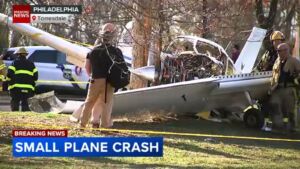 said. "This is not common. This is our first accident. We have 30 flights every day. We have a fleet of 24 airplanes. We have over 200 students with thousands of graduates."
Souponetsky said the pilots reported engine trouble over the radio and attempted to glide back toward the airport.
"Very grateful to the skill and knowledge of our instructor who took control of the plane and started gliding it towards the airport and he almost made it," he said.
Emergency crews rushed to the scene to free the trapped occupants.
"They were pulling him out, and he was screaming in pain," Sergi said.
Philadelphia Fire Commissioner Jeffrey Thompson said both men were conscious when first responders arrived.
"They were both alert and oriented. We were very fortunate there was no resulting fire," he said. "We were very lucky. This is a residential neighborhood, so this could have been very different."
Thompson also said a small fuel spill occurred, and a hazmat team responded to the scene.
Residents and witnesses described the crash as frightening, but said they were relieved the outcome wasn't worse.
"I'm glad everyone got out," said Amanda Cappo, who lives nearby. "We get nervous with the planes around here. We see them all the time. It gets nervous with them training."
Sergi, whose university sits across from the park, said he often worries about low-flying training aircraft.
"I tell my students, 'What are you thankful for today?' I always say, 'I'm thankful one of those planes didn't hit one of the buildings at the college,'" he said. "Everybody is really lucky, including the occupants."
Souponetsky said the aircraft has regular inspections, and he does know why the engine lost power.
"This is a new plane also. It was built in 2021. In the flight training industry, this is a brand-new airplane," he said. "They've been constantly inspected. We're a flight school, so we have to abide by the strictest guidelines on maintenance."
The National Transportation Safety Board and Federal Aviation Administration are investigating the cause of the crash.
https://6abc.com/amp/post/small-plane-crashes-park-philadelphias-torresdale-neighborhood/18823758/
NTSB Final Report: Cameron Balloons US A-225
Pilot Determined That The Planned Landing Area Did Not Provide Sufficient Room For A Safe Landing Due To The Increase In Wind Speed
Location: Albuquerque, New Mexico Accident Number: WPR26LA052
Date & Time: November 24, 2025, 08:00 Local Registration: N980VA
Aircraft: Cameron Balloons US A-225 Aircraft Damage: None
Defining Event: Hard landing Injuries: 1 Serious, 1 Minor, 7 None
Flight Conducted Under: Part 91: General aviation - Business
Analysis: The hot air balloon pilot reported that he performed a safety briefing with all eight passengers before they boarded the balloon. During the flight the winds, which were forecasted to be about 3 knots at the time of landing, increased to 14 kts, gusting to 19 kts. The pilot determined that the planned landing area did not provide sufficient room for a safe landing due to the increase in wind speed and elected to divert to a more open area. The balloon crossed over a valley and encountered a downdraft, which the pilot said he unsuccessfully attempted to overcome using the gas burners. He activated the rapid-deflation system to help prevent dragging; the balloon touched down hard and was dragged by the wind as it deflated. The balloon landed hard at about 23 kts, which resulted in a serious injury to one of the passengers.
The pilot reported that there were no preaccident mechanical malfunctions with the balloon that would have precluded normal operations.
Probable Cause and Findings: The National Transportation Safety Board determines the probable cause(s) of this accident to be -- The balloon landing in increased wind, and the pilot’s inability to maintain the proper descent rate, which resulted in a hard landing.
FMI: www.ntsb.gov

Today in History
14 Years ago today: On 2 April 2012 UTair Aviation flight 120, an ATR 72-201, stalled and crashed shortly after takeoff from Tyumen-Roschino Airport, Russia, killing 33 occupants; 10 survived the accident.
| Date: | Monday 2 April 2012 |
| Time: | 07:35 |
| Type: | ATR 72-201 |
| Owner/operator: | UTair Aviation |
| Registration: | VP-BYZ |
| MSN: | 332 |
| Year of manufacture: | 1992 |
| Total airframe hrs: | 35523 hours |
| Cycles: | 49663 flights |
| Engine model: | P&W Canada PW124B |
| Fatalities: | Fatalities: 33 / Occupants: 43 |
| Other fatalities: | 0 |
| Aircraft damage: | Destroyed, written off |
| Category: | Accident |
| Location: | 1,6 km SW of Tyumen Airport (TJM) - Russia |
| Phase: | Initial climb |
| Nature: | Passenger - Scheduled |
| Departure airport: | Tyumen-Roschino International Airport (TJM/USTR) |
| Destination airport: | Surgut Airport (SGC/USRR) |
| Investigating agency: | MAK |
| Confidence Rating: | Accident investigation report completed and information captured |
Narrative:
UTair Aviation flight 120, an ATR 72-201, stalled and crashed shortly after takeoff from Tyumen-Roschino Airport, Russia, killing 33 occupants; 10 survived the accident.
Flight 120 took off from Tyumen Airport runway 21 on a regular domestic passenger flight to Surgut (SGC). The ATR-72 climbed to a height of 210 m and then banked 35° left, followed by a 50° right hand bank. It then struck a snowy field approx. 1,6 km past the end of the runway, broke up and a fire erupted.
The Interstate Aviation Committee stated that both engines were working properly at the time of the accident.
The Federal Air Transport Agency reported that the airplane had been parked outside for eight hours in weather conditions which included snow and temperatures at and just below freezing level. The airplane was not de-iced prior to departure and the crew did not insist on being de-iced.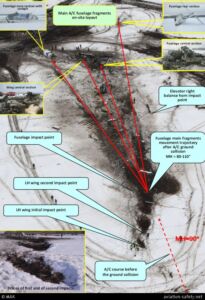
Causes:
The immediate cause of the ATR 72-201 VP-BYZ aircraft accident was the PIC's decision to takeoff without de/anti-icing treatment despite the fact that snow and ice deposits were present on aircraft surface and were discovered by the crew members during taxi which resulted in degradation of aircraft aerodynamic performance and stall during climbing after takeoff as well as inability of the crew to recognize stall and, consequently, failure to undertake recovery procedure.
The aircraft stall occurred at the operational angles of attack right after flaps retraction with engaged autopilot before stall warning system activation and was caused by the loss of the wing lift effectiveness due to takeoff with non-removed ground icing.
The system cause of the accident were shortcomings in ground handling activities and staff training in UTAir-Technik that became possible because of absence of due monitoring by the Technical and Operation Supervising Directorates of UTAir airline for compliance with airline requirements regarding ground handling and aircraft ground icing protection which resulted in erroneous evaluation of aircraft conditions by the PIC and aircraft mechanic (the shift head kept himself aloof from monitoring mechanic's activities) after the aircraft has been on ground in icing conditions for a long time and in release the aircraft to fly without de/anti-icing treatment.
The contributing factors were:
- The shortcomings in the UTAir safety management system, which contains, all in all, general issues only and is not adopted for the implementation of Airline activities in particular areas, which did not allow to reveal and correct existing safety risks in a timely manner.
- The shortcomings in the UTAir-Technic quality management system, resulted in neglecting of certain requirements of the UTAir ground handling management manual regarding staff training and monitoring for aircraft de/anti-icing treatment which led to the situation when not sufficiently-qualified staff performed the evaluation of the aircraft surface conditions and made the decision on need for the aircraft to be de-iced/anti-iced.
- The absence at the time of the accident of basic regulations in force that establish state requirements for ground handling (de/anti-icing treatment in particular) including staff training and organization licensing.
- The shortcomings in crewmembers initial and recurrent training as far as the danger of ground icing, its influence on the aircraft aerodynamic performance together with aircraft anti-icing system operation features and design are concerned that did not allow the crew to make the only appropriate decision to return for de-icing/anti-icing treatment after the observation of the snow and ice contamination on the wing after anti-icing system activation in de-icing mode while taxiing for takeoff.
- The methodological imperfection of the crew computer based and simulator training programs concerning the prevention of aircraft stall, identification of approach to stall and taking timely actions for recovery.
- The increasing need for number of flight crews to perform highly growing flights schedule which, with ineffective SMS, resulted in flight instructor work deficiencies during PIC training and absence of PIC skills to take correct decisions and to strictly comply with the regulations in force.
- The possible fatigue of the crew members due to the violation of the work and rest balance while performing split flight shifts together with a large number of unused days-off.
METAR:
01:30 UTC / 07:30 local time:
USTR 020130Z 24006G09MPS 9999 BKN013CB M01/M01 Q1002 TEMPO 26015MPS 1500 SHSN BLSN BKN005 RMK QFE742/0989 21290060 30750029
Wind 6 m/s (gusting to 9 m/s) at 240 degrees; Visibility: 10 km or more; Clouds: Broken, at 1300 feet above aerodrome level, cumulonimbus; Temperature: -01 degrees Celsius; Dewpoint: -01 degrees Celsius; QNH (Sea-level pressure): 1002 hPa; The following weather phenomena are expected to arise temporarily: Wind: 260 degrees, Speed: 15 m/s; Visibility: 1500 m; Weather: Showers of Snow; Clouds: Broken sky, at 500 feet above aerodrome level; Runway state: Runway 21: wet or water patches, contamination 51% to 100%, deposit less than 1 mm deep, friction coefficient 0.60
