Your stories for today...
Be safe out there!
Tom
--
Texas plane crash leaves one dead, more injured after business jet catches fire on highway
Five responding officers were hospitalized for smoke inhalation
By Landon Mion
A business jet crashed on a highway in Texas and caught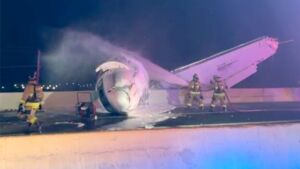 fire on Tuesday night, killing one person, according to police.
The plane was carrying six people when it crashed on Loop 20 in Laredo, Texas, shortly after 10 p.m., according to Jose Baeza, an investigator with the Laredo Police Department.
Baeza also said a vehicle was struck by the aircraft. It was not immediately clear if the person killed was in the aircraft or on the ground.
The conditions of those aboard the plane were not immediately known.
Authorities initially did not report serious injuries on the ground, though five responding officers were transported to the hospital for smoke inhalation according to Baeza.
Loop 20 was closed after the crash and was expected to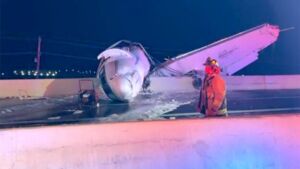 remain closed into Wednesday morning, Baeza said.
The plane involved in the incident was a Cessna Citation Latitude twin jet, according to data from FlightAware. The plane departed from Los Cabos International Airport in Mexico at 6:19 p.m.
NetJets said in a statement that the crash involved one of its planes. The company said it is working with authorities.
It was unclear what caused the crash as it reached Laredo, which is located about 140 miles southwest of San Antonio.
Video posted to social media showed the plane on its side and smashed into a highway barrier as the tail was ripped from the fuselage.
https://www.foxnews.com/us/texas-plane-crash-leaves-one-dead-more-injured-after-business-jet-catches-fire-highway
Pilot, 77, walks away after plane crashes near Whiteman Airport in Pacoima
by: Tony Kurzweil
A 77-year-old pilot was able to walk away after a small airplane veered off the runway and crashed into a parking lot at Whiteman Airport on Tuesday morning. 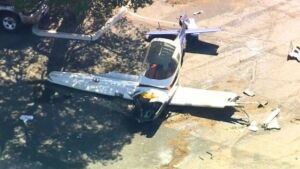
Crews from the Los Angeles Fire Department were dispatched to the incident near Osborne Street in Pacoima at about 9:11 a.m.
Fire officials initially reported the downed plane was a Cessna, but KTLA’s Rich Prickett, reporting from Sky5 at 9:45 a.m., said it may have been an experimental aircraft.
The pilot was injured in the crash but was able to walk away, according to a news release from the Whiteman Airport Coalition (WAC).
Fire officials did not identify the pilot but confirmed he was a 77-year-old man. Officials initially said the pilot declined transport to a local hospital, but later updated that he went for further evaluation.
Witnesses initially believed the crash occurred during takeoff, but updated information from the WAC suggests the plane was landing.
“Based on initial reports, the pilot safely landed on the runway, but the landing gear did not deploy properly,” WAC officials said in the news release. “Thankfully, no one else was injured. Most importantly, the incident remained entirely on airport grounds and posed no danger to surrounding neighborhoods or nearby residents.”
The Fire Department said some fuel leaked from the aircraft, but it was fully contained and there was no active fire.
“As always, the appropriate authorities will investigate the incident and determine exactly what occurred,” the news release said.
https://ktla.com/news/local-news/whiteman-airport-plane-crash-pacoima-pilot-survives/
NTSB Prelim: Cirrus SF50
After Takeoff At About 8,000ft Above Mean Sea Level (MSL), He Received An Engine Inter-Turbine Temperature (ITT) Warning
Location: Athens, GA Incident Number: ENG26LA026
Date & Time: June 2, 2026, 09:45 Local Registration: N129KA
Aircraft: Cirrus SF50 Injuries: 2 None
Flight Conducted Under: Part 91: General aviation - Personal
On June 2, 2026, at 0945 eastern daylight time, a Cirrus SF50, N129KA, powered by a Williams International FJ33-5A turbofan engine, experienced an uncontained engine failure during climb from Greene County Regional Airport (KCPP), Greensboro, Georgia. There were no injuries to the pilot or passenger. The airplane was operated as a Title 14 Code of Federal Regulations Part 91 general aviation flight from KCPP destined for Sgt. Lee Russell Carroll County Airport (KHZD), Huntingdon, Tennessee.
According to the pilot, after takeoff at about 8,000ft above mean sea level (MSL), he received an engine inter-turbine temperature (ITT) warning and full authority digital engine control (FADEC) NO DISPATCH cockpit alerting system (CAS) message. He then contacted air traffic control (ATC) and requested a hold at 10,000 ft MSL, and in accordance with the checklist procedures, reduced the thrust lever setting by switching the auto throttle to manual mode and reduced the airspeed to 180 kts. The engine ITT temperature decreased, and the CAS message cleared. He reported that he remained at 10,000ft MSL for several minutes to monitor the engine parameters, and all remained within operating limits. The pilot then contacted ATC to request a small climb to see how the engine would perform, and after receiving authorization, initiated a climb to 13,000ft MSL. Seconds after advancing the engine throttle, there was a loud bang and reduction in power. The pilot reported that he pitched the airplane for best glide, declared an emergency, and received vectors to Athens-Ben Epps Airport (AHN), Athens, GA. While performing the emergency checklist procedure he attempted to “clear the engine,” which aggressively shook the airplane. He continued on vectors, deployed the flaps and landing gear, and made a no power landing on runway 9 at AHN.
A post-incident examination of the airplane revealed an uncontained engine failure and separated section of engine cowl. A section of turbine disk protruded from the lower cowling structure on the right side of the airplane.
As part of the investigation process, the NTSB invited qualified parties to participate in the investigation, including the Federal Aviation Administration (FAA), Williams International, and Cirrus Aircraft. Party members from the FAA, Williams International, and Cirrus removed the engine at AHN and shipped it to Williams International in Pontiac, Michigan for teardown examination.
FMI: www.ntsb.gov
Today in History
37 Years ago today: On 17 June 1989 Interflug flight 102, an Ilyuhsin Il-62M, was destroyed following a runway excursion accident on takeoff from Berlin-Schönefeld Airport, East Germany. Of the 113 occupants, 21 were killed.
| Date: | Saturday 17 June 1989 |
| Time: | 06:28 |
| Type: | Ilyushin Il-62M |
| Owner/operator: | Interflug |
| Registration: | DDR-SEW |
| MSN: | 2850324 |
| Year of manufacture: | 1988 |
| Total airframe hrs: | 1939 hours |
| Cycles: | 546 flights |
| Engine model: | Soloviev D-30KU |
| Fatalities: | Fatalities: 21 / Occupants: 113 |
| Other fatalities: | 0 |
| Aircraft damage: | Destroyed, written off |
| Category: | Accident |
| Location: | Berlin-Schönefeld Airport (SXF) - Germany |
| Phase: | Take off |
| Nature: | Passenger - Scheduled |
| Departure airport: | Berlin-Schönefeld Airport (SXF/EDDB) |
| Destination airport: | Moskva-Sheremetyevo Airport (SVO/UUEE) |
| Confidence Rating: | Information verified through data from accident investigation authorities |
Narrative:
Interflug flight 102, an Ilyuhsin Il-62M, was destroyed following a runway excursion accident on takeoff from Berlin-Schönefeld Airport, East Germany. Of the 113 occupants, 21 were killed.
At 06:20 hours local time the engines were started. Immediately thereafter, the flight control surfaces were unlocked, a process which, according to the cockpit voice recorder, was not completed.
The crew did not carry out the necessary check of the warning panel on the condition of the elevator. While taxiing for departure, the captain checked for the second time the movement of the elevators but failed to notice they were locked.
The aircraft was cleared for takeoff from runway 25L and the engines were adjusted to rated power due to the low take-off mass of 113 tons. At 06:28:05 the aircraft reached VR.
The captain pulled the control column during VR, but the aircraft did not respond. Four seconds later he called out to abort the takeoff. At this time the aircraft had attained a speed of 293 km/h. Instead of using reverse thrust, the flight engineer shut down all four engines. The speed at this time was 303 km/h and the remaining distance to the end of the runway was about 940 meters.
The aircraft rolled over the end of the runway at a speed of 262 km/h and slightly to the left of the center line. During the emergency braking five tires of the main landing gear had been destroyed. The aircaft crossed an excavation pit of 40 cm deep, causing the right main landing gear to collapse. It then collided with a water tank, concrete piles of the airport fence, a road embankment and six trees. At 06:28:37 the aircraft came to rest and burst into flames.
Within two minutes, 82 passengers could be rescued alive from the fuselage, which had been broken into three parts. All ten crew members survived.
