We start the new week with the following stories...
Be safe out there!
Tom
--
A fire broke out in the overhead luggage compartment after a flight landed. The crew extinguished the fire in time. Airport fire department reported that a power bank carried by a passenger spontaneously combusted; there were no injuries.
Source: Wang Can, reporter for Jimu News
On July 24th at noon, a netizen reported that around 11:00 AM that day, a flight from Lanzhou to Guiyang caught fire in the cabin after landing at Guiyang Longdongbao Airport. Fortunately, the fire was extinguished in time by the crew. According to the Longdongbao Airport Fire Department, the fire originated in the overhead luggage compartment caused by a power bank carried by a passenger spontaneously combusting. No injuries were reported.
Videos posted online show flames erupting from the overhead luggage compartment of an airplane. Several crew members are seen dealing with the situation, pulling passengers' suitcases out, and someone is loudly reassuring passengers, saying, "Don't worry, the fire department is here." Outside the cabin, firefighters have arrived at the scene.
The netizen said that around 11 a.m. on the 24th, his plane had just landed and was taxiing when suddenly the passengers in front of him screamed, shouting "Fire!" and ran to the back. "I thought the outside of the plane was on fire, but when I looked up, I saw flames coming out of the overhead luggage rack."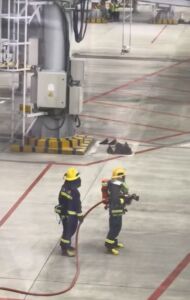
A passenger on board told a reporter from Jimu News that the plane had just landed when he saw the fire in the cabin and was startled. He immediately stood up and prepared to run towards the exit. The crew told everyone not to panic, and three crew members quickly opened the overhead luggage compartment door, took out all the suitcases, and extinguished the flames. "Fortunately, the plane had already landed; it was really terrifying."
When contacted by reporters, the airline operating the flight said that they were unaware of the situation and would look into it.
On the afternoon of the 24th, a reporter from Jimu News contacted the Guiyang Longdongbao Airport Fire Department. A staff member confirmed that a fire did occur in the overhead luggage compartment of a flight that day, caused by a power bank carried by a passenger spontaneously combusting. By the time firefighters arrived, the crew had already extinguished the fire, and no injuries were reported.
https://www.cqnews.net/web/content_1530297239645446144.html
Lightning strike at Arturo Michelena International Airport leaves nine injured
A lightning bolt struck the platform of the Arturo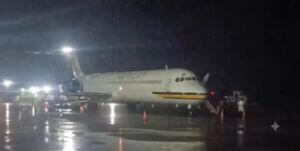 Michelena International Airport, located in Valencia, Carabobo state, leaving nine people injured and causing the temporary suspension of flights and air operations at the terminal.
According to information provided by journalist Randolfo Blanco on his Instagram account, the violent electrical discharge directly affected four national guardsmen and five workers from different companies that provide services inside the airport, who suffered various injuries after the natural phenomenon.
Following the incident, the injured were rushed to the Dr. Enrique Tejera Hospital Complex (CHET) in Valencia for immediate medical attention. Two of them were later transferred by ambulance to another medical facility for specialized examinations and a thorough evaluation of their health.
In parallel with the health emergency, the natural phenomenon struck the apron area, very close to where three aircraft were located. Due to the latent risk generated by the heavy rainfall and the lightning strike, airport authorities temporarily suspended all flight departures and runway operations.
Once the emergency situation was under control and the environmental risks in the area were mitigated, operations and flights that had been halted were formally resumed at the main air terminal in the Carabobo region.
Impacto de rayo en el Aeropuerto Internacional Arturo Michelena deja nueve heridos
Aircraft makes emergency landing at Portland Jetport
The aircraft was on its way from Portland to New York City and landed safely back at the airport.
Madeleine Kaptein - Staff Writer
Delta Air Lines Flight 5860 flying from Portland International Jetport to LaGuardia Airport in New York City on Saturday afternoon declared an emergency and returned to the Jetport a few minutes after takeoff.
An alert from Maine first responders at roughly 1:30 p.m. said a sensor in the aircraft detected smoke in the cockpit, triggering the emergency landing. Seventy-eight people — 74 passengers and four crew members — were aboard and landed safely, according to a second alert minutes later.
Airport rescue called for a full emergency response. The Portland Fire Department’s aircraft rescue and firefighting team evaluated the plane upon its landing and found that the sensor had gone off due to an electrical issue, according to Lt. Matthew Hawkes. Any smoke had cleared by the time the craft returned to the ground.
The aircraft was then taxied to the gate and deplaned using the passenger boarding bridge, Assistant Airport Director Zach Sundquist wrote in a news release.
Jon Austin, a spokesman for Republic Airways, which operates regional flights for Delta, said the passengers will reach their destination in a replacement aircraft today. Mechanics are working on the initial plane.
NTSB Prelim: Luscombe 8A
The Engine Experienced A Partial Loss Of Power During The Departure Climb About 600 Ft Above Ground Level
Location: Novato, CA Accident Number: WPR26LA251
Date & Time: July 7, 2026, 12:00 Local Registration: N45886
Aircraft: Luscombe 8A Injuries: 2 None
Flight Conducted Under: Part 91: General aviation - Personal
On July 7, 2026, about 1200 Pacific daylight time, a Luscombe 8A, N45886, was substantially damaged when it was involved in an accident near Novato, California. The pilot and passenger were not injured. The airplane was operated as a Title 14 Code of Federal Regulations Part 91 personal flight.
While conducting touch-and-go takeoff and landings on runway 31 at Gnoss Field (DVO), Novato, California, the engine experienced a partial loss of power during the departure climb about 600 ft above ground level. As the pilot attempted to return to the departure runway, he applied carburetor heat and the engine briefly regained power before experiencing a total loss of power. The pilot then moved the fuel selector from the wing tanks to the fuselage tank; however, he was unable to restart the engine.
Subsequently, the airplane touched down in an area of soft gravel about 10 ft short of runway 13, and the left main landing gear collapsed. The airplane slid about 20 ft before it came to rest upright. Post accident examination of the airplane revealed that both wings sustained substantial damage.
The airplane was recovered for further examination.
FMI: www.ntsb.gov
NTSB Prelim: Mooney M20M
While On The Approach To TLH, About 1,000 Feet Mean Sea Level, All Engine Power Was Lost
Location: Tallahassee, FL Accident Number: ANC26LA070
Date & Time: July 8, 2026, 11:48 Local Registration: N488AT
Aircraft: Mooney M20M Injuries: 1 Minor
Flight Conducted Under: Part 91: General aviation - Ferry
On July 8, 2026, at 1148 eastern daylight time, a Mooney M20 airplane was substantially damaged when it was involved in an accident near Tallahassee, Florida. The pilot sustained minor injuries. The airplane was operated as a Title 14 Code of Federal Regulations Part 91 personal flight.
According to the pilot, the airplane had recently been sold, and he had been hired to ferry it from Florida to Texas. Prior to the flight, a known mechanical issue existed with the No. 5 cylinder. During the flight, the engine began surging, prompting the pilot to divert to Tallahassee International Airport (TLH), Tallahassee, Florida.
While on the approach to TLH, about 1,000 feet mean sea level, all engine power was lost. The airplane subsequently impacted heavily wooded terrain about one-half mile short of Runway 18.
According to a Federal Aviation Administration inspector that traveled to the scene, about 14 gallons of fuel were recovered from the wreckage following the accident.
The airplane and engine have been recovered and retained for further examination.
FMI: www.ntsb.gov
NTSB Pushes Back On Ryanair Statements About 737 Engine Incident
Agency Contradicts Airline Statement And Has Not Ruled Out Age, Service Issues
The U.S. National Transportation Safety Board said on Wednesday in a letter it has not ruled out age or service issues in a probe into an incident in which a passenger was partly sucked out of a Boeing 737 NG broken window after an uncontained engine failure. 
The letter contradicted Ryanair CEO Michael O'Leary who said on Monday an initial finding from the probe suggested "foreign object damage" and was not due to the aircraft's age or servicing conditions, Reuters reported.
"The NTSB has not made any such determination, and our investigators have not yet ruled out age or servicing issues as contributing to this event," NTSB Chair Jennifer Homendy wrote in a letter to O'Leary, adding the CEO's comments had violated the agency's rules on disclosure by parties to the investigation. She urged him to refrain from making further public statements regarding the probe.
The NTSB is investigating the July 10 incident, in which a piece of the engine broke off the aircraft and smashed the window shortly after takeoff from Thessaloniki in Greece, according to video and the Federal Aviation Administration. The plane, headed to Germany, lost pressure and made an emergency landing.
"Initial indication would suggest it looks like a foreign object damage to the engine on takeoff at Thessaloniki, but we don't have, we can't say that definitively," O'Leary told analysts.
O'Leary said the aircraft was 18 years old and its engine had been fully serviced and overhauled within the last two years. He added that a draft report on the incident would be issued in about 28 days, followed by a more detailed report.
FMI: www.ntsb.gov
Today in History
37 Years ago today: On 27 July 1989 Korean Air flight 803, a DC-10-30, crashed while on approach to Tripoli Airport, Libya, killing 74 occupants and 6 persons on the ground; 124 survived the accident.
| Date: | Thursday 27 July 1989 |
| Time: | 07:05 |
| Type: | McDonnell Douglas DC-10-30 |
| Owner/operator: | Korean Air |
| Registration: | HL7328 |
| MSN: | 47887/125 |
| Year of manufacture: | 1973 |
| Total airframe hrs: | 49025 hours |
| Cycles: | 11440 flights |
| Engine model: | General Electric CF6-50C2 |
| Fatalities: | Fatalities: 74 / Occupants: 199 |
| Other fatalities: | 6 |
| Aircraft damage: | Destroyed, written off |
| Category: | Accident |
| Location: | 2,4 km E of Tripoli International Airport (TIP) - Libya |
| Phase: | Approach |
| Nature: | Passenger - Scheduled |
| Departure airport: | Jeddah-King Abdulaziz International Airport (JED/OEJN) |
| Destination airport: | Tripoli International Airport (TIP/HLLT) |
| Confidence Rating: | Accident investigation report completed and information captured |
Narrative:
Korean Air flight 803, a DC-10-30, crashed while on approach to Tripoli Airport, Libya, killing 74 occupants and 6 persons on the ground; 124 survived the accident.
Flight KE803 departed Seoul, South Korea on a flight to Tripoli, Libya with intermediate stops at Bangkok, Thailand and Jeddah, Saudi Arabia.
Weather was poor as the aircraft approached Tripoli. Visibility was varying between 100-800 feet and the runway 27 ILS had been reported unserviceable. On final approach to runway 27 the aircraft crashed short of the runway, striking 4 houses and a number of cars.
Probable Causes
1) Crew fatigue due to lack of proper sleep affecting their mental concentration on the operation of the aircraft and their performance led to:
a) Captain failed to make proper weather and NDB Approach Briefing.
b) The flight crew continued the approach in bad visibility below company and Jeppesen minima for NDB Approach and failed to follow the prescribed procedures.
c) The flight crew failed to grasp the actual visibility information given by the ACC as 50 meters.
d) F/O and F/E failed to follow the Captain’s instructions.
2) The available GPWS failed to maintain the warning while the aircraft still in dangerous situation in colliding with terrain.
3) Flight crew simulator training was conducted on an aircraft simulator differently equipped from the crashed aeroplane especially in the GPWS.
