Here are your stories for today...
Be safe out there!
Tom
--
Military helicopter crashes during training near Opp
by: Richard Everett
DOTHAN, Ala (WDHN) — A military helicopter with three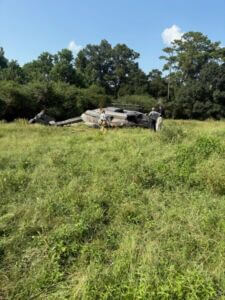 pilots from Fort Rucker crashed near Opp Monday afternoon.
Blake Turman, the sheriff of Covington County, confirmed that a UH-72 Lakota helicopter crashed in a privately owned field on Cool Springs Road, near the Opp Bypass.
Officials with Fort Rucker say an instructor and two student pilots were aboard the helicopter conducting flight training when the Lakota crashed.
The pilots were transported to a Dothan hospital for evaluation. They are in stable condition, according to officials.
No property was damaged in the crash.
https://www.wdhn.com/news/local-news/covington-county/helicopter-crashes-near-opp/
Pilot OK after plane veers off Arlington runway
The FAA and NTSB will investigate the incident and issue a formal report.
By Frank Heinz
The pilot of a single-engine plane is OK after veering off the runway after landing at Arlington Municipal Airport on Monday morning. 
According to the Federal Aviation Administration, the pilot of a 2024 Aviat Husky A-1C-200 left the runway after landing at about 10:35 a.m.
Texas Sky Ranger flew over the airport Monday morning and recorded video of the aircraft just off the runway, with the wing tipped to the ground on the port side. It appears part of the landing gear may have collapsed.
The Arlington Fire Department said there were no fires, fuel leaks, or other hazardous conditions associated
with the incident and that no injuries were reported.
According to the FAA, a pilot and a passenger were on board. In a separate statement Monday afternoon, the Arlington Fire Department said they were told only a pilot was on board. NBC 5 has not been able to confirm which statement was correct.
The pilot has not been identified. According to FAA records, the plane is registered to an owner in Helena, Montana.
An official cause of the crash has not been determined. The FAA and NTSB will investigate the incident and issue a formal report.
https://www.nbcdfw.com/news/local/pilot-passenger-plane-arlington-runway/4054572/
Small plane makes emergency landing on Southern California beach; no injuries reported
by: Jocelyn Fiset
No injuries were reported after a small plane carrying two people made an emergency landing Monday afternoon on Huntington State Beach, officials said. 
The FAA told KTLA that a Piper PA-28 landed safely on the sand after the pilot reported an engine issue following departure from John Wayne Airport.
The incident occurred shortly after 2 p.m. near Pacific Coast Highway and Magnolia Avenue.
The two people who were on board the aircraft, a man and his 16-year-old nephew, were uninjured. The plane sustained no visible damage.
The pilot, Mike Bremner, is an Orange County resident who works with nonprofit Elder Abuse Air Force. His nephew, Griffin, is visiting from Canada for a basketball tournament.
“About five minutes into into our flight, the plane slows down, the propeller slows down, and the plane sputters a little bit and shakes,” said Griffin Bremner. “(The pilot) just looks over and he tells me, ‘Griffin, the engine is failing. We’re landing on the beach.'”
New video shared with KTLA from the plane’s point of view shows the pilot choosing a spot to land.
“Given we’re out about 1,000 feet or so, I had to start looking for a place to land,” said Mike Bremner. “Luckily, there was a big, beautiful beach right there and the winds were light. We had the airplane flying at such a speed that it would glide as far as it could. Picked a spot, configured it for landing and in we went.”
Sky5 was overhead as Huntington Beach police and other first responders cordoned off the scene.
The plane landed on a stretch of sand between the parking lot and the beach, where there were luckily not a lot of people, according to Sky5’s Gil Leyvas.
The FAA said it will investigate what caused the engine to fail.
KTLA’s Chip Yost contributed to this report.
https://ktla.com/news/california/small-plane-makes-emergency-landing-huntington-beach/
Virgin Atlantic engineer, 23, dies after machinery fell on him while working on plane
Story by Simon Hamalienko & James Caven
An aircraft engineer has died after being crushed by machinery that dropped on him. Georgie Buxton spent four weeks in intensive care after the accident at London's Heathrow Airport, until life support machines were turned off earlier this month.
The 23-year-old aircraft technician was performing maintenance tests on a Boeing 787 Dreamliner in a hangar when the tragedy unfolded. It was reported that the plane has been taken out of service while experts work out how it happened. Bosses from the airline Virgin Atlantic were said to have been in contact with Boeing.
A source claimed to The Sun that he was a "young and very loved member of the team". An inquest will be opened and adjourned at West London Coroner's Court this week.
Georgie joined Virgin Atlantic two years ago after posting to his family and friends on social media that he was moving there from his current company Ryanair.
He wrote: “I’m happy to share that I’m starting a new position as an Aircraft Technician at Virgin Atlantic! It’s been a pleasure working with all the engineers and mechanics whilst at Ryanair in Stansted and I’ve been able to develop and learn a lot.
“Now it’s time to move on so I can develop and learn more on different airframes!!”
A Virgin Atlantic spokesperson said: “We are heartbroken to confirm that a much-loved member of our engineering team, has passed away. Our thoughts are firmly with Georgie’s family, loved ones, friends and colleagues at this incredibly sad and challenging time.
"We’re providing support to loved ones wherever we can and sharing our heartfelt condolences to everyone affected. Georgie’s family has asked for privacy at this very difficult time.
“The safety and wellbeing of our people is always our top priority, and we are devastated by this incident. We are working closely with relevant authorities and the aircraft manufacturer on the investigation to establish all facts.
"Out of respect for those involved and while the investigation is ongoing, we are unable to provide any further information at this stage."
https://www.msn.com/en-gb/news/other/virgin-atlantic-engineer-23-dies-after-machinery-fell-on-him-while-working-on-plane/ar-AA28O5E9
NTSB Prelim: Sikorsky S76
(Witnesses) Described That The Helicopter Pitched Up Just Prior To Impacting The Mountainside
Location: Huntersville, WV Accident Number: ERA26FA266
Date & Time: July 10, 2026, 07:45 Local Registration: N93RT
Aircraft: Sikorsky S76 Injuries: 1 Fatal
Flight Conducted Under: Part 91: General aviation - Positioning
On July 10, 2026, about 0745 eastern daylight time, a Sikorsky S-76D helicopter, N93RT, was destroyed when it was involved in an accident near Huntersville, West Virginia. The commercial pilot was fatally injured. The helicopter was operated as a Title 14 Code of Federal Regulations Part 91 positioning flight.
The pilot of the helicopter departed a private hangar near Glenville, West Virginia about 0710 to pick up the helicopter’s owner at his property. Preliminary ADS-B data showed the helicopter flying from near the departure point directly toward the destination landing zone until it was about 0.5 nautical miles (nm) northwest of the destination when the helicopter made a right turn. The helicopter was flying at an altitude of about 3,550 ft mean sea level (msl) when it made the turn to the right, away from the destination landing zone, which was located at an elevation of about 2,250 ft.
A witness recorded a video of the helicopter when it was about 1.3 nm west southwest of the destination, and it showed the helicopter flying about 100 to 150 ft above ground level (agl). The video also depicted could ceilings that were about 200 to 250 ft agl. The video showed the helicopter continuing down a valley toward the town of Huntersville, West Virginia with the landing gear extended, before making a right turn toward the destination. The witness, who watched the helicopter fly over his house, reported that the rotor wash from the helicopter was making the trees on his property sway as it passed overhead.
Witnesses who were located closer to the destination stated that it was foggy around the time of the accident and estimated the cloud ceiling was between 100 and 200 ft agl. They also stated that when they saw the helicopter it was partially obscured by the fog, with only the “belly” visible at various points. The described that as the helicopter passed over a ridge to the southwest of the destination, it continued east, perpendicular to the approach path they had
seen the helicopter fly in the past. They also described that the helicopter pitched up just prior to impacting the mountainside.
The accident site was about 0.15 nm southeast of the destination landing zone on the side of a mountain, at an elevation about 2,500 ft. The debris path was about 330 ft in length and oriented on a magnetic heading of about 110°. The debris area was on a slope that varied between 30° and 50° with the lowest debris located consisting of main rotor blade spars. The initial tree impact was about 200 ft in elevation below where the main wreckage came to rest, and those tree strikes were located about 40 ft the tree.
A majority of the helicopter was consumed by postimpact fire. Part of the tail rotor gearbox was impact-separated and was found near the tail section of the helicopter, both about 60 ft below the main wreckage. Both of the tail rotor control cables were found in the main wreckage and exhibited fire damage. A portion of one tail rotor control cable remained attached to the tail rotor control in the tail. The fuselage was unrecognizable and destroyed by postaccident fire. The main rotor head was found about 10 ft below the engines in the main wreckage. The main gearbox magnesium housing was entirely consumed by postaccident fire. The primary and multifunction flight displays were found in the burned portion of the wreckage and exhibited fire damage.
Both engines remained encased by the nacelle, came to rest inverted, and were damaged by postaccident fire. Both engine external and internal surfaces exhibited varying degrees of ash and soot accumulation. The left engine inlet case had been consumed by fire. A borescope examination of the 1st-stage high-pressure compressor (HPC) rotor showed all airfoils intact and full length, with no apparent deformation. Viewing through the exhaust duct confirmed that the T6 temperature-indicating probes remained intact. The 2nd-stage power turbine (PT) blades were also observed to be full length with no obvious damage.
The right engine upper section of the reduction gearbox was perforated, exposing the internal gear system. A borescope examination of the 1st-stage HPC rotor showed all airfoils intact and full length, with no apparent deformation. Viewing through the exhaust duct confirmed that the T6 temperature-indicating probes remained intact. The 2nd-stage PT blades were also observed to be full length with no obvious damage.
The helicopter’s cockpit voice recorder/flight data recorder combination unit, along with two other devices with the capability of recording data in nonvolatile memory, were recovered and sent to the NTSB Vehicle Recorders Laboratory for data extraction and download.
The helicopter was retained for further examination.
FMI: www.ntsb.gov

Today in History
16 Years ago today: On 28 July 2010 Airblue flight 202, an Airbus A321, crashed while on approach to Islamabad-Benazir Bhutto Airport, Pakistan, killing all 152 occupants
| Date: | Wednesday 28 July 2010 |
| Time: | 09:41 |
| Type: | Airbus A321-231 |
| Owner/operator: | Airblue |
| Registration: | AP-BJB |
| MSN: | 1218 |
| Year of manufacture: | 2000 |
| Total airframe hrs: | 34018 hours |
| Cycles: | 13566 flights |
| Engine model: | IAE V2533-A5 |
| Fatalities: | Fatalities: 152 / Occupants: 152 |
| Other fatalities: | 0 |
| Aircraft damage: | Destroyed, written off |
| Category: | Accident |
| Location: | 15 km NNW of Islamabad-Benazir Bhutto International Airport (ISB) - Pakistan |
| Phase: | Approach |
| Nature: | Passenger - Scheduled |
| Departure airport: | Karachi-Jinnah International Airport (KHI/OPKC) |
| Destination airport: | Islamabad International Airport (ISB/OPRN) |
| Investigating agency: | PakCAA |
| Confidence Rating: | Accident investigation report completed and information captured |
Narrative:
Airblue flight 202, an Airbus A321, crashed while on approach to Islamabad-Benazir Bhutto Airport, Pakistan, killing all 152 occupants
Flight ED202 had departed Karachi International Airport (KHI) on a domestic service to Islamabad.
Weather at Islamabad was poor with deteriorating visibility. A PIA flight had landed on the third attempt to land and a flight from China had returned. ABQ202 was cleared for a runway 12 Circling Approach procedure. During the approach the captain descended below Minimum Descent Altitude (MDA) (i.e. 2,300 ft instead of maintaining 2,510 ft), losing visual contact with the airfield. The captain then decided to fly a non-standard self-created PBD (Place Bearing Distance, RNAV waypoint)-based approach, thus transgressing out of the protected airspace by an distance of 4.3 NM into the Margalla Hills area.
The captain did not take appropriate action following calls from the first officer. He also did not respond to 21 EGPWS warnings related to approaching rising terrain and pull up.
The airplane flew into the side of a mountain. The first officer remained a passive bystander in the cockpit and did not participate as an effective team member failing to supplement and compliment or to correct the errors of his captain assertively due to the captainÂ’s behaviour in the flight. The investigation report said that during initial climb, the captain tested the knowledge of the first officer and used harsh words and a snobbish tone, contrary to the company procedure/norms. The question/answer sessions, lecturing and advices by the captain continued with intervals for about one hour after takeoff. After the intermittent humiliating sessions, the FO generally remained quiet, suffered from underconfidence, became submissive and subsequently did not challenge the captain for any of his errors, breaches and violations.
FINALIZATION: "Air blue crash has been finalized as a case of Controlled Flight into Terrain (CFIT), in which aircrew failed to display superior judgment and professional skills in a self created unsafe environment. In their pursuit to land in inclement weather, they committed serious violations of procedures and breaches of flying discipline, which put the aircraft in an unsafe condition over dangerous terrain at low altitude."
METAR:
03:00 UTC / 08:00 local time:
OPRN 280300Z 05016KT 2000 RA FEW015ST SCT040 BKN100 FEW030TCU 24/23 1006.5=
Wind 050 degrees at 16 knots; 2000m visibility; rain; few clouds at 1,500 ft, few clouds at 3,000 ft with Towering CB, scattered clouds at 4,000 ft, broken clouds at 10,000 ft.; Temperature 24°C, dew point 23°C
04:00 UTC / 09:00 local time:
OPRN 280400Z 05016KT 3500 SCT010 SCT030 BKN100 FEW030TCU 29/24 1006.7=
Wind 050 degrees at 16 knots; 3500m visibility; scattered clouds at 1,000 ft and 3,000 ft, few clouds at 3,000 ft with Towering CB, broken clouds at 10,000 ft.; Temperature 29°C, dew point 24°C
05:00 UTC / 10:00 local time:
OPRN 280500Z 09018KT 3500 RA SCT010 SCT030 OVC100 FEW030 25/24 Q1006.9=
Wind 090 degrees at 18 knots; 3500m visibility; rain; scattered clouds at 1,000 ft and 3,000 ft, overcast at 10,000 ft.; Temperature 25°C, dew point 24°C
