Here are the stories for today...
Be safe out there!
Tom
--
Rare DC-8 freighter veers off runway, collapses nose gear in Kinshasa
By Stephen Pope
One of the world’s last operational Douglas DC-8s suffered serious damage after overrunning the runway while landing in Kinshasa, Democratic Republic of the Congo, on September 8, 2026.
The DC-8-73CF freighter, registered 9S-AJO and operated by Trans Air Cargo Service, veered left off Runway 24 at N’Djili International Airport (FIH). The aircraft came to rest on soft ground with its nose landing gear collapsed.
Images and video from the airport show the four-engine jet resting nose-down in the grass beside the runway. The extent of the damage has not been confirmed, and it is unclear whether the aircraft can be repaired.
No fatalities were reported. 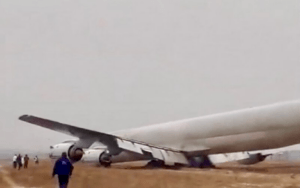
The Democratic Republic of the Congo’s Bureau Permanent d’Enquêtes d’Accidents et Incidents d’Aviation (BPEA) classified the event as an accident and dispatched investigators to the airport. The agency called for the aircraft and other evidence to be preserved until its investigators could examine the scene.
The circumstances leading to the runway excursion remain unclear. Weather reports around the time of the accident indicated reduced visibility with mist in the Kinshasa area, but investigators have not said whether weather played a role.
The accident is especially notable because 9S-AJO was among the last DC-8s still flying commercially. The approximately 56-year-old aircraft was Trans Air Cargo Service’s only active aircraft, according to fleet databases.
The jet was originally built as a DC-8-63, part of the stretched “Super 60” series. It was later converted to the DC-8-73 standard with quieter and more fuel-efficient CFM56 turbofan engines.
Only a small number of DC-8s remained operational worldwide before the Kinshasa accident. Another DC-8-73 freighter, registered OB-2231P, has been operated by Peru-based Skybus Jet Cargo.
Douglas developed the DC-8 as a competitor to the Boeing 707. The aircraft entered airline service with Delta Air Lines and United Airlines in 1959.
Douglas and McDonnell Douglas built 556 DC-8s before production ended in 1972. Although the type disappeared from scheduled passenger service decades ago, several re-engined examples continued flying as freighters, research aircraft and humanitarian transports.
NASA retired its DC-8 flying laboratory in 2024, while Samaritan’s Purse retired the last US-registered operational DC-8 in 2025.
https://www.aerotime.aero/articles/rare-dc-8-freighter-runway-excursion-kinshasa
The NTSB has released some data from the Boeing 767 accident at Miami yesterday.
The information is consistent with the theories that the 767 was carrying a tailwind component and new information the crew initiated a go around but then cancelled it almost immediately 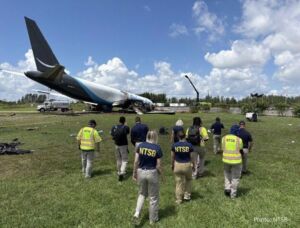
Data is seconds before end of flight data recorder
-0:30: Nose gear + Right main landing gear touchdown at 158 kt ground speed (Now extrapolated to be around half way down the runway)
-0:23: brakes applied, 146 kt
-0:19: Left MLG touchdown, 134 kt
-0:15: Brakes released, 120 kt; throttles “increased to values consistent with go-around thrust” (Approx 1000 feet before the end of the runway)
-0:11: throttles reduced to idle, brakes reapplied, 117 kt
-0:07: Lateral, longitudinal, and vertical accelerations change, 96 kt
-0:00: Final ground speed 65 kt
The National Transportation Safety Board (NTSB) has not released the exact number of hours the pilots logged specifically on the Boeing 767. However, the NTSB stated the Captain, 55, received his type rating for the 767 in May 2026 and has 7,145 hours of total time. The first officer, 37, received his type rating on the 767 in April 2025 and has 2,655 total time.
https://www.facebook.com/AIRLINESECRETS/posts/the-ntsb-has-released-some-data-from-the-boeing-767-accident-at-miami-yesterday-/1050739074256782/
NTSB Prelim: Textron Aviation Inc 172S
The Flight Was Operated By ATP Flight School
Location: Provo, UT Accident Number: WPR26FA294
Date & Time: August 7, 2026, 15:49 Local Registration: N1842E
Aircraft: Textron Aviation Inc 172S Injuries: 1 Fatal, 1 Serious
Flight Conducted Under: Part 91: General aviation - Instructional
On August 7, 2026, about 1549 mountain daylight time, a Textron Aviation Inc. 172S, N1842E, was substantially damaged when it was involved in an accident near Provo, Utah. The flight instructor sustained serious injuries, and the pilot undergoing instruction was fatally injured. The airplane was operated as a Title 14 Code of Federal Regulations Part 91 instructional flight.
The flight was operated by ATP Flight School under the callsign Career Track (CXK) 138 and was intended to provide preparation for the pilot undergoing instruction’s upcoming instrument checkride. The airplane was scheduled to depart for the practice area south of the airport via the “Golf Course” departure, a route that would have initially taken the airplane east over Provo Bay. Preliminary air traffic control audio indicated that multiple aircraft operating in the vicinity of Provo Municipal Airport (PVU) in the period before the accident reported moderate to severe turbulence. One of those airplanes, which was also operated by ATP, reported descent rates exceeding 1,000 ft per minute while approaching Bird Island, a reporting point in Utah Lake about 5 miles southwest of the airport.
At about 1546, the accident airplane was cleared for takeoff from runway 18. ADS-B data showed that the airplane began a climbing left turn to the southeast with a groundspeed that varied between 68 and 75 knots. A few seconds later, the airplane began a rapid descent, accelerating to a groundspeed of about 96 knots before the last ADS-B target was recorded approximately 160 ft above the water, and 350 ft short of the accident site.
Security camera footage from multiple buildings located on the east side of the airport, facing west and south-southwest, showed several areas of tall dust formations moving through the surface area along and south of the airport during the time preceding the accident. One dust formation appeared to move across the departure end of runway 18 as the airplane entered the video frame in the upper-right portion of one of the cameras. A few seconds later, the airplane began to descend, and a splash was observed about 30 seconds later as the airplane impacted the water.
The airplane came to rest in marshland within Provo Bay, about 6,000 ft south-southeast of the departure end of runway 18. The main wreckage was semi-submerged in about 18 inches of water and resting on soft mud. The debris field extended about 100 ft in length. The first identified point of impact was the nose landing gear assembly, which had separated from the airframe. The remaining wreckage was concentrated to the east of that location.
The forward cabin section, engine, and both wings were submerged, with a section of a propeller blade tip visible above the water.
The wreckage was recovered for further examination.
FMI: www.ntsb.gov

Today in History
57 Years ago today: On 9 September 1969 Allegheny Airlines flight 853, a DC-9-30, crashed near Fairland, Indiana, USA, following a mid-air collision with a Piper PA-28, killing all 82 occupants of the DC-9 and the pilot of the Piper.
| Date: | Tuesday 9 September 1969 |
| Time: | 15:29 |
| Type: | McDonnell Douglas DC-9-31 |
| Owner/operator: | Allegheny Airlines |
| Registration: | N988VJ |
| MSN: | 47211/357 |
| Year of manufacture: | 1968 |
| Total airframe hrs: | 3170 hours |
| Engine model: | P&W JT8D-7 |
| Fatalities: | Fatalities: 82 / Occupants: 82 |
| Other fatalities: | 1 |
| Aircraft damage: | Destroyed, written off |
| Category: | Accident |
| Location: | 6,5 km NW of Fairland, IN - United States of America |
| Phase: | En route |
| Nature: | Passenger - Scheduled |
| Departure airport: | Cincinnati/Northern Kentucky Airport, KY (CVG/KCVG) |
| Destination airport: | Indianapolis-Weir Cook Municipal Airport, IN (IND/KIND) |
| Investigating agency: | NTSB |
| Confidence Rating: | Accident investigation report completed and information captured |
Narrative:
Allegheny Airlines flight 853, a DC-9-30, crashed near Fairland, Indiana, USA, following a mid-air collision with a Piper PA-28, killing all 82 occupants of the DC-9 and the pilot of the Piper.
Flight 853 was a regularly scheduled flight from Boston, Massachusetts, to St. Louis, Missouri, with intermediate stops at Baltimore, Maryland, Cincinnati, Ohio, and Indianapolis, Indiana. The flight proceeded routinely to Cincinnati from where it departed at 15:15 hours local time.
An IFR clearance was received to Indianapolis via airway V-97 at an altitude of 10,000 feet.
At 15:22 the Indianapol1s Air Route Traffic Control Center (ARTCC) controller advised, "Allegheny e1ght fifty three is in radar contact, cross Shelbyville (VOR) at and maintain six thousand and your position now thirty-two miles (unintelligible) ... southeast of Shelbyville."
Approximately 3 minutes later, the flight reported leaving 10,000 feet, and during its descent, was instructed to contact Indianapolis Approach Control. At 15:27, the approach controller advised,
"Allegheny eight five three roger, squawk ident heading two eight zero radar vector visual approach three one left." Allegheny 853 acknowledged the vector and was, almost immediately instructed to descend to 2,500 feet. The flight acknowledged at 15:27:29, "Eight five three cleared down two thousand five hundred and report reaching." This was the last recorded transmission from the flight.
At the same time a Piper PA-28-140, N7374J, was operating in the area on a solo training flight from Brookside Airpark, Indiana, to Bakalar Air Force Base. The aircraft was on a VFR flight plan indicating a cruising altitude of 3,500 feet. The pilot advised the Indianapolis Flight Service Station at 15:21 that he had departed Brookside, requesting activation of his flight plan. This was the last known communication with N7374J.
The approach controller did not notice any conflicting traffic in the area of Allegheny 853. Yet both aircraft were on a converging course, with the DC-9 descending towards the altitude of the PA-28.
After the DC-9 broke through the clouds, both flights had a window of 14 seconds to see and avoid. The NTSB determined that the captain, from his position, was unable to see the Piper. The first officer was likely monitoring the altimeter in preparation for a 3500 feet altitude call. Two seconds after this call, both aircraft collided. The initial impact between the two aircraft occurred at the forward upper right side of the vertical fin just below the horizontal stabilizer, of the DC-9, and the left forward side of the PA-28, just forward of the left wing root.
The horizontal stabilizer of the DC-9 broke off and the aircraft impacted the ground inverted, almost wings-level, in a nose-down attitude. The Piper broke up and crashed about 4500 feet from the DC-9. All 82 occupants of the DC-9 and the pilot of the PA-28 were killed.
PROBABLE CAUSE: "The deficiencies in the collision avoidance capability of the Air Traffic Control (ATC) system of the Federal Aviation Administration in a terminal area wherein there was mixed Instrument Flight Rules (IFR) and Visual Flight Rules (VFR) traffic. The deficiencies included the inadequacy of the see-and-avoid concept under the circumstances of this case; the technical limitations of radar in detecting all aircraft; and the absence of Federal Aviation Regulations which would provide a system of adequate separation of mixed VFR and IFR traffic in terminal areas."
