Your stories for today...
Be safe out there!
Tom
--
Pilot hurt after World War II era plane crashes at Montgomery County airport
By Kamryn Scrivens, Brian Wilson and Morgan Parrish
The Brief
-
- A World War II era single-engine plane crashed at Heritage Field Airport in Limerick Township on Wednesday night, sending the pilot to the hospital, according to Limerick Township officials.
- Emergency crews responded to a scene where the plane was upside down and leaking fuel, but airport staff removed the pilot before firefighters arrived.
- The reason for the crash and updates on the pilot's injuries have not been released by officials.
LIMERICK TWP., Pa. - A World War II-era plane crashed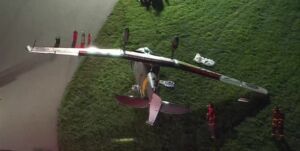 at Heritage Field Airport in Limerick Township just after Wednesday evening, leaving the pilot hospitalized and prompting a response from fire, police and ambulance services.
Emergency crews said the plane crashed upside down and was leaking fuel, but airport staff were able to remove the pilot before firefighters arrived.
Emergency response and airport closure after crash
What we know:
The plane took off from Pottstown and was headed to Quakertown, according to Limerick Township officials. It crashed at around 7:15 p.m. Wednesday at Heritage Field Airport on the 3300 block of West Ridge Pike.
The plane was only in the air for 9 minutes before coming down unexpectedly, officials said.
Officials say the single-engine plane crashed off the runway and landed upside down, leading to a fuel leak.
"We got reports the pilot was trapped in the plane. On our arrival, they were pulling him out. So there was no extrication needed by the fire department," Limerick Township Fire Chief Ken Shuler said.
The fire department and other emergency crews stayed at the scene to monitor for potential fire hazards and helped with the fuel leak, according to Limerick Township officials.
The pilot was taken to Reading Trauma Center after being found alert and talking at the scene, but no additional update on his condition has been provided by officials.
Investigation into cause and safety measures
The backstory:
Heritage Field Airport, formerly Pottstown Municipal Airport, serves private and recreational aviation, officials said.
The World War II era plane was not due to land until around 7:28 p.m., but the crash occurred at about 7:18 p.m., according to officials.
What's next:
Limerick police are investigating the crash, and officials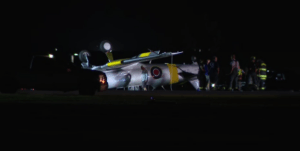 say the Federal Aviation Administration and National Transportation Safety Board have been contacted but haven't confirmed their involvement yet.
The airport remained closed Wednesday night while crews worked to resolve the fuel leak and remove the plane from the runway.
What we don't know:
Officials have not shared the cause of the crash or released more details about the pilot's injuries beyond saying he was alert and communicating at the scene.
https://www.fox29.com/news/1-injured-small-plane-crash-near-heritage-field-airport-montgomery-county-officials.amp
Small plane makes emergency landing in Robert Moses parking lot
Brian Harmon
FAA says the pilot of a single-seat aerobatic aircraft landed in the Field 4 lot
A small plane made an emergency landing in a parking lot at Robert Moses State Park in Babylon Wednesday morning.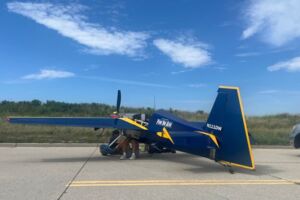
The pilot of a Zivko Edge 540 — a single-seat aircraft built for competitive aerobatics and air racing — landed in the Field 4 parking lot about 9:30 a.m., the FAA said in a statement reported by NBC New York.
Only the pilot was aboard, which is consistent with the aircraft’s single-seat design. He was not injured and was later seen working on the plane’s engine.
By mid-morning, the blue aircraft was standing upright on its wheels in the parking lot.
No cause for the emergency landing had been released as of Wednesday at noon.
Robert Moses is no stranger to planes making emergency landings. There have been at three such landings since 2010, including a Cessna 172 training flight out of Republic Airport in Farmingdale in January 2018.
That flight developed mechanical trouble and came down on the sand at Field 2. The flight instructor and his two 16-year-old students walked away with only minor scratches, despite the plane having flipped over during touchdown.
Mike White contributed to this report.
Top: Photo by Mike White/GLI
Small plane makes emergency landing in Robert Moses parking lot
Small plane crashes in Richmond
Jusolyn Flower
RICHMOND, R.I. (WPRI) — Two adult passengers are unharmed after a small plane overshot the runway while landing in Richmond on Wednesday morning, according to officials.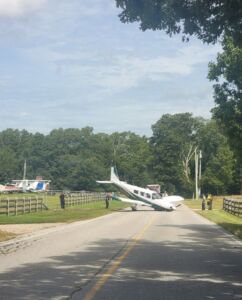
First responders were called to the Richmond Airport around 11:50 a.m. for reports of a plane down on Heaton Orchard Road.
Richmond – Carolina Fire District Chief Scott Barber told 12 News the plane crashed through a fence and landed nose first in the middle of the road. He said the two occupants — a husband and wife from New Jersey — had already climbed out before crews arrived.
No injuries were reported, nor were there any fuel spills or fire as a result of the incident. The plane, listed in the Federal Aviation Administration registry as a Piper Cherokee 6, only sustained only minor damage.
“The pilot had never landed here before. He got diverted from Quonset. He came in a little fast for the length of the runway and overshot,” Barber explained, adding that the pilot might have misjudged the airspeed.
Police said detours were place but the road has since reopened, as of 2 p.m.
The RI Airport Corporation and Crash Rescue responded to the scene. The FAA is investigating.
https://www.wpri.com/news/local-news/south-county/small-plane-crashes-in-richmond/amp/
NTSB Prelim: Cessna 172L
When The Throttle Was Pushed In It Would Forcibly Push Back Out On Its Own
Location: Micanopy, FL Accident Number: ANC26LA088
Date & Time: August 18, 2026, 11:00 Local Registration: N3866Q
Aircraft: Cessna 172L Injuries: 2 None
Flight Conducted Under: Part 91: General aviation - Instructional
On August 18, 2026 at 1100 eastern daylight time, a Cessna 172L, N3866Q, was substantially damaged when it was involved in an accident near Micanopy, Florida. The flight instructor and student pilot were uninjured. The airplane was operated as a Title 14 Code of Federal Regulations Part 91 instructional flight.
The flight instructor reported that during the power recovery to a power off stall the student pilot was having trouble pushing the throttle back in during the recovery portion of the procedure. The flight instructor attempted to demonstrate the maneuver and when he attempted the power on recovery the movement of the throttle did not increase the engine power. When the throttle was pushed in it would forcibly push back out on its own. They ran through their checklist as they attempted to return to the runway. The engine continued to run at idle speed as they made a force landing to a dry lakebed. During the landing rollout the nose wheel traveled into a marshy area and the airplane nosed over. The airplane sustained substantial damage to the wings.
An inspection of the throttle control system is pending.
FMI: www.ntsb.gov
Today in History
50 Years ago today: On 10 September 1976 Hawker Siddeley HS-121 Trident 3B operated by British Airways as flight BE476 and a McDonnell Douglas DC-9-32, operated by Inex-Adria Aviopromet, were destroyed when both aircraft crashed near Vrobec following a mid-air collision. All 176 on board both aircraft were killed.
| Date: | Friday 10 September 1976 |
| Time: | 10:14 |
| Type: | McDonnell Douglas DC-9-32 |
| Owner/operator: | Inex-Adria Aviopromet |
| Registration: | YU-AJR |
| MSN: | 47649/741 |
| Year of manufacture: | 1976 |
| Total airframe hrs: | 1345 hours |
| Cycles: | 990 flights |
| Engine model: | Pratt & Whitney JT8D-9A |
| Fatalities: | Fatalities: 113 / Occupants: 113 |
| Other fatalities: | 63 |
| Aircraft damage: | Destroyed, written off |
| Category: | Accident |
| Location: | near Vrbovec - Croatia |
| Phase: | En route |
| Nature: | Passenger - Non-Scheduled/charter/Air Taxi |
| Departure airport: | Split Airport (SPU/LDSP) |
| Destination airport: | Köln/Bonn Airport (CGN/EDDK) |
| Investigating agency: | AIB |
| Confidence Rating: | Accident investigation report completed and information captured |
Narrative:
Hawker Siddeley HS-121 Trident 3B operated by British Airways as flight BE476 and a McDonnell Douglas DC-9-32, operated by Inex-Adria Aviopromet, were destroyed when both aircraft crashed near Vrobec following a mid-air collision. All 176 on board both aircraft were killed.
The Trident was on a scheduled flight from London-Heathrow Airport in England to Istanbul-Yesilköy Airport in Turkey, carrying 54 passengers and a crew of 9. The aircraft took off at 08:32 GMT and the flight proceeded normally. First contact with the Zagreb Area Control Centre was established on the Upper Sector frequency 134,45 MHz at 10:04 GMT. The flight was requested to report passing the Zagreb VOR at flight level 330.
The aircraft flew along the centreline of airway UB5 with slight side deviation 1-2 km to the right due to wind. At 2 minutes and 50 seconds before the collision, the aircraft changed heading to 115° to head back towards the airway centreline. Airspeed was 295 Kts.
The DC-9 departed Split Airport at 09:48 GMT to fly 108 West German tourists back to Cologne. Flight JP550 was issued instructions to climb to FL180.
At 09:54 the flight, on passing flight level 130, switched to the Zagreb Area Control Centre lower sector east frequency of 124.6 MHz, receiving clearance to climb to FL240 and later to FL260.
At 10:03 the crew switched to the frequency of the middle sector controller, responsible for safety and regulation of traffic between flight levels 250 and 310. This controller cleared to flight to FL350.
The aircraft assumed a heading of 353° and a speed of 273 Kts as it passed a beam and to the west of the KOS NDB, approximately 2-3 km from the airway centreline. While heading towards the Zagreb VOR, the flight crew radioed the Upper Sector controller on frequency 134,45 MHz at 10:14:04 GMT and reported that they were climbing through FL325. The controller then requested, in Serbo-Croatian, flight JP550 to maintain their present altitude and report passing the Zagreb VOR. The controller stated that an aircraft was in front passing from left to right at FL335, while in fact BE476 was at FL330. At 10:14:38 the crew replied, also in Serbo-Croatian, that they where maintaining FL330.
Three seconds later both aircraft collided. The outer five meters of the DC-9's left wing cut through the Trident's cockpit. Due to the sudden decompression, the forward part of the Trident's fuselage disintegrated. The remaining part of the fuselage struck the ground tail-first. With its left wing torn off, the DC-9 tumbled down and hit the ground right-wing first.
CAUSES OF THE ACCIDENT: "1) Direct cause of the accident was the struck of the DC-9 wing into the middle side of the TRIDENT THREE fuselage which occurred at the height of 33.000 feet above Zagreb VOR so that both aircraft became uncontrollable and fell on the ground.; 2) Improper ATC operation; 3) Non-compliance with regulations on continuous listening to the appropriate radio frequency of ATC and non-performance of look-out duty from the cockpits of either aircraft."
