Today is Friday the 11th of September, 2026 – NEVER FORGET!
Today is the twenty-fifth anniversary of the cowardice and murderous attacks on our Country on September 11th, 2001, a day that forever changed our country, our careers as firefighters and first responders, and the lives of so many families.
We honor the 343 FDNY Firefighters, 37 PANYNJ police officers, 23 police officers from the NYPD and the 8 EMS paramedics and EMT’s who made the ultimate sacrifice that day, and remember the 36 United and American Airline flight and cabin crew members along with the thousands of innocent lives lost at the World Trade Center, the Pentagon, and aboard United 93 near Shanksville, Pennsylvania. 
We also remember the many Firefighters, Paramedics, Police Officers, and Recovery Workers who have since lost their lives or continue to suffer from illnesses, physical injury or related trauma connected to their service at Ground Zero.
Our hearts, our thoughts and our prayers continue to be with the families and friends of those whose lives were lost, as well as those survivors who continue to suffer from the events of that day. WE WILL ALWAYS REMEMBER!
God Bless you all, and for those who have made the supreme sacrifice, may they all Rest in Peace….
Firefighter's Prayer
When I am called to duty, God wherever flames may rage, give me strength to save a life, whatever be its age.
Help me to embrace a little child before it's too late, or save an older person from the horror of that fate.
Enable me to be alert to hear the weakest shout, and quickly and efficiently to put the fire out.
I want to fill my calling and to give the best in me, to guard my neighbor and protect his property.
And if according to your will I have to lose my life, bless with your protecting hand my loving family from strife.
NEVER FORGET!
Here are the ARFF related stories for today...
Plane crash at Jetport under investigation
By Yvonne Suarez
SANTA TERESA, NM (KVIA) - Two people were injured after a plane crash Thursday morning according to a release from Doña Ana County. 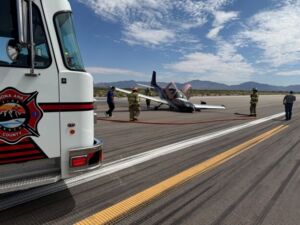
The crash happened at the Doña Ana County International Jetport in Santa Teresa, New Mexico.
Members of the Doña Ana County Fire Rescue responded to the crash. Two people received minor injuries and refused transport.
Authorities said the runway is secured at this time and will reopen later this afternoon.
Pilot uninjured after small plane crashes through fence near Polson Airport
by NBC Montana Staff
POLSON, Mont. — Lake County Sheriff Don Bell says emergency crews responded to a report of a plane crash around 10 a.m. Thursday. 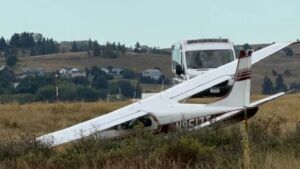
On scene the pilot, a Polson resident, was already out of the plane and uninjured.
The pilot said he was returning from a flight down the Mission Valley when he lost lift as he was coming in for a landing at the Polson Airport.
On approach, the single-engine two-door plane crashed through a fence on the north side of the airport near Highway 93.
The crash through the fence tore off two wheels, bent one prop and damaged the wing before it came to a rest.
https://nbcmontana.com/newsletter-daily/pilot-uninjured-after-small-plane-crashes-through-fence-near-polson-airport
NTSB Data: Amazon Cargo Pilots Appeared To Try To Abort Landing
Throttles Were Increased To Values Consistent With Go-Around Thrust
The pilots of the Amazon cargo jet that overran a runway at Miami International Airport on Sunday struggled to control the aircraft as it touched down and may have considered aborting the landing, according to a timeline of its final seconds federal investigators said.
The sequence of events detailed by National Transportation Safety Board investigators likely cost the pilots hundreds of feet of runway length and crucial seconds before the plane ran off the runway, according to aviation experts who reviewed the timeline. The plane struck two vehicles as it exited the airport grounds and crossed a public road, killing five.
During a news conference on Tuesday night, Chihoon Shin, the lead investigator, laid out what happened during the final 30 seconds captured by the flight data recorder, which stopped operating as designed when the plane’s power supply cut off, most likely from the crash.
The problems with the landing were apparent from the start.
At 30 seconds out, according to Shin, the plane’s nose landing gear and its right-side main landing gear touched down. The plane was traveling at nearly 182 miles per hour — faster than what is considered ideal for such planes, according to aviation experts.
The pilots did not apply the brakes for seven more seconds, and the left-side main landing gear did not make contact with the runway for four seconds after that, Shin said.
Fifteen seconds before the recording cut off, after all the landing gear was on the runway, the planes’ brakes released and the throttles increased, which five aviation experts told the New York Times was a telltale sign of a decision to abort the landing.
The plane was moving at 138 m.p.h. when the brakes released, and “throttles increased to values consistent with go-around thrust,” Shin told reporters.
The pilots did not idle the throttles and reapply the brakes until 11 seconds before the recording ended, at which point the aircraft was moving at nearly 135 m.p.h., according to Mr. Shin. While the brakes remained engaged for the rest of the recording, he added, the pilots never deployed the airplane’s speed brakes, which are flaps located on the wings, or its thrust reversers, both of which could have helped slow the aircraft further.
Investigators did not detail how close to the end of the runway the plane was at the critical junctures.
“That’s something we still have to determine,” Jennifer Homendy, the NTSB chair, told reporters.
FMI: www.ntsb.gov
NTSB Prelim: Piper PA-32-260
About 10 Minutes After Establishing Cruise Flight, The Engine Experienced A Total Loss Of Power
Location: Pinetown, NC Accident Number: ANC26LA080
Date & Time: August 6, 2026, 13:55 Local Registration: N8791E
Aircraft: Piper PA-32-260 Injuries: 3 Minor
Flight Conducted Under: Part 91: General aviation - Personal
On August 6, 2026, about 1355 eastern daylight time, a Piper Aircraft PA-32-260 airplane, N8791E, was substantially damaged when it was involved in an accident near Pinetown, North Carolina. The private pilot and two passengers sustained minor injuries. The airplane was operated as a Title 14 Code of Federal Regulations Part 91 personal flight. According to the pilot, after departing Martin County Airport (MCZ), Williamston, North Carolina, enroute to Ocracoke Island Airport (W95), Ocracoke, North Carolina, he climbed to and leveled at 3,000 ft mean sea level. About 10 minutes after establishing cruise flight, the engine experienced a total loss of power.
The pilot established the airplane's best-glide airspeed, transmitted a mayday call, and attempted to restart the engine. Unable to restore engine power, he selected a logging path within a wooded area for a forced landing. During the landing rollout, the airplane's left wing struck a tree. The airplane subsequently impacted another tree and came to rest in a ditch, resulting in substantial damage to the wings and fuselage.
The wreckage was recovered to a secure facility for further examination.
FMI: www.ntsb.gov
Today in History
Aside from the obvious history of this day in 2001, we remember the following tragic aviation accident that occurred this date in 1974 at Charlotte-Douglas Airport in North Carolina…
52 Years ago today: On 11 September 1974 Eastern Air Lines flight 212, a DC-9-30, crashed while on approach to Charlotte-Douglas Airport, NC, USA, killing 72 occupants; 10 survived the accident.
| Date: | Wednesday 11 September 1974 |
| Time: | 07:34 |
| Type: | McDonnell Douglas DC-9-31 |
| Owner/operator: | Eastern Air Lines |
| Registration: | N8984E |
| MSN: | 47400/443 |
| Year of manufacture: | 1969 |
| Total airframe hrs: | 16860 hours |
| Engine model: | P&W JT8D-7B |
| Fatalities: | Fatalities: 72 / Occupants: 82 |
| Other fatalities: | 0 |
| Aircraft damage: | Destroyed, written off |
| Category: | Accident |
| Location: | 5,3 km S of Charlotte-Douglas Airport, NC (CLT) - United States of America |
| Phase: | Approach |
| Nature: | Passenger - Scheduled |
| Departure airport: | Charleston Municipal Airport, SC (CHS/KCHS) |
| Destination airport: | Charlotte-Douglas Airport, NC (CLT/KCLT) |
| Investigating agency: | NTSB |
| Confidence Rating: | Accident investigation report completed and information captured |
Narrative:
Eastern Air Lines flight 212, a DC-9-30, crashed while on approach to Charlotte-Douglas Airport, NC, USA, killing 72 occupants; 10 survived the accident.
Flight EA212, a Douglas DC-9-31, N8984E, operated as a scheduled passenger flight from Charleston, South Carolina, to Chicago, Illinois, with an en route stop at Charlotte, North Carolina. The flight departed Charleston at 07:00 hours local time with 78 passengers and 4 crew members on board. The first officer was Pilot Flying.
During the descent into Charlotte, until about 2 minutes and 30 seconds prior to the accident, the flightcrew engaged in conversations not pertinent to the operation of the aircraft. These conversations covered a number of subjects, from politics to used cars, and both crewmembers expressed strong views and mild aggravation concerning the subjects discussed.
At 07:32:13, as the flight intercepted the inbound VOR radial for the approach, the flightcrew commenced a discussion of Carowinds Tower, which was located ahead and to the left of the projected flightpath.
This discussion lasted 35 seconds, during which 12 remarks were made concerning the subject. A considerable degree of the flightcrew's attention was directed outside the cockpit during that time. During this period, the aircraft descended through 1,800 feet (1,074 feet above touchdown elevation), the altitude which should have been maintained until it crossed Ross Intersection, the final approach fix (FAF). At the end of the 35-second period, the aircraft was still 1.5 nm short of the FAF.
At 07:32:41, during the latter part of the discussion regarding Carowinds Tower, the terrain warning alert sounded in the cockpit, signifying that the aircraft was 1,000 feet above the ground.
Within seconds after the discussion of Carowinds Tower terminated at 07:32:48, the rate of descent of the aircraft was slowed from about 1,500 feet per minute to less than 300 feet per minute.
At 07:33:24, the aircraft passed over Ross Intersection (the FAF) at an altitude of 1,350 feet (624 feet above field elevation), which is 450 feet below the prescribed crossing altitude.
The captain did not make the required callout at the FAF, which should have included the altitude (above field elevation) and deviation from the Vref speed. Although shortly before crossing the FAF, one of the pilots stated "three ninety four," a reference to the MDA in height above field elevation.
While in the vicinity of Ross Intersection, the first officer asked for 50 degrees of flaps; this request was carried out by the captain. The airspeed at this time was 168 knots, as contrasted with the recommended procedure which calls for the airspeed when passing over the FAF to be in the area of Vref, which in this instance was 122 knots.
At 07:33:36, the captain advised Charlotte Tower that they were by Ross Intersection. The local controller cleared the flight to land on runway 36. The last radio transmission from the flight was the acknowledgement, "Alright," at 07:33:46.
Shortly after passing Ross Intersection, the aircraft passed through an altitude of 500 feet above field elevation, which should have prompted the captain to call out altitude, deviation from Vref speed, and rate of descent. No such callout was made, nor was the required callout made when the plane descended through an altitude 100 feet above the MDA of 394 feet above the field elevation. The descent rate, after passing Ross, increased to 800 feet per minute, where it stabilized until approximately 7 to 8 seconds prior to impact, when it steepened considerably.
According to the CVR, at 0733:52, the captain said, "Yeah, we're all ready," followed shortly thereafter by "All we got to do is find the airport". At 07:33:57, the first officer answered "Yeah". About one-half second later both pilots shouted. The aircraft struck some small trees and then impacted a cornfield about 100 feet below the airport elevation of 748 feet.
The aircraft struck larger trees, broke up, and burst into flames. It was destroyed by the impact and ensuing fire.
The aircraft crashed about 1.75 statute miles from Ross Intersection and about 3.3 statute miles short of the threshold of runway 36.
Eleven passengers and two crewmembers survived the crash and fire. One passenger died 3 days after the crash, one after 6 days and another passenger died 29 days after the accident.
PROBABLE CAUSE: "The flight crew's lack of altitude awareness at critical points during the approach due to poor cockpit discipline in that the crew did not follow prescribed procedure."
