From Chattanooga, Tennessee where we're setting up for the kick-off event this evening at the 2026 ARFFWG Annual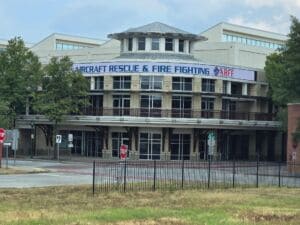 Educational Symposium, the premier event for those involved in the aviation firefighting profession.
Looking forward to meeting my old ARFF Brothers and Sisters as well as having the opportunity to make new ones at these ARFF Working Group events.
We'll be here all week, so if you're here at the conference, stop by the Simulation Booth and say hello!
Now here are the stories to start the week...
Be safe out there!
Tom
--
Two dead after a small plane crashes in Santa Elena de Uairén
Candy Valbuena
A small plane crashed on Sunday afternoon, September 20, a few meters from the Santa Elena de Uairén airport, in the Gran Sabana municipality of Bolívar state, resulting in two deaths.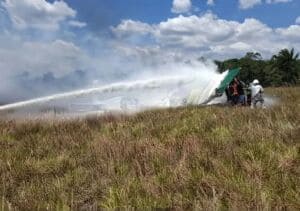
According to witnesses at the crash site, the aircraft had just taken off when it went down. Two people were on board: Gilberto Bruzual, the pilot, and mechanic Luis Cabriales.
Through social media, those present shared images showing the aircraft engulfed in flames, while authorities attempted to control and extinguish the fire.
According to initial reports from the area, the civilian aircraft crashed to the ground a few kilometers from the runway shortly after taking off.
The impact caused a fire that consumed much of the aircraft's structure, hindering initial rescue efforts and complicating the identification of bodies at the site.
Witnesses in the area reported hearing a loud bang before observing a column of smoke rising over the rural area near the airfield.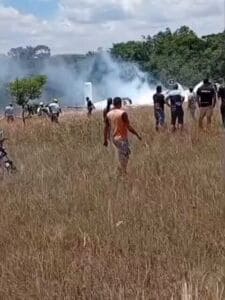
Firefighters, state security officials, and emergency personnel immediately moved to the scene to extinguish the flames and cordon off the perimeter while the initial investigations were carried out.
An official report is expected.
Authorities have not yet specified the technical causes of the aircraft crash, although they do not rule out that a mechanical failure may have been related to the accident.
Officials from the Scientific, Criminal and Forensic Investigations Corps (Cicpc) removed the victims' bodies and collected evidence at the site as part of the investigation process, which will seek to determine if there were human, mechanical or other types of failures.
Authorities are expected to release an official statement in the coming hours with more details about the aircraft's registration number, its flight path, and the progress of the investigation into this latest air accident in the south of the country.
Dos muertos al estrellarse una avioneta en Santa Elena de Uairén
One pilot dies, another survives after gliders collide in New York state
The crash occurred Friday afternoon near Wheeler Road in the town of Edinburg, New York State Police said.
By Minyvonne Burke and Dennis Romero
The pilot of a glider involved in a midair collision in the skies above New York’s Saratoga County on Friday was found dead following a search for wreckage, New York State Police said. 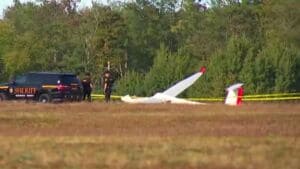
The discovery was made after state police, New York State Forest Rangers, and the Saratoga County Sheriff’s Office found debris in a remote area in Edinburg, police said in a statement.
The other glider landed safely at Plateau Sky Ranch Airport and its pilot was said to be uninjured, police said earlier.
The identity of the deceased pilot has not been publicly released.
State police said they responded to a report of a collision near Wheeler Road, in the small town of Edinburg, just before 2:30 p.m. Friday.
The Federal Aviation Administration described the crashed glider as a Schempp-Hirth Ventus, and the one that landed safely as a Schleicher AS24.
Each glider had only a pilot on board, the FAA said in a statement.
The crash prompted a sizable response from area first responders, according to Broadcastify radio traffic from the Saratoga County Fire and EMS.
The FAA said the National Transportation Safety Board will be in charge of the investigation.
Edinburg, a town of a little more than 1,300, is located in Saratoga County and is about 54 miles northwest of Albany.
https://www.nbcnews.com/news/us-news/police-investigating-aircraft-collision-new-york-rcna598616
Man describes finding US military F-16 fighter jet pilot after Michigan crash
By Aaron Cooper, Jillian Sykes
BLAIR TOWNSHIP, Mich. -- A US military F-16 fighter jet crashed in northern Michigan during a training exercise Thursday afternoon, with the pilot ejecting and 30 people being treated for toxic chemical exposure, officials reported.
The Texas Military Department said the F-16 belonged to the Texas Air National Guard's 149th Fighter Wing and was doing a routine training mission from a National Guard base in Alpena, Michigan, when it crashed in Grand Traverse County.
"The pilot successfully ejected from the aircraft," the department said.
"We have a possible mayday by wingman. I believe (they) may have taken a bird," a military pilot alerted air traffic controllers, according to audio captured by LiveATC.net.
Ed Wilson saw the jet flying erratically moments before it crashed.
"I saw the fighter... with its nose up and it was and it was extremely low and I knew that it was going down," he told CNN affiliate WPBN.
The cause of the crash has not been determined and the military said it is investigating.
Video shared with CNN showed a fireball in a field next to homes and a large smoke plume in a rural community south of Traverse City, about 130 miles north of Grand Rapids.
"It appears that they may have lost an engine and ejected... but we do see a lot of black smoke, which we believe is the ejected F-16," an air traffic controller relayed to other pilots.
Benjamin Vyverberg says he saw the pilot parachuting down and called 911.
"I just like darted over, crossed the road and into the woods and I just ran until I saw an open field. It was super easy to find. There was like this giant orange parachute in this field," he told WPBN. "I went over to him and I was like, don't move. He said he could wiggle his toes, so I assumed like he wasn't paralyzed."
The pilot was taken to a local hospital in stable condition, police said.
No one else was injured in the initial crash, but "several" first responders were among the 30 people treated for possible exposure to hazardous chemicals, police and hospital said Friday morning. Six people remained in Munson Medical Center overnight and all were in stable condition.
The hospital said it used an outdoor treatment area to evaluate and decontaminate patients for exposure to the hazardous chemical hydrazine.
Hydrazine is a highly toxic fuel used in an emergency power system in the F-16 and can cause coughing, wheezing or trouble breathing.
Homes and businesses within a one-mile radius were evacuated due to a "hazardous chemical spill related to the plane crash," Michigan State Police said in a social media post. Most residents were allowed to return home by 10 p.m. Thursday.
Shellie Doornbos and her husband were driving home from running errands when they saw the fireball.
"We could hear explosions coming from the fire and asked a police officer what it was we were hearing as we were driving away, and he told us it was a fighter jet crash and the explosions were ammunition," she told CNN.
If it was a bird strike, as the military pilot suggested to air traffic control, it would not be unusual.
Thousands of planes hit birds and other animals in the United States each year, according to the Federal Aviation Administration Wildlife Strike Database. Forty-one strikes were reported in 2025 in Traverse City, Michigan, alone in 2025.
https://abc13.com/post/michigan-news-man-describes-finding-us-military-16-fighter-jet-pilot-crash-during-training-exercise/19848212/
Airport Vehicles Get New Eyes
FAA Funding Will Equip 3,000 Ground Vehicles With Technology Designed To Give Controllers A Better View Of Runway And Taxiway Activity
A vehicle moving across an airport surface may look routine, but knowing exactly where it is can matter just as much as tracking an aircraft overhead.
The FAA is putting $10.9 million toward equipping 3,000 airport vehicles with vehicle movement area transmitters, or VMATs, across 61 airports. The technology is arriving as part of a much larger $1.1 billion investment in airport infrastructure.
The grants, distributed through the Airport Improvement Program, span 46 states and three U.S. territories and include everything from runway reconstruction to terminal improvements. Hartsfield-Jackson Atlanta International Airport is receiving $30.7 million for runway work, while Shreveport Regional Airport has been awarded $18.9 million for a terminal expansion.
VMATs stand out because they address one of aviation's most complicated spaces, the airport surface. Service trucks, maintenance vehicles and other ground traffic can operate around aircraft and taxiways, creating an environment where controllers need an accurate picture of what is moving and where.
FAA Administrator Bryan Bedford said the transmitters will provide controllers with greater situational awareness of aircraft and vehicles on the airport surface.
The funding also includes $11.5 million for a new contract tower at Mankato Regional Airport and $2 million for improvements at McAllen International Airport, including baggage claim areas, restrooms, nursing stations and ticket counters.
The investment shows how modernizing aviation increasingly means improving what happens between the runway and the terminal, where every movement still depends on knowing exactly where everything is.
FMI: www.faa.gov/airports
NTSB Prelim: Zenith CH701
While Climbing Through Approximately 300 Ft Agl, The Pilot Observed A Decrease In Engine Rpm Followed By A Total Loss Of Power
Location: Byron, CA Accident Number: WPR26LA324
Date & Time: August 30, 2026, 09:05 Local Registration: N701WJ
Aircraft: Zenith CH701 Injuries: 1 None
Flight Conducted Under: Part 91: General aviation - Personal
On August 30, 2026, about 0905 Pacific daylight time, an experimental amateur-built Zenith CH701, N701WJ, was substantially damaged when it was involved in an accident at Byron Airport (C83), Byron, California. The pilot was not injured. The airplane was operated as a Title 14 Code of Federal Regulations Part 91 personal flight.
The airplane had previously sustained damage in an accident at Byron in 2019 (see NTSB report WPR20LA035). It was subsequently repaired by the pilot, with work including reconstruction of the aft fuselage, construction of a new rudder, and fabrication of a new set of wings. Following completion of the repairs, engine and systems testing was conducted. The day before the accident, additional taxi tests, high-speed runs, and takeoff tests with immediate landings were performed at Byron, with no anomalies reported.
On the day of the accident, the pilot taxied the airplane to the run-up area following which he conducted two additional cycles of high-speed taxi and takeoff tests on runway 23. After observing normal operation, the pilot elected to takeoff and remain in the traffic pattern. While climbing through approximately 300 ft agl, the pilot observed a decrease in engine rpm followed by a total loss of power.
The pilot reported that his attention was focused on returning to the airport for landing and he did not have sufficient time to troubleshoot the loss of engine power. The pilot maneuvered the airplane toward the airport and landed in a grass area adjacent to the runway.
During the landing roll, the airplane struck a ditch and nosed over. The airplane sustained substantial to the leading edges of both wings, left-wing strut, rudder and aft fuselage.
The airplane was retained for further examination.
FMI: www.ntsb.gov
NTSB Prelim: Cirrus Design Corp SR22
Pilot Stated That During Landing At Ashland County Airport (3G4), Ashland, Ohio, The Airplane’s Right Brake Did Not Operate
Location: Ashland, OH Accident Number: ERA26LA333
Date & Time: September 7, 2026, 12:55 Local Registration: N521LM
Aircraft: Cirrus Design Corp SR22 Injuries: 1 None
Flight Conducted Under: Part 91: General aviation - Personal
On September 7, 2026, about 1255 eastern daylight time, a Cirrus Design Corp SR22, N521LM, was substantially damaged when it was involved in an accident near Ashland, Ohio. The pilot was not injured. The airplane was operated as a Title 14 Code of Federal Regulations Part 91 personal flight.
The pilot stated that during landing at Ashland County Airport (3G4), Ashland, Ohio, the airplane’s right brake did not operate. The left brake operated normally, and the airplane began to veer to the left. He kept the airplane on the centerline of the runway utilizing rudder controls; however, when the airplane slowed down it departed the left side of the runway and contacted two runway lights, which resulted in substantial damage to the wing and firewall.
Examination of the airplane by an FAA inspector revealed that the right brake disc was circumferentially fractured.
The brake disc was retained for further examination.
FMI: www.ntsb.gov
NTSB Final Report: Jeremy Price Smith Super Cub
After Landing, During A “Fast-Taxi Maneuver” (The Pilot) Struck Ground Equipment That Was Obscured Because Of The Tailwheel Airplane’s Nose-High Pitch Attitude
Location: Allisonia, Virginia Accident Number: ERA26LA275
Date & Time: July 19, 2026, 13:30 Local Registration: N251HF
Aircraft: Jeremy Price Smith Super Cub Aircraft Damage: Substantial
Defining Event: Ground collision Injuries: 2 None
Flight Conducted Under: Part 91: General aviation - Personal
Analysis: The pilot reported that he performed four practice landings at the departure airport, to confirm landing performance, then continued to a private gravel airstrip. He overflew the airstrip and observed calm wind conditions, then performed another flyover to verify the runway was clear of obstructions. While on final approach, a gust of wind resulted in a temporary increase in airspeed then a touchdown farther than planned. After landing, during a “fast-taxi maneuver” he struck ground equipment that was obscured because of the tailwheel airplane’s nose-high pitch attitude. The landing gear collapsed, then the airplane then struck another piece of equipment, which resulted in substantial damage to the left wing.
The pilot stated that there were no preimpact mechanical malfunctions or failures of the airplane that would have precluded normal operation.
Probable Cause and Findings: The National Transportation Safety Board determines the probable cause(s) of this accident to be -- The pilot’s inadequate lookout, which resulted in a collision with ground equipment during taxi.
FMI: www.ntsb.gov

Today in History
57 Years ago today: On 21 September 1969 Mexicana flight MX801, a Boeing 727, crashed while on approach to Mexico City-Benito Juárez Airport, Mexico, killing 27 occupants; 91 survived the accident.
| Date: | Sunday 21 September 1969 |
| Time: | 17:20 |
| Type: | Boeing 727-64 |
| Owner/operator: | Mexicana de Aviación |
| Registration: | XA-SEJ |
| MSN: | 19255/331 |
| Year of manufacture: | 1966 |
| Engine model: | P&W JT8D-7B |
| Fatalities: | Fatalities: 27 / Occupants: 118 |
| Other fatalities: | 0 |
| Aircraft damage: | Destroyed, written off |
| Category: | Accident |
| Location: | 1,5 km NE of Mexico City-Juarez International Airport (MEX) - Mexico |
| Phase: | Approach |
| Nature: | Passenger - Scheduled |
| Departure airport: | Chicago-O'Hare International Airport, IL (ORD/KORD) |
| Destination airport: | Mexico City-Benito Juárez International Airport (MEX/MMMX) |
Narrative:
Mexicana flight MX801, a Boeing 727, crashed while on approach to Mexico City-Benito Juárez Airport, Mexico, killing 27 occupants; 91 survived the accident.
The Boeing 727 was cleared for a runway 23L ILS approach at Mexico City-Juarez International Airport (MEX) when it suddenly lost height and struck the ground 1500 m short of the runway. The aircraft became airborne again until the undercarriage and forward fuselage struck a railway embankment. Aircraft configuration at the time of the accident was gear down, flaps 30deg, leading edge slats extended, spoilers retracted, stabilizer at 10.25 units nose up.
No data could be retrieved from the Flight Data Recorder because it had been incorrectly installed two days prior to the accident. The Cockpit Voice Recorder had been removed and no replacement had been installed.
