Here's what we have for today...
Be safe out there!
Tom
--
Four Injured After Landing Mishap Aboard USS Dwight D. Eisenhower, Crew Safely Recovered
By Sam LaGrone
Four personnel were injured in a landing mishap aboard USS Dwight D. Eisenhower (CVN-69) on Monday, USNI News has learned. 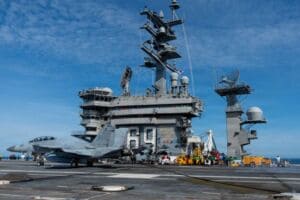
The crew of the unspecified two-seat aircraft assigned to Carrier Air Wing 3 was safely recovered after ejecting from the aircraft, the Navy said in a statement provided to USNI News.
“At approximately 6:18 p.m. EDT on Sept. 28, a mishap occurred during aircraft recovery operations aboard the Nimitz-class aircraft carrier USS Dwight D. Eisenhower (CVN 69) off the coast of Virginia,” reads the statement. “Both aviators were safely returned to the ship and are being evaluated by medical personnel. Four shipboard personnel were also injured during the mishap and are receiving medical care. One sailor is being transported to a Norfolk-area hospital for treatment of non-life-threatening injuries.”
Eisenhower is in the midst of early carrier qualifications after completing its most recent repair period in July. According to ship spotters, the ship left this afternoon from Naval Station Norfolk, Va.
While the service did not identify the lost plane, the Navy has two types of two-seat carrier aircraft – the F/A-18F Super Hornet and EA-18G Growler electronic attack aircraft – assigned to air wings. The Navy also flies the two-seat T-45 Goshawk trainer.
https://news.usni.org/2026/09/28/four-injured-after-landing-mishap-aboard-uss-dwight-d-eisenhower-crew-safely-recovered
NTSB: Training Flight Went Down After Multiple Go-Arounds
Flight Instructor, Student Died In Cessna 172 Accident At Montgomery-Gibbs Executive Airport In San Diego
The National Transportation Safety Board preliminary report says the airplane remained in the local airport traffic pattern for the duration of the accident flight on September 7, performing nine left-hand visual traffic patterns to runway 28L.
“Airport and nearby business security cameras captured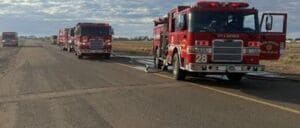 portions of the accident flight as the airplane approached the runway and as the pilots performed multiple go around maneuvers. Witnesses also observed the airplane and described the airplane as flying very erratically during multiple go-around maneuvers, pitching upward steeply after the go-around was initiated, flying very slow, and “stalling” before the airplane recovered, the report says.
“On the nineth approach the airplane can be seen in one of the videos flying low near the ground as it approached the runway, nosing over, pitching up and then nosing over a second time. The airplane then entered a steep nose high pitch attitude prior to the runway 28L threshold. The airplane appeared to attain about 45° pitch up attitude while about 100 to 200 ft above ground level. The airplane entered a steep left descending turn and impacted runway 28L near the runway threshold. The airplane came to rest on taxiway B and a post impact fire ensued,” the NTSB said.
Flight instructor Frederic Hewett, 37, and a student of his, Roger Shimizu, 45, were fatally injured.
No anomalies were identified that would have precluded the normal production of engine power.
Photo courtesy San Diego Fire And Rescue.
FMI: www.ntsb.gov

Today in History
20 Years ago today: On 29 September 2006 Gol flight 1907, a Boeing 737-800, crashed near Peixoto Azevedo, Brazil, following a mid-air collision with an Embraer Legacy 600 executive jet, killing all 154 occupants.
| Date: | Friday 29 September 2006 |
| Time: | 16:57 |
| Type: | Boeing 737-8EH |
| Owner/operator: | Gol Linhas Aéreas |
| Registration: | PR-GTD |
| MSN: | 34653/2039 |
| Year of manufacture: | 2006 |
| Total airframe hrs: | 202 hours |
| Cycles: | 162 flights |
| Engine model: | CFMI CFM56-7B26 |
| Fatalities: | Fatalities: 154 / Occupants: 154 |
| Other fatalities: | 0 |
| Aircraft damage: | Destroyed, written off |
| Category: | Accident |
| Location: | 30 km from Peixoto Azevedo, MT - Brazil |
| Phase: | En route |
| Nature: | Passenger - Scheduled |
| Departure airport: | Manaus-Eduardo Gomes International Airport, AM (MAO/SBEG) |
| Destination airport: | Brasília-Presidente Juscelino Kubitschek International Airport, DF (BSB/SBBR) |
| Investigating agency: | CENIPA |
| Confidence Rating: | Accident investigation report completed and information captured |
Narrative:
Gol flight 1907, a Boeing 737-800, crashed near Peixoto Azevedo, Brazil, following a mid-air collision with an Embraer Legacy 600 executive jet, killing all 154 occupants.
On September 29, an Embraer Legacy 600 executive jet (N600XL) was scheduled to be delivered from the Embraer factory at São José dos Campos Airport (SJK) to the United States. An intermediate stop was planned at Manaus (MAO). The Legacy took off at about 14:51. The filed flight plan included a routing via the OREN departure procedure to Pocos beacon, then airway UW2 to Brasilia VOR (BRS), airway UZ6 to Manaus. The cruise altitude was filed as FL370, with a planned change to FL360 at BRS, and to FL380 at the TERES navigational fix, approximately 282 miles north of BRS.
Meanwhile, at 15:35, GOL Flight 1907, a Boeing 737-800, departed Manaus (MAO) on a scheduled flight to Brasilia (BSB) and Rio de Janeiro (GIG). The flight was also routed via UZ6 to BRS. Cruising altitude was FL370, which was reached at 15:58. At that time, Legacy N600XL had just passed BRS, level at FL370. There is no record of a request from N600XL to the control agencies to conduct a change of altitude after passing BRS. There is also no record of any instruction from air traffic controllers at Brasilia Center to the aircraft, directing a change of altitude. When the airplane was about 30 miles north-northwest of BRS, at 16:02, the transponder of N600XL was no longer being received by ATC radar. Between 15:51 and 16:26, there were no attempts to establish radio communications from either the crew of N600XL or ATC. At 16:26 the CINDACTA 1 controller made a "blind call" to N600XL. Subsequently until 16:53, the controller made an additional 6 radio calls attempting to establish contact. The 16:53 call instructed the crew to change to frequencies 123.32 or 126.45. No replies were received. Beginning at 16:48, the crew of N600XL made a series of 12 radio calls to ATC attempting to make contact. They heard the 16:48 call, but the pilot did not understand all of the digits, and requested a repeat. No reply from ATC was received. The pilot made 7 more attempts to establish contact.
Both the GOL Boeing 737 and the Legacy were now on a head on collision course on airway UZ6 at the same altitude. Because the transponder of N600XL was not functioning properly the TCAS equipment on both planes did not alert the crews. At FL370, over the remote Amazon jungle, both aircraft collided. The left winglet of the Legacy (which includes a metal spar) contacted the left wing leading edge of the Boeing 737. The impact resulted in damage to a major portion of the left wing structure and lower skin, ultimately rendering the 737 uncontrollable. The Boeing 737 was destroyed by in-flight break-up and impact forces.
The Embraer's winglet was sheared off and damage was sustained to the vertical stabilizer tip. The crew made numerous further calls to ATC declaring an emergency and their intent to make a landing at the Cachimbo air base. At 17:02, the transponder returns from N600XL were received by ATC. At 17:13, an uninvolved flight crew assisted in relaying communications between N600XL and ATC until the airplane established communication with Cachimbo tower.
A safe emergency landing was made.
CONTRIBUTING FACTORS.
1. Human Factor
1.1. Psychological aspect - a contributor
1.1.1. PR-GTD
Neither active failures were identified in relation to the crew, nor latent failures in relation to the organizational system of the company.
1.1.2. N600XL
Relatively to the crew of the N600XL, the following active failures were identified: lack of an adequate planning of the flight, and insufficient knowledge of the flight plan prepared by the Embraer operator; non-execution of a briefing prior to departure; unintentional change of the transponder setting, failure in prioritizing attention; failure in perceiving that the transponder was not transmitting; delay in recognizing the problem of communication with the air traffic control unit; and non-compliance with the procedures prescribed for communications failure.
The low situational awareness of the pilots (airmanship) was a relevant factor for the occurrence of the accident. It began during the phase of preparation for the operation, which was considered by them as routine. The attitude of the pilots about the mission permeated their behavior during the other phases, with the addition of several factors that contributed to aggravate the lowering of the situational awareness:
The non-elaboration of an adequate planning of the flight, a behavior that was influenced by the habitual procedure of the company, an aspect not favorable for the construction of a mental model to guide the conduction of the flight;
The haste to depart and the pressure from the passengers, hindering adequate knowledge of the flight plan, and negatively influencing the sequence of actions during the pre-flight and departure phases;
The crew dynamics, characterized by lack of division of tasks, lack of an adequate monitoring of the flight, and by informality. It was influenced by the lack of knowledge of the weight and balance calculations, and by the predominant little experience of the pilots in that aircraft model; and
the lack of specific Standard Operational Procedures (SOPs) set by the company for that
aircraft model to be complied with by the pilots.
Within this context, the inadvertent switch-off of the transponder occurred, possibly on account of the pilots little experience in the aircraft and its avionics. The transponder switchoff was not perceived by the crew, due to the reduction of the situational awareness relative to the alert of the TCAS condition, which did not draw the attention of the pilots. The lack of situational awareness also contributed to the crews not realizing that they had a communication problem with the ATC. Although they were maintaining the last flight level authorized by the ACC BS, they spent almost an hour flying at a non-standard flight level for the heading being flown, and did not ask for any confirmation from the ATC.
The performance deficiencies shown by the crew have a direct relationship with the organizational decisions and processes adopted by the operator: the inadequate designation of the pilots for the operation; the insufficient training for the conduction of the mission, and the routine procedures relative to the planning of the flight, in which there was not full participation of the crew.
1.1.3 SISCEAB
Considering the diversity and complexity of the non-conformities observed in the air traffic control domain, they will be presented in topics.
It is important to point out that the refusal of the Brasilia ACC controllers involved in the accident to participate in the interviews hindered the precise identification of the individual aspects that contributed to the occurrence of the non-conformities. Some of these aspects were kept in the field of hypotheses.
a) Transmission of an incomplete flight clearance by the assistant controller of the São Paulo Region of Brasilia ACC, and by the Ground controller of DTCEA-SJ.
