10 days to get your shopping done!
Here are the stories to start the week...
Be safe out there!
Tom
-
No injuries after United plane engine sparks during takeoff, starting brush fire
By Maggie More
A United Airlines flight out of Dulles International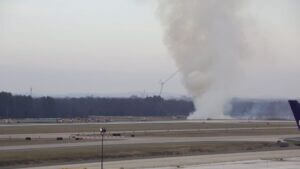 Airport made an emergency landing after one of the plane's engines failed during takeoff on Saturday afternoon.
One of the engines of the Boeing 777-200ER suddenly failed at takeoff around 12:20 p.m., the FAA said, producing sparks and smoke.
United Airlines Flight 803, en route to Tokyo, Japan, then landed safely back at Dulles, the FAA said.
There are no reports of injuries. No parts fell off of the plane, despite social media rumors.
As the plane was taking off and the engine sparked, it also "ignited some brush around the runway," the Metropolitan Washington Airports Authority (MWAA) said in a statement to News4.
The fire was extinguished by airport fire responders, the MWAA said. Those responders also checked the plane.
Smoke from the brush fire was visible from some distance away, and photos and video of the smoking plane were quickly shared on social media.
However, flights continued takeoff and landing at other Dulles runways while emergency crews delt with the United flight, indicating the scale of the emergency was small.
"Our fire department extinguished brush that caught fire near a runway around 12:20 p.m. as an aircraft took off," Dulles said in the statement. "The plane returned safely to Dulles. Flights continued operating on other runways. Thanks to those who reached out with your concerns."
United Airlines shared a statement with News4 about the engine failure and emergency landing.
"Shortly after takeoff, United flight 803 returned to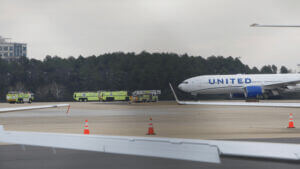 Washington Dulles and landed safely to address the loss of power in one engine," the statement said. "There were no reported injuries."
"We’ve temporarily closed a United Club lounge at Dulles to help assist our customers and work to get them to their destinations," the statement continued. "United is grateful to our crews and to the teams at Washington Dulles for their quick work to help ensure the safety of everyone involved."
There were 275 passengers and 15 crew members aboard the flight, United said. Another aircraft will continue the same flight later in the day.
The FAA is investigating.
https://www.nbcwashington.com/news/local/no-injuries-after-united-plane-engine-sparks-during-takeoff-starting-brush-fire/4028246/
Officials extract pilot after small plane crashes in Parker County
By Mack Shaw
The Brief
-
- Officials are responding to a small plane crash in Parker County.
-
- The pilot is conscious, but required extraction from the craft after the crash.
-
- Details on cause and injuries are limited.
CRESSON, Texas - A response is underway after a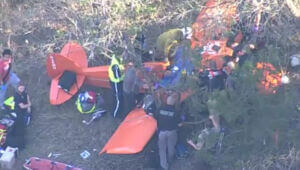 small plane crashed near a runway in Parker County Friday afternoon.
Cresson plane crash
What we know:
Parker County officials confirmed the crash to FOX 4 around 2:40 p.m. The incident happened near the 17000 block of U.S. Highway 377 in Cresson, Texas, southwest of Fort Worth.
Shortly after 3 p.m., it was confirmed that the plane crashed into a small creek near a runway, and first responders were actively working to free the pilot from the airplane.
The pilot was conscious and responding to personnel at the time, officials said.
Photos from the scene came from SKY 4, which flew over the scene of the incident.
The FAA will be investigating the crash.
What we don't know:
The cause of the crash has not been confirmed.
The identity of the pilot is unknown.
Information was extremely limited at the time of publishing.
https://www.fox4news.com/news/plane-crash-parker-county-cresson
Plane crashes near Sarnia
By Lauren Kuivenhoven
An aircraft crashed outside Sarnia on Friday night,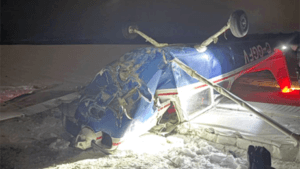 according to Sarnia Police.
Emergency crews are on the scene near Telfer Road and Michigan Line.
According to police, the pilot is being transferred to Bluewater Health with non-life-threatening injuries.
The public is asked to avoid the area, as emergency crews will be onsite for an unknown amount of time.
https://www.ctvnews.ca/london/article/plane-crashes-near-sarnia/
Aircraft Emergency in London Grove
West Grove Fire Company
A small single-engine plane had trouble while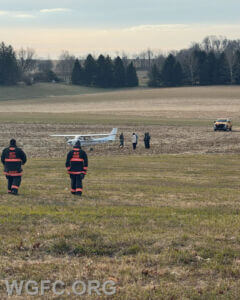 flying out of the New Garden airfield on Friday morning. It made an emergency landing in a field near the intersection of Lloyd Road and Route 841 in London Grove Township.
Emergency responders from the West Grove and Avondale Fire Companies were alerted for the possible aircraft down emergency at 8:43am. Arriving crews found that the plane had successfully executed an emergency landing, with no apparent damage to the aircraft nor injuries to those onboard. Medic 94 and the rescue from Longwood Fire Company, along with the Township Fire Marshal also responded.
The FAA is investigating the incident.
Units: Engine 22-1, Ambulance 22-2, Brush 22
Mutual Aid: Engine 23, Ambulance 23-1, Medic 94-2, Squad 23, FM59, Rescue 25
https://www.wgfc.org/news/1638/Aircraft-Emergency-in-London-Grove
Following the emergency at Cortissoz Airport, "the aircraft was removed and the runway is now fully operational."
Aerocivil confirmed.
The Civil Aeronautics Authority of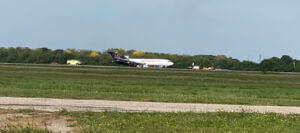 Colombia reported that following the air incident that occurred in the early hours of Friday, December 12, with a Boeing 727 cargo aircraft, registration HK-5216, operated by the company Aerosucre, at the Ernesto Cortissoz International Airport, the runway is currently fully operational.
The agency indicated that after takeoff, the aircraft reported a technical failure when it was unable to fully retract the left main landing gear. The crew executed the established procedures, declaring an in-flight emergency and performing a visual inspection of the landing gear.
No injuries or structural damage to the runway surface were reported during the emergency.
"Having exhausted all available options, the aircraft proceeded to a controlled landing with the left main landing gear partially retracted. The emergency plan was immediately activated, strictly adhering to national and international protocols. The response was coordinated between the operator Aerosucre, Air Traffic Control, the Fire Service, the Air Traffic Flow and Capacity Management Group, airport management, and a specialized oversized cargo crane operator," Aerocivil wrote in a statement.
He explained that the work consisted of unloading the 19 tons of cargo being transported, lifting the aircraft, manually deploying the left landing gear, securing the aircraft, and towing the aircraft safely off the runway.
"The aircraft was successfully removed and the runway is fully operational," he said
In coordination with Air Combat Command No. 3, technical and cleaning personnel carried out the collection of FOD material and the decontamination of minor fluid spills.
"To mitigate the impact on the schedule, airport management is reorganizing air traffic in coordination with all airlines, expecting the complete normalization of operations in the coming hours," Aerocivil assured.
Finally, he indicated that "a thorough review of operational and maintenance procedures will be coordinated with the relevant authorities to ensure operational safety at all airports in the country. The findings will be reported in due course."
https://zonacero.com/generales/tras-emergencia-en-el-cortissoz-aeronave-fue-retirada-y-la-pista-se-encuentra-plenamente
NTSB Final Report: North American T-6G
When He Next Looked Outside He Was Surprised To See That The Airplane Had Drifted To The Left
Location: Rossville, Tennessee Accident Number: ERA25LA371
Date & Time: September 28, 2025, 17:50 Local Registration: N888WV
Aircraft: North American T-6G Aircraft Damage: Substantial
Defining Event: Runway excursion Injuries: 1 Minor
Flight Conducted Under: Part 91: General aviation - Personal
Analysis: The pilot of the vintage, tailwheel-equipped airplane was departing from a turf runway. The pilot described that as he initiated the takeoff toward the west, and into the setting sun, he looked inside the airplane to verify the engine instruments. It took his eyes several seconds to adjust to the shaded cockpit and when he next looked outside he was surprised to see that the airplane had drifted to the left and he was no longer able to see the runway edge markers. The airplane’s main landing gear then encountered a “dip” that ran alongside the runway and he was unable to apply corrective control inputs to bring the airplane back onto the runway. The airplane’s left wing subsequently struck a metal pole and trees, after which the airplane nosed over and caught fire. Bystanders extricated the pilot from the cockpit and the airplane’s wings, fuselage, and empennage were substantially damaged.
A witness video of the takeoff showed that when the pilot began the takeoff roll, the airplane was not aligned with the runway and was oriented slightly left. As the engine power increased, the airplane veered further left. The airplane’s tailwheel was oscillating from side to side, and the rudder was visibly moving. Following the accident, the pilot could not recall whether he had locked the tailwheel prior to initiating the takeoff. Postaccident examination of the tailwheel assembly revealed that the tailwheel locking mechanism was locked, though it could not be determined whether this as-observed condition was consistent with the configuration during takeoff, had been engaged later during the accident sequence, or as the result of manipulation during the examination. Additionally, the tailwheel locking pin was broken into two pieces, with the upper half frozen into position in its guide while the lower half was worn. This condition would likely have resulted in the tailwheel lock operating unreliably, and with the tailwheel not properly locked, would have hampered any efforts the pilot would have made to realign the airplane with the runway after initiating the misaligned takeoff roll. Had the pilot confirmed the operation of the tailwheel locking mechanism prior to initiating the takeoff, it is possible that he could have recognized the deficiency and avoided the accident.
Probable Cause and Findings: The National Transportation Safety Board determines the probable cause(s) of this accident to be -- The pilot’s failure to adequately monitor the airplane’s path during takeoff toward the setting sun. Contributing was the undetected worn and fractured tailwheel locking pin.
FMI: www.ntsb.gov
NTSB Final Report: Textron Aviation Inc 525C
The Flight Crew Felt A Bump/Thud In The Back Of The Airplane, Which They Thought Was Caused By Something Falling Into The Aisle
Location: Baton Rouge, Louisiana Accident Number: CEN25LA402
Date & Time: September 25, 2025, 18:25 Local Registration: N361MB
Aircraft: Textron Aviation Inc 525C Aircraft Damage: Substantial
Defining Event: Landing gear collapse Injuries: 2 None
Flight Conducted Under: Part 91: General aviation - Positioning
Analysis: About 10,000 ft mean sea level during a repositioning flight, the flight crew felt a bump/thud in the back of the airplane, which they thought was caused by something falling into the aisle from the lavatory. The flight crew observed that the landing gear unsafe light was illuminated.
The flight crew stated that they followed emergency/abnormal airplane checklist items and reset the landing circuit breaker, which did not retract the landing gear. Then, the crew lowered the landing gear, which resulted in three green landing gear position lights. They continued the flight to the destination with the landing gear extended where they landed the airplane.
During landing rollout and after applying moderate braking, they felt the right main landing gear collapse, which then punctured the right wing and resulted in substantial damage to right wing. Postaccident examination revealed the aft main landing gear trunnion pin for the right main landing gear was not properly installed during the recent maintenance as the aft trunnion pin was not installed far enough to allow the retaining roll pin to engage and retain the trunnion pin. The pilot reported and maintenance records showed that maintenance performed by the aircraft manufacturer’s service center, which included the reinstallation of the main landing gear trunnion pin, occurred 2.9 hours before the accident.
According to the manufacturer’s maintenance manual installation procedures, maintenance personnel are required to make sure the aft end of the trunnion pin is at least 2.0 inches (50.8 mm) forward of the aft spar fitting to verify proper installation.
The Civil Aviation Accident and Incident Investigation Commission (CIAIAC) of Spain investigated a similar accident that occurred on May 4, 2018, as documented in CIAIAC Report A-012/2018. As a result of the investigation, the aircraft manufacturer published a mandatory service letter (SL525C-32-12) to do an inspection of the aft main landing trunnion pins for proper installation.
Probable Cause and Findings: The National Transportation Safety Board determines the probable cause(s) of this accident to be -- The improper installation of the trunnion pin, which resulted in a failure of the right main landing gear. Contributing to the accident was the failure of maintenance personnel to follow the aircraft manufacturer’s maintenance procedures.
FMI: www.ntsb.gov
NTSB Final Report: Gippsland GA-8
While Taxiing To Parking The Right Landing Gear Leg Collapsed, Resulting In Substantial Damage
Location: Lihue, Hawaii Accident Number: ANC25LA021
Date & Time: February 28, 2025, 10:58 Local Registration: N699AV
Aircraft: Gippsland GA-8 Aircraft Damage: Substantial
Defining Event: Sys/Comp malf/fail (non-power) Injuries: 1 Minor, 5 None
Flight Conducted Under: Part 91: General aviation - Aerial observation
Analysis: The pilot made a normal approach with full flaps and landed on the runway. While taxiing to parking the right landing gear leg collapsed, resulting in substantial damage to the fuselage and the right wing.
Postaccident examination showed that the right main landing gear leg failed from a fatigue crack that had developed in the gear leg and was not identified during annual maintenance inspections. There were visible oxides, corrosion pits, bubbled paint adjacent to the fracture surface, consistent with the presence of underlying corrosion damage. The fatigue crack should have been discovered during the recent inspection.
Probable Cause and Findings: The National Transportation Safety Board determines the probable cause(s) of this accident to be -- The failure of the right landing gear leg due to a fatigue crack, which resulted in its separation from the airplane during taxi. Contributing to the accident, was the mechanic’s inadequate inspection of the landing gear leg during the last maintenance inspection.
FMI: www.ntsb.gov
Today in History
28 Years ago today: On 15 December 1997 Tajikistan Airlines flight 3183, a Tupolev Tu-154B-1, crashed while on approach to Sharjah Airport, United Arab Emirates, killing 85 occupants; 1 survived the accident.
| Date: | Monday 15 December 1997 |
| Time: | 18:35 |
| Type: | Tupolev Tu-154B-1 |
| Owner/operator: | Tajikistan Airlines |
| Registration: | EY-85281 |
| MSN: | 78A281 |
| Year of manufacture: | 1978 |
| Engine model: | Kuznetsov NK-8-2U |
| Fatalities: | Fatalities: 85 / Occupants: 86 |
| Other fatalities: | 0 |
| Aircraft damage: | Destroyed, written off |
| Category: | Accident |
| Location: | 13 km E of Sharjah Airport (SHJ) - United Arab Emirates |
| Phase: | Approach |
| Nature: | Passenger - Non-Scheduled/charter/Air Taxi |
| Departure airport: | Dushanbe Airport (DYU/UTDD) |
| Destination airport: | Sharjah Airport (SHJ/OMSJ) |
| Confidence Rating: | Accident investigation report completed and information captured |
Narrative:
Tajikistan Airlines flight 3183, a Tupolev Tu-154B-1, crashed while on approach to Sharjah Airport, United Arab Emirates, killing 85 occupants; 1 survived the accident.
Flight 3183 was a charter flight from Dushanbe (DYU) to Sharjah (SHJ). After entering the United Arab Emirates airspace, the crew of the Tu-154 contacted Dubai Approach. Traffic was handled by Dubai because Sharjah did not have a surveillance radar. The crew received radar vectors and consecutive descent clearances from 17000 to 10000, 6000 and 2500 feet with a corrective turn to the course of 190°.
While the Tu-154 descended through a height of 3460 feet the crew were cleared further down to 1500 feet. At 1800 feet the aircraft entered an area of turbulence. The height of 1500 feet was reached at a point almost 16 km from the runway. The crew did not report reaching this height, but at the same time Dubai Approach instructed the crew to turn to a heading of 270 degrees in preparation for an ILS approach to runway 30.
While turning to the right, at a speed of 400 km/h, the landing gear was lowered. As the aircraft descended through 820 ft, an aural "bank angle" warning sounded, which ceased as the crew decreased the bank angle from 20 degrees to 14°. Descending through 690 ft, the crew again encountered turbulence. While preparing the aircraft for the final approach and landing the crew did not pay attention to their altitude. Suddenly one of the crew members noticed that they were too low and requested power to be added, but it was too late.
The aircraft struck desert terrain, broke up and caught fire.
PROBABLE CAUSE: "The pilot descended below the assigned altitude and unintentionally continued a descent into terrain. Contributing factors were self-induced stress, slight turbulence and non-adherence to operating procedures."
