Here are the stories to start the week...
Be safe out there!
Tom
--
Private Gulfstream Jet incident at La Romana International Airport triggers emergency response
Dominican Today
A private Gulfstream G200 business jet, registration 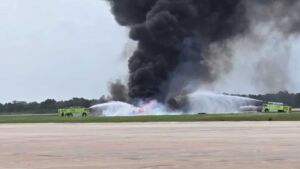 N318JF, was involved in an aviation incident Sunday afternoon at La Romana International Airport in the Dominican Republic, prompting a large-scale emergency response, according to the Dominican Institute of Civil Aviation (IDAC).
Images from the scene showed a thick column of black smoke as specialized airport rescue and firefighting teams worked to contain the blaze and secure the affected area.
Preliminary flight-tracking data indicates that the aircraft had been conducting maneuvers in the vicinity of La Romana before proceeding toward the airport. However, the circumstances surrounding the incident have not yet been officially confirmed.
Authorities have not released information regarding the number of occupants on board, nor have they confirmed whether there were any injuries or fatalities. The cause of the incident also remains under investigation. 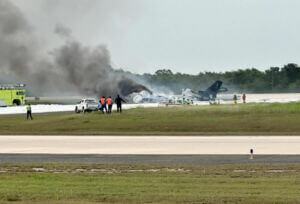
Emergency personnel, airport security teams, and aviation authorities remain on site as response operations and investigative efforts continue.
Update:
New information indicates that the aircraft’s crew reported mechanical issues during takeoff and proceeded to return for an emergency landing. The aircraft crashed on the runway, leaving two people dead, according to preliminary reports.
This is a developing story and will be updated as more information becomes available.
Private Gulfstream Jet incident at La Romana International Airport triggers emergency response
Small plane crashes in Santa Teresa, three hospitalized with serious injuries
by David Ibave
SANTA TERESA, N.M. (KFOX14/CBS4) — Emergency crews responded to a small plane crash in Santa Teresa that sent three people to the hospital with serious injuries. 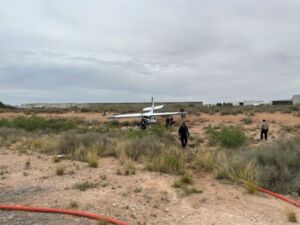
According to officials, a small plane crashed at 8100 Airport Road at around 11 a.m., near the Dona Ana County International Jetport, on Friday morning.
The Sunland Park Fire Department said three people were rushed to the hospital, one in critical condition, while the other two were with serious injuries but reportedly in stable condition.
All three were taken to the University Medical Center in El Paso.
Dona Ana County officials said that when firefighters arrived, they had to rescue one of the victims who was still trapped in the small aircraft, after witnesses had already pulled the two others from the wreckage.
New Mexico State Police said the Federal Aviation Administration has been notified of the incident.
Small plane makes crash landing at St. George Regional Airport
Written by Grace Hansen
A small plane made an emergency crash landing at the St. George Regional Airport this morning, resulting in a temporary runway closure. 
The crash caused the runway to close for 30 minutes before it was reopened for normal operations, St. George City spokesperson David Cordero told St. George News. No injuries were reported.
The aircraft involved was a Piper PA-44-280T, registration N8390K. It is owned by Glidepath Aviation, which rents it out, said a local certified flight instructor who requested anonymity.
“This was a nice plane, so it’s sad to lose it,” said the flight instructor. “They think fuel starvation was the cause of the crash, but I can’t confirm that 100% yet."
The flight instructor said the pilot’s approach to the airport was unusual, which suggested either a mechanical issue or a pilot error. The pilot, who has not yet been identified, is a former Utah National Guard Apache pilot.
This report is based on statements made during an ongoing investigation and may not contain the full scope of findings.
https://www.stgeorgeutah.com/news/small-plane-makes-crash-landing-at-st-george-regional-airport/article_d708171a-57a5-42b7-9ccc-4436d2df9dc8.html
Smoke causes panic on Pegasus plane!
A smoke scare occurred on a Pegasus Airlines passenger plane scheduled to fly from Ankara to Izmir.
AIRPORTHABER
A smoke scare occurred on a Pegasus Airlines passenger plane scheduled to fly from Ankara to Izmir.
According to reports, smoke began to spread on the Pegasus aircraft departing from Ankara and bound for Izmir. When the source of the smoke could not be found, an emergency evacuation was ordered. Passengers were evacuated from the aircraft using emergency slides.
No injuries were reported.
It was learned that the smoke was caused by a power bank belonging to one of the passengers.
https://www.airporthaber2.com/havacilik-haberleri/pegasus-ucaginda-duman-panigi.html
Emergency crews respond to plane crash at Jaffrey Airport
by Ashley Saari
On Friday morning, a small plane with a single occupant crashed shortly after take-off at the Jaffrey Airport. 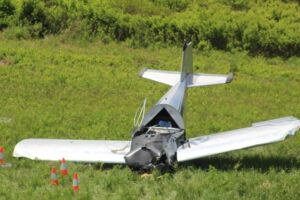
At about 11:49 a.m., emergency crews responded to the airport on Turnpike Road for a report of a single adult man trapped in a plane that had crashed in a field adjacent to the runway.
The pilot and sole occupant, Ronald Jones, 75, of Brookline, was trapped inside the plane and was extricated by the fire department and emergency personnel.
According to Airport Manager and Owner Harvey Sawyer, Jones took off from the runway in a Sonex, a type of small, kit-built airplane, and almost immediately lost power. The plane came down in an open field in the area between the airfield and Kimball Farm.
“It hit hard,” Sawyer said. Sawyer said the pilot was conscious and able to speak with him right after the crash, but did su
stain injuries to his head and lip.
According to police, Jones sustained substantial injury to his face and reported back pain. Jaffrey Fire Chief David Chamberlain said when emergency crews arrived, the pilot was conscious and assessed by Jaffrey-Rindge Memorial Ambulance and Peterborough Ambulance. He was airlifted by helicopter to UMass Memorial Medical Center in Worcester
Sawyer said the pilot had intended to take a short, scenic flight in the area.
The runway was reopened by early afternoon on Friday.
The incident comes less than a month after two men suffered serious injuries when a plane veered off the runway during landing and overturned at Jaffrey Airfield.
The Jaffrey Police Department, Jaffrey Fire Department, Jaffrey-Rindge Memorial Ambulance, Peterborough Fire Department, Peterborough Ambulance, and UMASS Life Flight assisted at the scene.
https://ledgertranscript.com/2026/06/05/plane-crash-jaffrey-airport/
No one injured after plane makes emergency landing on Pennsylvania highway
by Sam Woloson
SNYDER COUNTY, Pa. (WHP) — Drivers in Snyder County witnessed some unusual overhead traffic after a plane made an emergency landing on Saturday morning.
The plane had a mechanical issue, forcing it to land on Route 11/15 near the Selinsgrove Overpass around 8:58 a.m.
County dispatch confirmed that the plane landed without issue, and no injuries were reported.
The plane was towed from the highway to Penn Valley Airport, which is around three miles from where it landed.
The landing did briefly stop traffic Saturday morning, but the highway is now fully open.
Crews respond after small plane crashes in Kissimmee, officials say
The Cessna C150 had two occupants, and dense vegetation made the crash site difficult to reach, officials said.
Marissa Rodriguez, Logistics Coordinator
KISSIMMEE, Fla – Emergency crews responded Saturday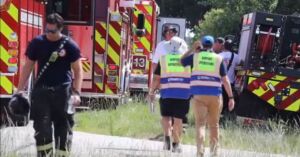 afternoon after a small aircraft crashed in Kissimmee near West Clay Street and South John Young Parkway, officials said.
City of Kissimmee Fire Department crews were dispatched around 2:59 p.m. June 6 after receiving a report of the crash, according to a city release. The response involved the Kissimmee Police Department and the Osceola County Sheriff’s Office.
Officials said dense vegetation and limited access made it difficult for first responders to reach the crash site.
According to KFD, Aviation support from the sheriff’s office was used to help guide crews to the downed aircraft, identified as a Cessna C150 carrying two occupants.
The National Transportation Safety Board and the Federal Aviation Administration will investigate and determine the cause of the crash, officials said. Check back for updates...
NTSB Prelim: Cessna 182T
Aircraft Impacted The Rock-Covered Hillside In A Left-Wing-Low Flight Attitude
Location: Armistead, CA Accident Number: ANC26FA039
Date & Time: May 7, 2026, 10:55 Local Registration: N227TF
Aircraft: Cessna 182T Injuries: 2 Fatal
Flight Conducted Under: Part 91: General aviation - Instructional
On May 7, 2026, about 1055 pacific daylight time (PDT), a Cessna 182T airplane, N227TF, was destroyed when it was involved in an accident near Armistead, California. The flight instructor and the pilot receiving instruction were fatally injured. The airplane was operated as a Title 14 Code of Federal Regulations Part 91 instructional flight.
According to the flight school, Top Flight Aviation, the flight instructor, who was presumably seated in the right seat, and the pilot receiving instruction, who was presumably seated in the left seat, had planned to fly from the Corona Municipal Airport (AJO), Corona, California to the Inyokern Airport (IYK), Inyokern, California, then return to AJO before continuing on to Las Vegas, Nevada for an overnight stay. The purpose of the flight was for the pilot receiving instruction to build technically advanced aircraft (TAA) time in pursuit of a commercial pilot certificate. They had planned to accumulate 10 hours of TAA flight time over the course of two days. 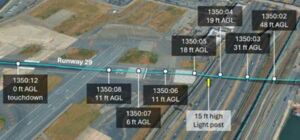
According to archived automatic dependent surveillance–broadcast (ADS-B) data from OpsVue, FlightAware, and the Federal Aviation Administration, the airplane departed Inyokern Airport (IYK) about 1047. Data shows the airplane traveled southwest towards the El Paso Mountains for about 7 minutes before turning to fly up a steep, narrow canyon. The final available data point was located about a half mile northwest of the accident site at 1054. The altitude of the airplane at this data point was 3425 ft. The wreckage was located about 3771 ft in elevation on the side of a steep, rocky canyon about 1000 ft in width. 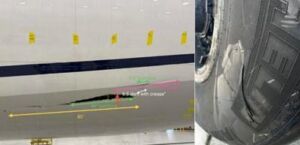
The aircraft impacted the rock-covered hillside in a left-wing-low flight attitude. All four corners of the airplane were accounted for at the accident site. The outboard portion of the left wing was bent upward and aft from impact damage. A large rock was embedded in the lower leading edge of the left wing, just inboard of the deformation. The fuselage, empennage, and inboard right wing were consumed by a post-impact fire. The wreckage came to rest with the engine facing downhill on a northeast heading of 028°. The engine and burned remnants of cockpit were inverted and facing downhill. The propeller assembly was still attached to the engine. One propeller blade came detached from the hub during impact and was found about 30 feet north-northwest of the main wreckage site. Additional small pieces of debris were strewn along a path to the north-northwest of the main wreckage.
The wreckage has been recovered to a secure facility for further examination.
FMI: www.ntsb.gov
NTSB Says Jet That Hit Pole Flew Too Slow And Low
Captain Flying United Plane Into Newark While First Officer Monitored Instruments
The National Transportation Safety Board (NTSB) says in a preliminary report the captain of a United Airlines flight from Venice, Italy was flying too slow and too low before landing last month at Newark Liberty International Airport.
The report says United Airlines flight 169, a Boeing B767-424ER, N77066, struck a light pole on the New Jersey turnpike while on final approach to runway 29 at Newark Liberty International Airport (EWR), Newark, N.J., and debris subsequently impacted a tractor-trailer traveling southbound on the New Jersey turnpike. The airplane landed and taxied to the gate without further incident. The 3 flight crew members, 8 cabin crew members and 220 passengers deplaned at the gate without any injury. The driver of the tractor-trailer sustained minor injuries. The damage to the airplane was substantial.
In its 11-page preliminary report of the May 3, 2026 accident, the NTSB said the flight from Venice was "normal until the descent." Investigators say the flight crew planned to land on runway 4R but the landing was changed to a different runway, and then changed again, to runway 29.
The captain stated that he turned off the autopilot and the auto-throttles at approximately 880 feet above mean sea level (MSL). He said that he “got fast” while he turned the airplane into the headwind and pulled the power levers back to compensate. The airplane shortly returned to a stable airspeed even though the wind gusts were producing “moderate turbulence.” The captain stated he heard the first officer call out “airspeed slow” while on short final (inside a half-mile). The captain mentioned that he did not receive any windshear alerts and that he always felt that the airplane was in a safe position to land. He responded to the automated 500-foot callout with the statement “stable”.
At 500 feet, the first officer stated, they were on speed and on profile, and the captain was maintaining his planned profile of 3 red and 1 white on the precision approach path indicator (PAPI). Once again, the cockpit voice recorder did not capture any discussion of PAPI lights for runway 29 prior to landing. The display of two red lights and two white lights indicate to pilots that they are on the desired glide path. Additionally, the captain, as the pilot flying, was looking outside the airplane, and the first officer as the pilot monitoring was “more committed to being inside the airplane, looking for trends.”
As they descended, the airspeed began to decay, and the first officer recalled that he stated, “hey you are slow,” followed moments later by, “you are still slow and a little low.” The co-pilot then looked back outside, and at that point recalled “I thought we were low”, however they were just about to touch down, and he didn’t process the information in time to get a go-around callout verbalized. The airplane landed, taxied to the gate, and all passengers and crew deplaned normally.
The captain stated that just before touchdown “he heard a thump”. The first officer recalled feeling a mild jolt as they neared the threshold. The relief officer stated that he heard an audible thump as they went over the airport boundary a second or two before landing. After the flight landed, the purser called the flight deck and said the aft flight attendants heard a loud bang just prior to landing.
The jet crossed over the turnpike at 19 feet above the ground. After parking at the gate, the plane was found to have three punctures on the fuselage. One of the tires on the landing gear had "slash marks."
The NTSB says that after the accident, United reminded its pilots landing at Newark to use the visual glideslope indicators next to the runway to ensure safe obstruction clearances. It emphasized that all approaches shall be conducted so that touchdown occurs 1500’ from the runway threshold, but not prior to 1000’ from the threshold, in accordance with their Flight Manual.
The report says the flight times for the 3 flight crew members were as follows: the captain had 2,724 hours in the B757 and B767 with 378 hours as captain. The first officer had 1,958 hours and the relief officer (for the international flight) had 853 hours in the B757 and B767. Total time with United: the captain had 16,385 hours with 5,205.5 as captain and 11,179.5 as first officer, the first office had 1,958 hours, and the relief officer had 1,075 hours.
NPR asked for comment about the NTSB report and whether the captain remains on flight status, a United spokesperson told NPR, "We don't have anything to share."
The final NTSB investigation is expected to be complete within a year.
FMI: www.ntsb.gov
NTSB Final Report: Bell 407
Pilot Conducted A Good Deceleration Flare But Applied The Initial Collective Too Early Resulting In Rotor RPM Decay
Location: Jacksonville, Florida Accident Number: ERA26LA170
Date & Time: April 10, 2026, 20:22 Local Registration: N314JP
Aircraft: Bell 407 Aircraft Damage: Substantial
Defining Event: Hard landing Injuries: 2 None
Flight Conducted Under: Public aircraft
Analysis: The pilot and flight instructor were conducting a helicopter training flight using night vision goggles. The training included multiple hovering and straight-in touchdown autorotation maneuvers. The flight instructor stated that during the last touchdown autorotation landing the approach was normal. He continued that the pilot conducted a good deceleration flare but applied the initial collective too early resulting in rotor rpm decay. The helicopter landed hard on the heel of the skids while applying aft cyclic. The main rotor blades contacted both vertical stabilizers and the tailboom resulting in substantial damage. The operator reported that there were no preaccident mechanical malfunctions or failures with the helicopter that would have precluded normal operation.
Probable Cause and Findings: The National Transportation Safety Board determines the probable cause(s) of this accident to be -- The pilot’s improper recovery from a practice autorotation, which resulted in a hard landing.
Contributing to the accident was the flight instructor’s inadequate supervision of the pilot receiving the instruction.
FMI: www.ntsb.gov

Today in History
44 Years ago today: On 8 June 1982 VASP Flight 168, a Boeing 727, struck a wooded mountainside while on approach to Fortaleza Airport, Brazil , killing all 137 occupants.
| Date: | Tuesday 8 June 1982 |
| Time: | 02:25 |
| Type: | Boeing 727-212 |
| Owner/operator: | VASP - Viação Aérea São Paulo |
| Registration: | PP-SRK |
| MSN: | 21347/1282 |
| Year of manufacture: | 1977 |
| Engine model: | P&W JT8D-17 |
| Fatalities: | Fatalities: 137 / Occupants: 137 |
| Other fatalities: | 0 |
| Aircraft damage: | Destroyed, written off |
| Category: | Accident |
| Location: | Serra de Pacatuba, CE - Brazil |
| Phase: | Approach |
| Nature: | Passenger - Scheduled |
| Departure airport: | Rio de Janeiro-Galeão International Airport, RJ (GIG/SBGL) |
| Destination airport: | Fortaleza-Pinto Martins Airport, CE (FOR/SBFZ) |
| Investigating agency: | CENIPA |
| Confidence Rating: | Accident investigation report completed and information captured |
Narrative:
VASP Flight 168, a Boeing 727, struck a wooded mountainside while on approach to Fortaleza Airport, Brazil , killing all 137 occupants.
Flight 168 departed São Paulo for a flight to Fortaleza, with an intermediate stop at Rio de Janeiro (GIG). The first leg of the flight was uneventful. As the flight approached Fortaleza, the crew were cleared to descend from their cruising altitude of FL330 to FL50 (5000 feet). In night-time conditions with the bright lights of the city in front, the captain descended below 5000 feet. Despite two altitude alert system warnings and the co-pilot's warning of the mountains ahead, the captain continued to descend below the minimum descend altitude. The Boeing then struck a wooded mountainside at 1950 feet.
Human Factor:
It contributed to the extent that during the descent the Commander concentrated his attention on the illuminated city, disconnecting himself from other sensory impulses, such as observation of distance and altitude.
Material Factor: Did not contribute.
Operational Factor:
Contributed for the reasons below:
- Poor planning for the descent.
- Non-observance of air traffic rules (non-compliance with control instructions, non-observance of the minimum safety altitude and non-maintenance of the speed foreseen for terminal flight below 10,000 feet). Therefore, serious flight indiscipline.
- lack of cabin discipline.
- Non-compliance with company operating standards.
