We close out the week and the month of July with the following stories...
Have a safe weekend!
Tom
--
Two hospitalized after small plane crashes on Layton highway
by Derick Fox & Anneka Johns, KUTV
LAYTON, Utah (KUTV) — Two people were taken to the hospital early Friday morning after a small plane crashed near Highway 193 and Fort Lane in Layton. 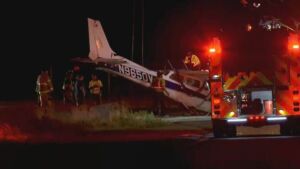
The plane went down shortly before midnight, according to Layton fire officials.
Both the pilot and a passenger were able to get out of the plane on their own but were taken to a local area hospital once medical crews arrived. The two sustained non-life-threatening injuries and are reported to be in stable condition.
Officials said there were no signs of any post-crash fires, and first responders were able to secure the plane and mitigate fuel spill concerns.
The Federal Aviation Administration and the National Transportation Safety Board have responded and are leading the investigation.
Sgt. Teague with the Layton Police Department said investigators believe the plane took off from Ogden but were unsure about where the plane was headed. While it is unclear at the time what exactly caused the plane to go down, investigators said wind may have been a factor.
The plane was reportedly attempting trying to reach a Hill Air Force Base runway, but "didn't quite make it," according to Sgt. Teague. Investigators said the pilot attempted to make an emergency landing in the field across the street, but wind picked up, causing the plane to crash.
The highway was closed as emergency crews investigated and cleared the scene. All roadways have since reopened.
https://kutv.com/news/local/two-hospitalized-after-small-plane-crashes-on-layton-highway
No injuries after small plane makes emergency landing near Smithfield
By: Michael Martin
SMITHFIELD, Utah — Nobody was injured following a small plane having to make an emergency landing just West of Smithfield on Thursday. Officials with the Logan Cache Airport called the landing "impressive." 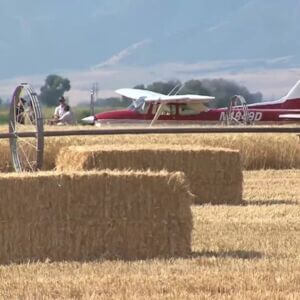
According to the manager of the Logan Cache Airport, Bob Low, at around 8:30 a.m. they were called by the Utah State University flight school to inform them of a plane incident. Initially, first responders were told that the aircraft had gone down at the airport.
However, a short time later, they learned that the plane had made the emergency landing near the airport. Neither of the two people on board were injured.
So, Low at the airport called USU's flight school back and had other aircraft orbit the area to search for the plane. Those planes then sent images of the plane to first responders and helped narrow down the search.
"We were able to identify it because of the picture that we had received from the USU Flight school that showed this color of vegetation that had bales baled in it," Low explained.
"That was basically my involvement was to help the fire department find their way here, just relay information between the flight school and the updated information that they were getting from the pilots in the air back to the fire department so they could make the correct turns to to arrive here safely."
Low commended the pilot for the landing, saying, "This pilot did a great job as a as a retired helicopter pilot myself, having been in the industry for 17 years and having had some experience with with emergencies, this pilot was able to quickly assess where to go."
The Cache County Sheriff's Office says they are working now to load the plane onto a trailer and have it moved from the field.
What caused the plane to have to make the emergency landing is under investigation.
https://www.fox13now.com/news/local-news/cache-county/no-injuries-following-small-plane-making-emergency-landing-near-smithfield
NTSB’s Homendy Urges Congress To Pass Aviation Safety Legislation
Time For Action That Was Promised Months Ago
The head of the National Transportation Safety Board (NTSB) on Monday urged Congress to resolve a months-long standoff over competing aviation safety measures and approve significant reforms. 
NTSB Chair Jennifer Homendy said the NTSB had "provided a clear roadmap to improve aviation safety and reduce the risk of another catastrophic midair collision. Now it's time for action that was promised months ago," Homendy told Reuters.
Homendy is urging lawmakers to reconcile the competing House and Senate bills that were drafted following the January 2025 midair collision between an American Airlines regional jet and a U.S. Army Black Hawk helicopter near Reagan National Airport. The NTSB concluded that the accident resulted from systemic FAA failures and has issued 50 safety recommendations.
However, the House and Senate have been bogged down over differences between the ALERT Act and the ROTOR Act.
- The ROTOR Act would require ADS-B In on airline aircraft. ADS-B In allows pilots to see nearby traffic in the cockpit and receive traffic alerts, supplementing what controllers and TCAS provide. NTSB investigators concluded that had the aircraft involved in the Reagan National accident been equipped with ADS-B In, the crew likely would have had significantly more time to recognize the conflict.
- The ALERT Act does not include the same broad statutory ADS-B In mandate. Instead, it emphasizes FAA-directed reforms, studies, operational improvements, training, airspace changes, and implementation of the NTSB's recommendations without prescribing that one technology requirement. That omission is why pilot groups such as ALPA and the NTSB have pushed to preserve the ROTOR Act's ADS-B In provisions during conference negotiations.
FAA Administrator Bryan Bedford told Reuters earlier this month that the agency had provided technical assistance to Congress during the legislative process. He said the FAA could move ahead with broader deployment of ADS-B technology without congressional approval but preferred clear legislative direction.
FMI: www.ntsb.gov
NTSB Prelim: Diamond Aircraft Ind Inc DA40 NG
The Occupants Heard A Loud Bang Near Midfield, Followed By A Reduction In Engine Power
Location: Petersburg, VA Accident Number: ANC26LA066
Date & Time: June 29, 2026, 19:45 Local Registration: N602RF
Aircraft: Diamond Aircraft Ind Inc DA 40 NG Injuries: 1 Serious, 1 Minor
Flight Conducted Under: Part 91: General aviation - Instructional
On June 29, 2026, about 1945 eastern daylight time (EDT), a Diamond Aircraft Industries Inc. DA40 NG airplane, N602RF, was substantially damaged when it was involved in an accident near Petersburg, Virginia. The flight instructor sustained serious injuries, and the student pilot sustained minor injuries. The airplane was operated as a Title 14 Code of Federal Regulations Part 91 instructional flight.
The flight instructor reported that during the initial climb following a go-around on Runway 05 at Dinwiddie County Airport (PTB), the occupants heard a loud bang near midfield, followed by a reduction in engine power. The flight instructor assumed control of the airplane and observed that engine power decreased to below about 40%, resulting in a loss of expected climb performance; the engine continued to produce partial power. The airplane was unable to achieve sufficient climb performance to clear obstacles beyond the departure end of the runway environment. While assessing available areas for a forced landing, the flight instructor maneuvered the airplane, which resulted in activation of the stall warning horn. The flight instructor discontinued the turn and secured the engine by moving the fuel selector to the off position before the airplane impacted treetops.
The airplane came to rest inverted in a densely wooded area about 1 mile northeast of the departure end of Runway 05, which resulted in substantial damage to the fuselage, wings, and empennage.
A data card from the avionics installed in the airplane was retained and forwarded to the NTSB Recorders Laboratory for flight and engine data extraction.
The wreckage has been recovered to a secure facility for further examination.
FMI: www.ntsb.gov
Today in History
34 Years ago today: On 31 July 1992 Thai Airways International flight 311, an Airbus A310-304, impacted a mountain during the descent towards Kathmandu Airport (KTM), Nepal, killing all 113 occupants.
| Date: | Friday 31 July 1992 |
| Time: | 12:45 |
| Type: | Airbus A310-304 |
| Owner/operator: | Thai Airways International |
| Registration: | HS-TID |
| MSN: | 438 |
| Year of manufacture: | 1987 |
| Total airframe hrs: | 13127 hours |
| Cycles: | 4768 flights |
| Engine model: | GE CF6-80C2A2 |
| Fatalities: | Fatalities: 113 / Occupants: 113 |
| Other fatalities: | 0 |
| Aircraft damage: | Destroyed, written off |
| Category: | Accident |
| Location: | 40 km N of Kathmandu-Tribhuvan Airport (KTM) - Nepal |
| Phase: | En route |
| Nature: | Passenger - Scheduled |
| Departure airport: | Bangkok-Don Muang International Airport (BKK/VTBD) |
| Destination airport: | Kathmandu-Tribhuvan Airport (KTM/VNKT) |
| Confidence Rating: | Accident investigation report completed and information captured |
Narrative:
Thai Airways International flight 311, an Airbus A310-304, impacted a mountain during the descent towards Kathmandu Airport (KTM), Nepal, killing all 113 occupants.
Flight TG311 was conducting the Sierra (VOR/DME) approach to runway 02 at Tribhuvan International Airport, in instrument weather conditions. A flap fault occurred while the flight was on the approach; this caused the crew to ask for clearance back to Calcutta, a decision that was in keeping with both Company and performance requirements, which necessitate the use of full flaps for the steep final approach. Shortly (21 seconds) after making this request, at a distance of approximately 12 nm from the Kathmandu VOR, the flap fault was rectified by retracting and then reselecting the flaps. The crew determined that it was not possible to continue the straight-in approach, due to the steep descent angles required and the position of the aircraft. The crew stated to the control tower that they wished to start their approach again and requested a left turn back to the Romeo fix, which is 41 nm south south-west (202 radial) of the Kathmandu VOR. The Controller, in the non-radar environment, responded by clearing the flight to make the Sierra approach, which starts at the 202 radial and 16 nautical miles from the VOR. The crew response to the clearance was to report that, at the moment, they couldn't land and to ask again for left turn back to Romeo to start their approach again. After further dialogue with the controller, which included requests for a left turn, the crew unilaterally initiated a right turn from the aircraft's 025 degree heading and commenced a climb from an altitude of 10,500 feet to FL180, when the flight was about 7 nm south of the Kathmandu VOR. The crew reported to the tower controller that the flight was climbing and the controller replied by instructing the crew to report at 16 nm for the Sierra approach. During the turn, there was more discussion between the tower controller and the flight, where it was established that the aircraft was to maintain an altitude of FL115 and was to "proceed to Romeo" and contact the Area Control Center (ACC) controller. The flight, commencing a descent while in the turn, completed a 360-degree turn, momentarily rolling out on headings of 045 and 340 degrees, and again proceeded toward the north on a heading of 025 degrees magnetic. When the flight was about 5 nm south-west of the Kathmandu VOR, the crew contacted the ACC and stated that the aircraft was "heading 025" and they wished to proceed to Romeo to start their approach again; adding they had "technical problems concerned with the flight." It was again established that the flight was to proceed to Romeo and the crew agreed to "report over Romeo." It was determined from the cockpit voice recorder that the crew was in the process of inserting "Romeo" and other related navigational information in the Flight Management System, but were experiencing difficulties. The flight continued towards the north on a heading of 025 degrees and then, at about 16 nm north, the heading was altered to the left to 005 degrees. Slightly over one minute later, the Ground Proximity Warning System (GPWS) sounded the warning "terrain" "terrain" followed by "whoop whoop pull-up"; the aural warning continued until impact approximately 16 seconds later. Engine thrust was increasing and "Level Change" had been announced on the cockpit, just before the impact occurred at the 11,500-foot level of a 16,000-foot peak; the accident site was located on the 015 radial (north-north east) at 23.3 nm from the Kathmandu VOR.
PROBABLE CAUSE: "TG311 flight crew's management of the aircraft flight path wherein the flight proceeded in a northerly direction which was opposite to the cleared point Romeo to the South; ineffective radio communication between the area control centre and the TG311 flight crew which allowed the flight to continue in the wrong direction, in that the TG311 crew never provided the aircraft's VOR radial when stating DME and the controller never solicited this information and thus the aircraft's position was not transmitted at any time; and ineffective cockpit crew coordination by the TG311 crew in conducting flight navigation duties.
Contributing factors were: the misleading depiction of Romeo on the operator's approach chart used by the flight crew; a flap fault, although corrected, required that the initial approach be discontinued; and radio communication difficulties between the TG311 crew and the air traffic controllers that stemmed from language difficulties and ineffective discussion of apparent unresolved problems."
