New week, new month.
Here are the stories to kick them off...
Be safe out there!
Tom
--
Marine F-35 involved in fiery mishap at Miramar base in California; pilot ejects safely
By Gary Warner - Stars and Stripes
An F-35B Lightning II jet crashed and burned at Marine Air Station Miramar on Friday, the Marines confirmed.
The aircraft was part of the 3rd Marine Air Wing, Marine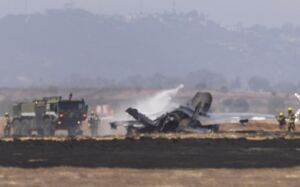 Aircraft Group 11 at the base north of San Diego, according to 1st Lt. Blake Starbuck, a spokesman for the 3rd Marine Aircraft Wing.
The pilot ejected and was being taken to medical care while emergency response teams came to the crash scene, Starbuck said.
The Marines said it was a Class A mishap, which involves a fatality or equipment damage of $2 million or more.
Live broadcast footage from a helicopter operated by NBC News in San Diego showed blackened wreckage near runways at the air base, with firefighting crews starting to douse the flames. The plane’s wedge tail section was clearly visible.
The Lightning is a “fifth-generation” fighter used by the Air Force, Marines and Navy in different versions. The F-35B is designed for short takeoff and vertical landings, making it ideal for operations on ships with smaller decks.
Lockheed Martin, the F-35 Lightning II manufacturer, says on its website that as of June 25, 2026, more than 1,340 F-35s have been delivered worldwide. The U.S. Marine Corps, Navy and Air Force together have more than 630 F-35s.
The price for one F-35B is $109 million.
https://www.stripes.com/branches/marine_corps/2026-07-31/f-35-crash-mcas-miramar-22422757.html
What we know so far about the plane crash that killed 11 European tourists near one of Peru’s most popular sites
By Gonzalo Zegarra
Peru has temporarily suspended the operations of sightseeing airline Aerodiana after one of its planes crashed in the country’s Ica region on Saturday, killing 11 European tourists and two crew members.
Aerodiana, which flies customers over the Nazca Lines archaeological site in southern Peru, must suspend all operations “until investigations are completed to verify the company’s compliance with the applicable aviation regulations, procedures and operating requirements,” Peru’s Ministry of Transportation and Communications said Sunday. 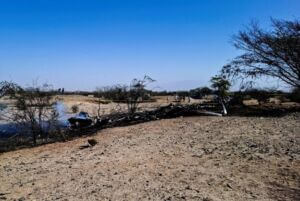
CNN has reached out to Aerodiana for comment.
The Peruvian government earlier said that the crew of the small sightseeing plane had reported a mechanical problem before radio contact was lost.
“There was a call from the aircraft indicating that it was experiencing mechanical problems,” Peruvian Foreign Trade and Tourism Minister Rogers Valencia told reporters at the crash site near the Nazca Lines, a collection of ancient geoglyphs etched into the desert floor.
The UNESCO world heritage site features designs of animals and geometric shapes that are best seen from the air. The flight was taking tourists to view the desert markings.
The ministry earlier said the pilots of the Cessna 208B Grand Caravan, which can carry 12 passengers, notified the control tower at Nazca airfield of the emergency, in the aircraft’s final radio transmission.
Valencia said the Aviation Accident Investigation Commission is analyzing the call, the plane’s flight path, along with mechanical evidence from the wreckage, but authorities have not said whether the reported problem caused the crash.
Tourists among those killed
Those aboard included 11 tourists from Spain, Italy and Germany, as well as the two Peruvian crew members.
“There will be immediate results, and the process of assessing the condition of the wreckage will provide an in-depth understanding of the cause” of the accident, Valencia added.
Valencia said the Italian and German consuls were at the scene and he offered his condolences over the deaths of seven Italian and two German tourists. Two Spanish tourists also died, according to official information.
The Italian Foreign Ministry said its embassy in Lima was in contact with Peruvian authorities and that the families of the Italian victims have already been notified. Italian Prime Minister Giorgia Meloni said on X: “On behalf of the Italian government and on my own behalf, I express my deepest condolences to their loved ones at this time of immense grief.”
Valencia said Pisco Airport, from where the Aerodiana flight took off, is “fully operational” and that “we need to determine the extent of liability” in the crash.
Asked about a possible suspension of operations at Pisco Airport, Peruvian President Keiko Fujimori told reporters that “the suspension of the airport is being evaluated,” but added that she wanted to wait until the investigation was complete and ministers had submitted their reports.
In a statement issued before its operations were suspended, Aerodiana said it extended its condolences to the victims’ families and is “fully prepared to provide the necessary support.”
“Throughout our 18 years of operation, we have maintained an unwavering commitment to the safety of our passengers and crews. Therefore, this incident affects us deeply and reaffirms our willingness to cooperate with full accountability in whatever is required by the authorities,” the airline said.
According to the ministry, the accident occurred around 1 p.m. local time (2 p.m. ET), about 2 kilometers (1.2 miles) from Nazca airfield, after the plane took off from Pisco Airport for a flight over the Nazca Lines.
There have been other deadly crashes involving sightseeing flights near the Nazca Lines. In 2022, five tourists and two Peruvian crew members died when an aircraft went down near the site, Reuters reported. And in a 2010 accident, four British tourists and two Peruvian crew members were killed when their light aircraft crashed.
CNN’S Mauricio Torres contributed to this report. With information from Spanish international news agency EFE.
https://www.cnn.com/2026/08/02/americas/nazca-plane-crash-dead-intl-latam
Two crew killed after firefighting helicopters collide in Greece, as British pilot survives
Paulin Kola and Nikos Papanikolaou
Two crew members have been killed after two helicopters collided mid-air in Greece while battling wildfires.
The fatalities were a Danish pilot and a Greek fire service liaison officer. A British pilot and another Greek co-ordinator on the second helicopter survived. 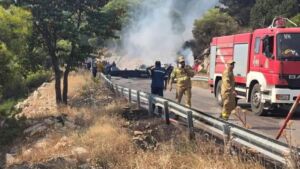
Video of the incident some 65 km (42 miles) west of the capital Athens shows one of the two Bell helicopters hitting the rotors of the other, which bursts into flames and crashes in a ravine. The other aircraft made an emergency landing.
Wildfires have broken out in Greece this week, prompting mass evacuations. Other European states have also suffered devastating blazes during prolonged heatwaves.
According to the Greek Fire Service, the two Bell helicopters leased from Australian company McDermott Aviation collided on Sunday while taking part in efforts to tackle a large wildfire burning on the Attica-Boeotia border.
The crew members of one aircraft were rescued alive, while the second crew were recovered unconscious and later pronounced dead.
Greek Prime Minister Kyriakos Mitsotakis expressed his "deepest sorrow" over the accident.
In a post on X, he said the loss of the Greek coordinator and Danish pilot "fills us all with grief". He also sent condolences to their families.
According to protocol, all Bell helicopters across the country have been grounded, a source from the civil protection ministry told the BBC.
The source added that the second Bell helicopter involved in the collision made an emergency landing in an area of low vegetation.
"The two people on board, a British pilot and a Greek fire service liaison officer - escaped with minor injuries," the source said.
"Both remained conscious and have been admitted to hospital, where they will remain under observation for 24 hours as a precaution."
The source also told the BBC the British survivor was a private pilot hired for the wildfire season.
He was not part of any exchange between the UK and Greece, and there was no request for assistance from Athens.
Meanwhile, Greece's Ekathimerini news website said the two survivors immediately reported the collision, guiding rescuers to the crash site.
The names of the four crew members have not been publicly released.
John McDermott, the founder and president of McDermott Aviation, said his staff's "thoughts and deepest condolences are with the families, friends and colleagues of those affected by this tragic incident."
"McDermott Aviation is working closely with the relevant authorities and will continue to assist as they undertake their investigation into the incident," he added.
Erickson Air-Crane and Chinook helicopters, as well as Canadair water-bombing aircraft are continuing to carry out firefighting efforts.
Early this week, France and Spain battled huge fires - two of the main ones were close to Madrid and Bordeaux respectively. Those have now been contained, though they are still burning. Some 300,000 people who were evacuated have started to return to their homes.
In Greece, media reports describe "a titanic battle" along a swathe of territory that includes Porto Germeno, Psatha, Fokida, Megara and Kefalonia, where more than 500 firefighters have been struggling to bring the situation under control over the past 72 hours.
Most wildfires are sparked by people, whether intentionally or accidentally, but climate change is making the conditions for them more common.
Last winter was mild and wet, encouraging vegetation growth, which has then dried out in successive hot spells, generating fuel for wildfires.
https://www.bbc.com/news/articles/c1417713ve6o
One man dead, two injured after second plane crashes in Blackfoot in single day
Nate Sunderland, EastIdahoNews.com
BLACKFOOT — A 27-year-old man is dead after an airplane crash late on Saturday night. Extraordinarily, it was the second airplane crash to occur at the Blackfoot City Airport on a single day. 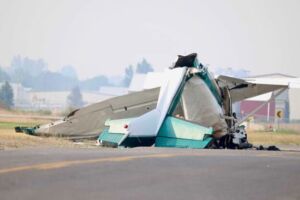
At about 11 p.m., Blackfoot Police Department responded to a plane crash on the north end of the airport, according to a department news release. The aircraft came to rest across Teeples Drive, and debris was blocking the roadway.
Bingham County Coroner Jimmy Roberts confirmed the death of a 27-year-old man. Police confirm two others were in the aircraft, and were injured.
The Federal Aviation Administration (FAA) and the National Transportation Safety Board are investigating the crash.
The closure of Teeples Drive is expected to remain in place until Monday, August 3 around noon. This timeframe may change, and the roadway could reopen earlier or remain closed longer depending on investigative needs.
Emergency traffic should use the gravel access road from South Von Elm when exiting the Champions Gate subdivision. If you need to access Champions Gate, please use the gravel road located at 100 North from Rose Road.
Police ask that only residents of the subdivision use the temporary gravel access route. This alternative route is not a standard roadway, and limiting use helps ensure that emergency services maintain clear access to the neighborhood.
At about 8:30 a.m. on Saturday, another aircraft crashed at the airport. A 69-year-old pilot walked away from that crash after flipping his plane during a rough landing.
No other information was available on Saturday night. EastIdahoNews.com will update this story as more details are released.
https://www.eastidahonews.com/2026/08/second-plane-crashes-in-blackfoot-in-single-day/
Man walks away from plane crash at Blackfoot City Airport
Nate Sunderland, EastIdahoNews.com
BLACKFOOT — A 69-year-old Blackfoot man escaped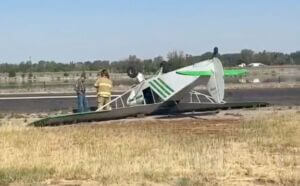 major injury following a plane crash on Saturday morning.
The crash occurred at about 8:30 a.m. at the Blackfoot City Airport.
Blackfoot Police Capt. Blake Davis said the pilot of the single-person aircraft was attempting a landing when the aircraft’s tire hit a gravel berm and flipped the plane over.
The pilot walked away from the crash with only minor injuries.
The Federal Aviation Administration and National Transportation Safety Board are investigating the crash.
No other information was available.
https://www.eastidahonews.com/2026/08/man-walks-away-from-plane-crash-at-blackfoot-city-airport/
Two injured in Dunn County plane crash
Brandon Taylor
MENOMONIE, Wis. (WKOW) -- A plane crashed in Dunn County on Sunday afternoon, injuring two people on board. 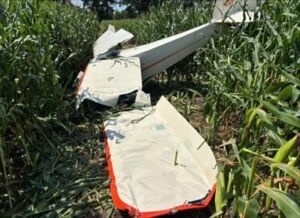
The Dunn County Communication Center received a call about the crash around 12:10 p.m. in the area of Boundary Road north of State Highway 170 in Hay River Township, according to a press release from the Dunn County Sheriff's Office. The Dunn County Sheriff's Office, Dunn County First Responders, Boyceville Fire Department, Glenwood City Ambulance, Menomonie Fire and Ambulance and the Wisconsin State Patrol responded to the scene.
The pilot, a 36-year-old woman from Sioux Falls, South Dakota, and a 51-year-old male passenger from Marshfield were transported to the hospital with injuries from the crash.
Preliminary investigation indicates the plane had just taken off from the Boyceville Municipal Airport before it crashed. The airplane has been removed from the scene.
The crash remains under investigation by the Federal Aviation Administration's Aviation Safety division and the National Transportation Safety Board.
https://www.wkow.com/news/two-injured-in-dunn-county-plane-crash/article_8a6de390-1e4d-40fd-b25c-bb1c8676ad16.html
1 dead after plane crashes near Oklahoma airport, sparking wildfire
Josh Wallace
Authorities say one person was killed in a plane crash that sparked a wildfire on the outskirts of Guymon, Oklahoma on Sunday. 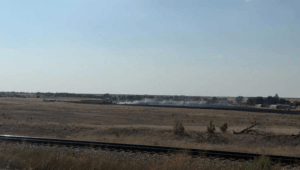
The crash happened around 4:15 p.m. near the Guymon Municipal Airport, not far from the Elks Addition.
Advertisement
Oklahoma Highway Patrol officials confirmed to sister station KOCO 5 that the crash, which involved a small aircraft, was deadly.
Officials said the crash sparked a wildfire. The flames have been contained, but crews continue to put out hotspots.
The Oklahoma Highway Patrol also told KOCO 5 that the Federal Aviation Administration and National Transportation Safety Board will lead the investigation.
https://www.4029tv.com/article/plane-crash-near-guymon-airport-sparks-wildfire/73328715
NTSB Final Report: Zenith CH601
Witnesses Reported That The Airplane Descended Rapidly And Impacted A Wooded Area
Location: Bristol, Indiana Accident Number: CEN24FA170
Date & Time: April 30, 2024, 14:18 Local Registration: N6271F
Aircraft: Zenith CH601 Aircraft Damage: Substantial
Defining Event: Loss of control in flight Injuries: 2 Fatal
Flight Conducted Under: Part 91: General aviation - Personal
Analysis: The private pilot and pilot-rated passenger were returning to their home airport following a personal flight. About 7 miles from the destination airport, the airplane’s airspeed increased, and it entered a steep descent. Witnesses reported that the airplane descended rapidly and impacted a wooded area. Witnesses also reported conflicting observations regarding whether the engine was operating normally. The engine examination did not reveal any preimpact anomalies, and the shattered and widely dispersed wooden propeller blade fragments were consistent with engine power at impact. The airframe examination did not reveal any preimpact mechanical malfunctions or failures that would have precluded normal operation.
Toxicological testing of the pilot identified ethanol at low levels in several of the specimens and was not detected in brain tissue. Based on these results, some or all of the small amount of detected ethanol may have been from postmortem production rather than alcohol consumption, and it is unlikely that ethanol effects contributed to the accident. As a result of his heart disease, the pilot was at some increased risk of a sudden impairing or incapacitating cardiac event, such as chest pain, arrhythmia, or heart attack. The autopsy identified no evidence of such an event. However, an acute cardiac event occurring immediately before death may leave no reliable autopsy evidence. Whether the pilot’s heart disease contributed to the accident could not be determined.
Toxicological testing of the pilot-rated passenger identified two oral medications commonly used to treat diabetes. People with medication-treated diabetes are at risk for both abnormally high blood sugar (from diabetes) and abnormally low blood sugar (from medication effects). Short-term effects of high blood sugar may include decreased cognitive performance, including slower information processing speed, decreased executive function and attention.
Low blood glucose may cause difficulty concentrating, impaired task performance, and, in extreme cases, diminished consciousness, seizure, and death. The pilot-rated passenger’s postmortem urine glucose concentration is inconsistent with a markedly high antemortem blood glucose; however, it provides no information about whether his blood sugar may have been low. It also is unknown if the pilot-rated passenger had less severe symptoms of diabetes, such as fatigue or blurred vision or chronic complications associated with diabetes, such as vision loss, neuropathy, or kidney disease.
As a result of his heart disease, the pilot-rated passenger was at some increased risk of a sudden impairing or incapacitating cardiac event, such as chest pain, arrhythmia, or heart attack. The autopsy identified no evidence of such an event. However, such an event does not leave reliable autopsy evidence if it occurs immediately before death. It is unknown what role the pilot-rated passenger had, if any, in aircraft operations and flight safety. Whether the effects of the pilot-rated passenger’s use of metformin and glipizide or his heart disease contributed to the accident cannot be determined.
Although either occupant could have experienced a sudden incapacitating medical event while manipulating the flight controls during the descent, the remaining occupant may have had insufficient time or opportunity to recover the airplane before impact. However, the investigation could not determine which occupant, if either, was manipulating the flight controls at the time of the accident. Therefore, whether either occupant experienced an incapacitating medical event that contributed to the accident could not be determined.
Probable Cause and Findings: The National Transportation Safety Board determines the probable cause(s) of this accident to be -- The pilot’s loss of control during the descent for reasons that could not be determined, which resulted in a steep descent into terrain.
FMI: www.ntsb.gov
NTSB Final Report: Rotorway Scorpion 133
Witness Heard A Loud “Bang” And Observed Debris Separating From The Helicopter As It Descended To The Ground
Location: Andale, Kansas Accident Number: CEN24FA248
Date & Time: July 5, 2024, 08:01 Local Registration: N51017
Aircraft: Rotorway Scorpion 133 Aircraft Damage: Destroyed
Defining Event: Mast bumping Injuries: 1 Fatal
Flight Conducted Under: Part 91: General aviation - Personal
Analysis: The pilot departed from his residence on a local area flight to practice maneuvers in the experimental helicopter. A witness heard a loud “bang” and observed debris separating from the helicopter as it descended to the ground. Surveillance camera audio captured the sound of the helicopter’s experimental engine at a constant high-power setting, followed by a momentary reduction in power. Shortly thereafter, the audio captured multiple impacts and the helicopter came into view inverted, then descended to the ground. A postimpact fire consumed the wreckage.
Postaccident examination of the wreckage found that the aft tailboom had separated from the helicopter and was located about 150 yards from the main wreckage. An impact mark consistent with the shape of a main rotor blade was noted at the right side of the tubular structure at the separation area, consistent with a main rotor blade impact. While no mechanical anomalies were found during the airframe and engine examination, the examination was limited due to extensive fire damage.
The throttle control cable was found thermally separated from the collective control and the snap-out ball joint was not in the safety position; it was found separated from the carburetor.
However, the surveillance audio of the engine’s reduction and increase of rpm before the main rotor’s impact with the tailboom are consistent with an intact throttle control and indicate that the throttle cable likely separated from the carburetor during the impact with terrain. The pilot did not hold a helicopter rating. His last solo endorsement was October 07, 2022, and was valid until January 05, 2023. The accident occurred 18 months after the expiration of the last solo endorsement, and the pilot was not authorized to conduct solo flight operations at the time of the accident.
The pilot previously reported that he felt uncomfortable performing autorotations and requested additional training from a flight instructor; however, it was unknown what maneuvers he was performing during the accident flight.
Teetering main rotor systems, such as the one on the accident helicopter, are particularly susceptible to main rotor mast bumping during the low-G conditions that result from abrupt forward (nose-down) cyclic inputs. Based on the available evidence the pilot likely applied abrupt control inputs while performing an unknown maneuver, which resulted in main rotor mast bumping during a low-G condition and subsequent main rotor blade contact with and subsequent separation of the tailboom.
Probable Cause and Findings: The National Transportation Safety Board determines the probable cause(s) of this accident to be -- The pilot’s abrupt control inputs, which resulted in a low-G condition, main rotor mast bumping, and subsequent severing of the tailboom by the main rotor blades.
FMI: www.ntsb.gov
NTSB Final Report: ICON A5 A Total Loss Of Engine Power Due To Oil Starvation
A Total Loss Of Engine Power Due To Oil Starvation
Location: Levittown, Puerto Rico Accident Number: ERA26LA176
Date & Time: April 15, 2026, 10:25 Local Registration: N558BA
Aircraft: ICON A5 Aircraft Damage: Substantial
Defining Event: Loss of engine power (total) Injuries: 1 None
Flight Conducted Under: Part 91: General aviation - Personal
Analysis: As the amphibious airplane was approaching the destination airport, the engine lost oil pressure shortly before losing power completely. Unable to glide to the airport, the pilot elected to conduct a forced landing to a nearby bay. Due to the rough water conditions, the landing was hard, which resulted in substantial damage to the left wing and empennage.
Postaccident examination of the wreckage revealed that that the oil line that connected the oil pump housing to the oil cooler had separated from the oil cooler adapter at the barbed end of the B-nut assembly. The respective clamp, which was supposed to secure the oil line past the barbed fitting, was not recovered. It is possible that the clamp was not completely secured past the barbed fitting when the new, upgraded engine was installed onto the airplane about 1 year prior to the accident; however, the clamp could not be located after the accident, so the preseparation position and condition of the clamp could not be determined.
Probable Cause and Findings: The National Transportation Safety Board determines the probable cause(s) of this accident to be -- An oil line separation at a barbed fitting in an experimental airplane, which resulted in a total loss of engine power due to oil starvation.
FMI: www.ntsb.gov

Today in History
51 Years ago today: On 3 August 1975 A Jordanian World Airways Boeing 707-300, operating for Royal Air Maroc, impacted a mountain near Amskroud, Morocco, killing all 188 occupants.
| Date: | Sunday 3 August 1975 |
| Time: | 04:25 |
| Type: | Boeing 707-321C |
| Owner/operator: | Jordanian World Airways, opf Royal Air Maroc - RAM |
| Registration: | JY-AEE |
| MSN: | 18767/376 |
| Year of manufacture: | 1964 |
| Total airframe hrs: | 39749 hours |
| Engine model: | P&W JT3D-3B |
| Fatalities: | Fatalities: 188 / Occupants: 188 |
| Other fatalities: | 0 |
| Aircraft damage: | Destroyed, written off |
| Category: | Accident |
| Location: | near Amskroud - Morocco |
| Phase: | En route |
| Nature: | Passenger - Non-Scheduled/charter/Air Taxi |
| Departure airport: | Paris-Le Bourget Airport (LBG/LFPB) |
| Destination airport: | Agadir-Inezgane Airport (AGA/GMAA) |
| Confidence Rating: | Information is only available from news, social media or unofficial sources |
Narrative:
A Jordanian World Airways Boeing 707-300, operating for Royal Air Maroc, impacted a mountain near Amskroud, Morocco, killing all 188 occupants.
The aircraft, operated by Alia Royal Jordanian Airlines' charter subsidiary Jordanian World Airways, carried out the flight from Paris-Le Bourget Airport (LBG), France to Agadir on behalf of Royal Air Maroc.
The aircraft was descending from FL80 for a runway 29 approach when the right wing tip and no. 4 engine struck a peak at 2400 feet altitude. Part of the wing (including the no. 4 engine) separated. Control was lost and the aircraft crashed into a ravine.
