These are the stories for today...
Be safe out there!
Tom
--
Southwest flight had nose gear issue while landing at Midway airport, airline says
By ABC7 Chicago Digital Team and Lissette Nuñez
CHICAGO (WLS) -- Passengers described the bumpy landing at Chicago Midway International Airport on Monday. 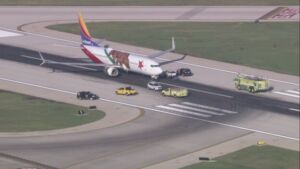
Chopper 7 was over the scene at about 7 a.m. as first responders surrounded a Southwest Airlines flight.
Flight 1243, also known as "California One" departed from Fort Myers, Florida on Monday morning, the airline said.
While landing, both nose gear tires "lost air pressure" while landing in Chicago, the airline said in a statement.
"I realized we stopped and we weren't close to getting off the plane, and then I could smell the burnt rubber," passenger Mya Castro said.
"Once we did come to a stop, we could see smoke coming. Not excessive, but we knew something was wrong," passenger Brian Rigsby said.
Mechanics changed the tires and the aircraft was towed to the gate, Southwest said.
No other information was available.
Pilot, student forced to land small plane on I-10 in Pensacola after engine trouble
By Craig Stevens, Jayme Berezdivin
PENSACOLA, Fla. (WSVN) — The pilot of a small plane was forced to make an emergency landing on a Florida highway after experiencing engine trouble. 
The small aircraft touched down on Interstate 10 in Pensacola on Monday morning, while avoiding traffic.
According to the Florida Highway Patrol, the pilot was with a student when their plane ran into trouble minutes after taking off from Pensacola International Airport,
“We do now have a burning oil smell in the cockpit, I don’t know if we’re going to make the airport. We are not making the airport, we’re going down on I-10,” said the pilot.
Trucker Eric Jordan was on I-10 when the plane landed, and shared video of the aircraft landing safely on the highway.
“‘if I wouldn’t have seen that shadow over my truck and slowed down, he would have been in the side of the cab. As you saw in the video, it was a close call from the truck and the sign, but he landed, he kept it in control,” said Jordan, “By the grace of God, he was able to land that plane in the middle of the interstate, and they’re not getting hit by another vehicle, so it all worked out.”
Following the landing, Jordan put his caution lights on to get other drivers to slow down.
He said the pilot and the student got off the plane and crews pushed it off the interstate.
Jordan also said he was grateful no one was hurt.
“Everyone was safe. He was a really good pilot, he was a good instructor; it was a miracle that he landed the thing with no problem,” said Jordan.
The FHP said that it appeared that an engine problem was to blame for the emergency landing.
Pilot, student forced to land small plane on I-10 in Pensacola after engine trouble
Chattanooga Airport flight ‘went into the runway safety area’ after aborting takeoff, FAA says
McKenzie Hughes
CHATTANOOGA, Tenn. — The Federal Aviation Administration (FAA) says Piedmont Airlines Flight 6105 went into the runway safety area at Chattanooga Metropolitan Airport after the crew aborted its takeoff around 10:10 a.m. local time on Monday, August 3, 2026.
American Airlines says American Eagle flight 6105, 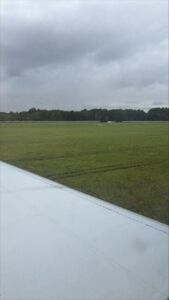 operated by Piedmont Airlines, experienced a possible mechanical issue on the runway prior to takeoff from Chattanooga.
The flight was carrying 50 passengers and 3 crew members, according to American Airlines.
They say the aircraft taxied to the gate under its own power where customers deplaned normally.
They also share the aircraft was taken out of service to be inspected by their maintenance team.
They say per protocol, first responders met the aircraft.
The flight was bound for Charlotte and there were no injuries.
The FAA will investigate this incident.
https://www.wdef.com/chattanooga-airport-flight-went-into-the-runway-safety-area-after-aborting-takeoff-faa-says/
FAA Certifies New Boeing 737-7 MAX Airplane
Regulatory Approval Clears Another 737 MAX Variant For Service
The U.S. Federal Aviation Administration has granted Boeing an amended type certificate for the new 737-7 airplane, clearing it for commercial service.
"This important certification validates the rigor of our  airplane's design and recognizes the determination and resilience of our 737 MAX development team," said Stephanie Pope, president and CEO of Boeing Commercial Airplanes.
The smallest and longest-range member of the 737 MAX family, the 737-7 model serves an important market segment by offering 135 to 160 seats (in a two-class configuration) while providing about 10% more range potential than its siblings. Like other 737 MAX jets, the 737-7 reduces fuel use and CO2 emissions by 20% and noise footprint by 50% compared to the airplanes it typically replaces.
The regulatory approval caps a multi-year certification effort in which Boeing demonstrated through comprehensive testing and analysis that the airplane meets all commercial aviation regulations. The test program, which began in 2018, included:
- More than 1,000 hours of flight and ground testing
- Extensive system safety analysis and human factors reviews
- An updated engine anti-ice system to address a potential condition that was discovered during flight testing
“Our Boeing team held regular and detailed discussions with the FAA to ensure Boeing understood the requirements and provided transparency of our progress," said Mike Sinnett, senior vice president of Product Strategy, Product Development and Development Programs. "With this certification program, Boeing has developed a clearer understanding of the latest regulatory requirements, which is expected to accelerate future airplane development with a renewed emphasis on human factors, safety and quality."
Boeing and Southwest Airlines, the 737-7 launch customer, are preparing for delivery of the first airplane. A team is readying the first airplanes, including implementing updates to the airplane's final configuration.
FMI: www.boeing.com
NTSB Prelim: Diamond Aircraft Ind Inc DA40 NG
Flight Instructor Assumed Control Of The Airplane And Observed That Engine Power Decreased To Below About 40%
Location: Petersburg, VA Accident Number: ANC26LA066
Date & Time: June 29, 2026, 19:45 Local Registration: N602RF
Aircraft: Diamond Aircraft Ind Inc DA40 NG Injuries: 1 Serious, 1 Minor
Flight Conducted Under: Part 91: General aviation - Instructional
On June 29, 2026, about 1945 eastern daylight time (EDT), a Diamond Aircraft Industries Inc. DA40 NG airplane, N602RF, was substantially damaged when it was involved in an accident near Petersburg, Virginia. The flight instructor sustained serious injuries, and the student pilot sustained minor injuries. The airplane was operated as a Title 14 Code of Federal Regulations Part 91 instructional flight.
The flight instructor reported that during the initial climb following a go-around on Runway 05 at Dinwiddie County Airport (PTB), the occupants heard a loud bang near midfield, followed by a reduction in engine power. The flight instructor assumed control of the airplane and observed that engine power decreased to below about 40%, resulting in a loss of expected climb performance; the engine continued to produce partial power. The airplane was unable to achieve sufficient climb performance to clear obstacles beyond the departure end of the runway environment. While assessing available areas for a forced landing, the flight instructor maneuvered the airplane, which resulted in activation of the stall warning horn. The flight instructor discontinued the turn and secured the engine by moving the fuel selector to the off position before the airplane impacted treetops.
The airplane came to rest inverted in a densely wooded area about 1 mile northeast of the departure end of Runway 05, which resulted in substantial damage to the fuselage, wings, and empennage.
A data card from the avionics installed in the airplane was retained and forwarded to the NTSB Recorders Laboratory for flight and engine data extraction.
The wreckage has been recovered to a secure facility for further examination.
FMI: www.ntsb.gov

Today in History
47 Years ago today: On 4 August 1979 An Indian Airlines HAL-748 crashed while on approach to Bombay-Santacruz Airport, India , killing all 45 occupants.
| Date: | Saturday 4 August 1979 |
| Time: | 20:16 |
| Type: | Hindustan Aeronautics Ltd. HAL-748-224 Srs. 2 |
| Owner/operator: | Indian Airlines |
| Registration: | VT-DXJ |
| MSN: | 515 |
| Year of manufacture: | 1968 |
| Fatalities: | Fatalities: 45 / Occupants: 45 |
| Other fatalities: | 0 |
| Aircraft damage: | Destroyed, written off |
| Category: | Accident |
| Location: | near Panvel - India |
| Phase: | Approach |
| Nature: | Passenger - Scheduled |
| Departure airport: | Pune-Lohegaon Airport (PNQ/VAPO) |
| Destination airport: | Bombay-Santacruz Airport (BOM/VABB) |
| Confidence Rating: | Accident investigation report completed and information captured |
Narrative:
An Indian Airlines HAL-748 crashed while on approach to Bombay-Santacruz Airport, India , killing all 45 occupants.
The Indian Airlines HAL-748 was operating a scheduled round trip between Bombay and Pune, India. After take-off from Pune, the aircraft established contact with Bombay Radar and transmitted its ETA Bombay. However, the aircraft crashed in the Kiroli Hills about 11 km east of Bombay.
The aircraft was destroyed due to impact and post-impact fire. All persons on board were killed. The accident occurred during night and it was raining at that time
PROBABLE CAUSE: Combination of the following factors:
(1) Momentary/intermittent loss of electrical contact in G/S system of aircraft which gave the pilot an erroneous impression of the interception of the glide slope;
(2) Failure of the pilot to discharge his obligations under DOC 4444 by failing to use the glidepath facility only after the Outer Marker and also in descending below 2910 feet without first cross-checking over the Outer Marker;
(3) Failure of the radar controller to discharge his obligations under DOC 4444 of giving position information to the aircraft from time to time, use of incorrect and/or non-standard phraseology and also failure to inform the aircraft about the loss of radar contact.
