These are the stories for today...
Be safe out there!
Tom
--
Pilot dead after unexpectedly veering into state police chopper, injuring troopers inside
by Sarah Burns, Alexa Southard, Alex Thill
CUMBERLAND COUNTY, Pa. (WHP) — The pilot of a small plane is dead and two Pennsylvania State Troopers are hurt after two aircrafts "violently" collided at Carlisle Airport Wednesday, according to officials. 
In a press conference, Governor Josh Shapiro said the troopers are expected to be okay thanks to the lifesaving efforts of the staff at Penn State Hershey Medical Center.
The pilot is believed to be the only individual onboard the Cessna, the other aircraft involved. Pennsylvania state police said the plane was from the area.
The troopers were identified as Corporal Bryce Corman and Trooper Jason Mills. Lt. Colonel George Bivens said the crew onboard the chopper were conducting routine training exercises, hanging around on the ground after the training.
The Cessna reportedly came down along the runway for an unknown reason, veering hard to the right at the last moment. It struck the helicopter from the rear, officials said.
The helicopter, without its blade and tail, rolled over and landed on its roof.
Cpl. Corman was able to push out a window and assist Tpr. Mills, who had more severe injuries, Bivens said. They were able to escape the wreckage through the window.
Medical staff said one trooper is expected to be discharged Wednesday night while the other undergoes tests.
There's no air traffic control tower at the Carlisle airport, but pilots communicate via radio frequencies, according to state police. 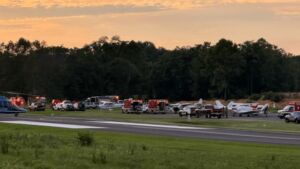
A spokesperson with the FAA initially claimed that a Cessna 150 airplane and a Bell 407 helicopter collided midair near the Carlisle Airport in the 200 block of Petersburg Road around 7 p.m.
Dispatch confirmed the coroner was called to the airport.
Photos from the scene showed the wreckage of a helicopter with the state police emblem.
The FAA and the National Transportation Safety Board are continuing to investigate.
The NTSB said the wreckage will be documented and moved to a secure facility for further examination.
A preliminary report of the accident is expected to be posted within the next day.
Malaysian Airlines aircraft reported to have malfunction at Narita Airport; "Black smoke coming from the rear of the left engine" has been reported. No injuries reported so far.
TBS Television
Shortly after 10:30 a.m., a 119 emergency call was received reporting "black smoke coming from the rear of the left engine of a Malaysia Airlines aircraft" on the runway at Narita Airport. 
According to Narita Airport Corporation, the aircraft was Malaysia Airlines Flight 89 bound for Kuala Lumpur from Narita, and a malfunction occurred as it was attempting to take off.
Passengers were believed to be on board, but according to the police, no injuries have been reported so far, and the black smoke has dissipated.
Narita Airport has closed Runway A, which was used for the takeoff, for inspection.
https://newsdig.tbs.co.jp/articles/-/2883925?display=1
No injuries after plane makes emergency landing in Arapahoe County field
By Aspen Andrews
ARAPAHOE COUNTY, Colo. (KKTV) - No injuries were reported after a plane safely landed in a field in Arapahoe County after experiencing an oil pressure issue Wednesday. 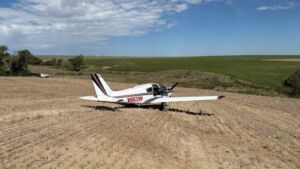
The Arapahoe County Sheriff’s Office (ACSO) said a single-engine plane had taken off from Colorado Air Space and Port in Watkins.
After taking off, deputies said the pilot reported that they lost contact with air traffic controllers and were experiencing oil pressure problems.
Deputies responded to search the area and said they found the plane, which had landed safely in an open field just south of Byers near the 1000 block of South County Road 173.
Two occupants were found uninjured walking near the plane, and deputies said the aircraft was not damaged during the landing.
https://www.kktv.com/2026/08/19/no-injuries-after-plane-makes-emergency-landing-arapahoe-county-field/
NTSB Prelim: Scoda Aeronautica LTDA Super Petrel XP
Airplane Was At About 45 Knots Indicated Airspeed When It Hit A Wave About 7 Inches In Height At About A 45 Degree Angle
Location: New York, NY Accident Number: ERA26LA242
Date & Time: June 13, 2026, 09:24 Local Registration: N817PP
Aircraft: Scoda Aeronautica LTDA Super Petrel XP Injuries: 2 None
Flight Conducted Under: Part 91: General aviation - Personal
On June 13, 2026, about 0924 eastern daylight time, a Scoda Aeronautica LTDA, Super Petrel XP airplane, N817PP, was substantially damaged when it was involved in an accident near New York, New York. The private pilot and a passenger were not injured. The airplane was operated as a Title 14 Code of Federal Regulations Part 91 personal flight.
The pilot stated that he was performing a water takeoff from the Long Island Sound between the Throggs Neck bridge and the Whitestone Bridge towards the northwest. The airplane was at about 45 knots indicated air speed when it hit a wave about 7 inches in height at about a 45 degree angle. The pilot reported that upon impact with the wave, the airplane broke apart and started to sink. The pilot and passenger inflated their life vests and were pulled out of the water a few minutes later by two individuals in a nearby boat. The fuselage was substantially damaged and was partially submerged.
The wreckage was recovered and retained for further examination.
FMI: www.ntsb.gov

Today in History
18 Years ago today: On 20 August 2008 Spanair flight 5022, an MD-82, crashed following a loss of control on takeoff from Madrid-Barajas Airport, Spain, killing 154 occupants; 18 survived the accident.
| Date: | Wednesday 20 August 2008 |
| Time: | 14:24 |
| Type: | McDonnell Douglas DC-9-82 (MD-82) |
| Owner/operator: | Spanair |
| Registration: | EC-HFP |
| MSN: | 53148/2072 |
| Year of manufacture: | 1993 |
| Engine model: | P&W JT8D-219 |
| Fatalities: | Fatalities: 154 / Occupants: 172 |
| Other fatalities: | 0 |
| Aircraft damage: | Destroyed, written off |
| Category: | Accident |
| Location: | Madrid-Barajas Airport (MAD) - Spain |
| Phase: | Take off |
| Nature: | Passenger - Scheduled |
| Departure airport: | Madrid-Barajas Adolfo Suárez Airport (MAD/LEMD) |
| Destination airport: | Las Palmas-Airport de Gran Canaria (LPA/GCLP) |
| Investigating agency: | CIAIAC |
| Confidence Rating: | Accident investigation report completed and information captured |
Narrative:
Spanair flight 5022, an MD-82, crashed following a loss of control on takeoff from Madrid-Barajas Airport, Spain, killing 154 occupants; 18 survived the accident.
The MD-82 aircraft operated Spanair flight JK5022 from Madrid-Barajas (MAD) to Gran Canaria (LPA). The estimated departure time was 13:00.
The aircraft was authorized by control for engine start-up at 13:06:15. It then taxied to runway 36L from parking stand T21, which it occupied on the apron of terminal T2 at Barajas. The flaps were extended 11°. Once at the runway threshold, the aircraft was cleared for takeoff at 13:24:57. The crew informed the control tower at 13:26:27 that they had a problem and that they had to exit the runway. At 13:33:12, they communicated that they were returning to the stand.
The crew had detected an overheating Ram Air Temperature (RAT) probe. The aircraft returned to the apron, parking on remote stand R11 of the terminal T2 parking area. The crew stopped the engines and requested assistance from maintenance technicians to solve the problem. The mechanic confirmed the malfunction described in the ATLB, checked the RAT probe heating section of the Minimum Equipment List (MEL) and opened the electrical circuit breaker that connected the heating element. Once complete, it was proposed and accepted that the aircraft be dispatched.
The aircraft was topped off with 1080 liters of kerosene and at 14:08:01 it was cleared for engine start-up and to taxi to runway 36L for takeoff.
The crew continued with the tasks to prepare the airplane for the flight. The conversations on the cockpit voice recorder revealed certain expressions corresponding to the before engine start checklists, the normal start list, the after start checklist and the taxi checklist. During the taxi run, the aircraft was in contact with the south sector ground control first and then with the central sector. On the final taxi segment the crew concluded its checks with the takeoff imminent checklist.
At 14:23:14, with the aircraft situated at the head of runway 36L, it was cleared for takeoff. Along with the clearance, the control tower informed the aircraft that the wind was from 210° at 5 knots.
At 14:23:19, the crew released the brakes for takeoff. Engine power had been increased a few seconds earlier and at 14:23:28 its value was 1.4 EPR. Power continued to increase to a maximum value of 1.95 EPR during the aircrafts ground run. The CVR recording shows the crew calling out "V1" at 14:24:06, at which time the DFDR recorded a value of 147 knots for calibrated airspeed (CAS), and "rotate" at 14:24:08, at a recorded CAS of 154 knots. The DFDR recorded the signal change from ground mode to air mode from the nose gear strut ground sensor. The stall warning stick shaker was activated at 14:24:14 and on three occasions the stall horn and synthetic voice sounded in the cockpit: "[horn] stall, [horn] stall, [horn] stall". Impact with the ground took place at 14:24:23.
During the entire takeoff run until the end of the CVR recording, no noises were recorded involving the takeoff warning system (TOWS) advising of an inadequate takeoff configuration. During the entire period from engine start-up while at parking stand R11 to the end of the DFDR recording, the values for the two flap position sensors situated on the wings were 0°.
The length of the takeoff run was approximately 1950 m. Once airborne, the aircraft rose to an altitude of 40 feet above the ground before it descended and impacted the ground. During its trajectory in the air, the aircraft took on a slight left roll attitude, followed by a fast 20° roll to the right, another slight roll to the left and another abrupt roll to the right of 32°. The maximum pitch angle recorded during this process was 18°.
The aircrafts tailcone was the first part to impact the ground, almost simultaneously with the right wing tip and the right engine cowlings. The marks from these impacts were found on the right side of the runway strip as seen from the direction of the takeoff, at a distance of 60 m, measured perpendicular to the runway centerline, and 3207.5 m away from the threshold, measured in the direction of the runway. The aircraft then traveled across the ground an additional 448 m until it reached the side of the runway strip, tracing out an almost linear path at a 16° angle with the runway. It lost contact with the ground after reaching an embankment/drop-off beyond the strip, with the marks resuming 150 m away, on the airport perimeter road, whose elevation is 5.50 m lower than the runway strip. The aircraft continued moving along this irregular terrain until it reached the bed of the Vega stream, by which point the main structure was already in an advanced state of disintegration. It is here that it caught on fire. The distance from the initial impact site on the ground to the farthest point where the wreckage was found was 1093 m.
CAUSES:
The crew lost control of the airplane as a consequence of entering a stall immediately after takeoff due to an improper airplane configuration involving the non-deployment of the slats/flaps following a series of mistakes and omissions, along with the absence of the improper takeoff configuration warning.
The crew did not identify the stall warnings and did not correct said situation after takeoff. They momentarily retarded the engine throttles, increased the pitch angle and did not correct the bank angle, leading to a deterioration of the stall condition.
The crew did not detect the configuration error because they did not properly use the checklists, which contain items to select and verify the position of the flaps/slats, when preparing the flight. Specifically:
- They did not carry out the action to select the flaps/slats with the associated control lever (in the "After Start" checklist);
- They did not cross check the position of the lever or the status of the flap and slat indicating lights when executing the" After Start" checklist;
- They omitted the check of the flaps and slats during the "Takeoff briefing" item on the "Taxi" checklist;
- The visual check done when executing the "Final items" on the "Takeoff imminent" checklist was not a real check of the position of the flaps and slats, as displayed on the instruments in the cockpit.
The CIAIAC has identified the following contributing factors:
- The absence of an improper takeoff configuration warning resulting from the failure of the TOWS to operate, which thus did not warn the crew that the airplane's takeoff configuration was not appropriate. The reason for the failure of the TOWS to function could not be reliably established.
- Improper crew resource management (CRM), which did not prevent the deviation from procedures in the presence of unscheduled interruptions to flight preparations.
