Labor Day in the United States is a holiday celebrated on the first Monday in September. It is a celebration of the American labor movement and is dedicated to the social and economic achievements of workers. It constitutes a yearly national tribute to the contributions workers have made to the strength, prosperity, and well-being of their country. 
I myself am a proud 40+ year member of the Chicago Firefighters Union Local 2, one of over 3500 Locals representing over 350,000 firefighters and EMS personnel under the umbrella of the International Association of Fire Fighters. The IAFF is one of the largest and most influential labor unions in North America, committed to advancing the rights, safety, and future of fire fighters, emergency medical workers, and rescue workers across the United States and Canada.
Labor Day was promoted by the Central Labor Union and the Knights of Labor, who organized the first parade in New York City. After the Haymarket Massacre, which occurred in Chicago on May 4, 1886, U.S. President Grover Cleveland feared that commemorating Labor Day on May 1 could become an opportunity to commemorate the affair. Thus, in 1887, it was established as an official holiday in September to support the Labor Day that the Knights favored.
The equivalent holiday in Canada, Labour Day, is also celebrated on the first Monday of September.
Let’s remember all of those who fought for workers rights in both the United States and Canada!
Now here are the stories from over the weekend with kudos to the Miami-Dade Airport Fire Rescue crews on their work at the tragic Amazon 767-300 crash at KMIA.
Be safe out there!
Tom
What we know about an Amazon cargo plane careening off a Miami runway, killing at least 5
By Andy Rose, Maria Aguilar Prieto
As it started its descent under dark clouds over Miami International Airport, it was hard to tell from a distance there were any problems with the Boeing 767-300 bearing Amazon’s “Smile” logo on the tail fin.
But as the plane got closer to touchdown Sunday, something clearly was wrong. 
The jet seemed to hover, video posted to social media showed, going well beyond the usual landing zone for Runway 30. But even after two of its landing gear made it to the ground, the left rear gear continued to bounce along the runway.
By the time it reached the runway’s end, the plane was still going nearly 130 miles per hour, tracking data from Flightradar24 showed.
It barreled across a small grassy patch, then through a chain-link fence with razor wire. Concrete barriers designed to keep cars out of the secure area crumbled as the jet, weighing more than 100 tons, headed straight for a four-lane road.
Slicing across the pavement, the aircraft struck several vehicles – including one left flipped onto its side and twisted into an arc not unlike the tail fin logo – before sliding to a fiery stop just shy of a parking lot filled with dozens of cars.
“Plane’s on fire!” a first responder soon shouted on an emergency radio channel. “Put your game faces on.”
At least five people died and five were injured, though the victims’ location during the crash and the condition of the pilots rescued from the cockpit still isn’t clear. The National Transportation Safety Board is expected to hold a news conference Monday on its investigation.
The catastrophe left Miami’s airport operating with just two of its normal four runways on a busy Labor Day and raised questions about whether the facility needs better equipment to prevent an overshooting aircraft from leaving airport property.
Here’s what we know so far about the incident.
How the crash unfolded
The cargo plane tried to land around 2 p.m. ET Sunday on a runway more than 9,000 feet long. But the jet rose above the normal path aircraft take on their approach to Runway 30 before dropping altitude to return back into proper position, tracking data from Flightradar24 showed.
The plane had passed through a developing thunderstorm as it approached the airport, one of several pop-up storms in the area, tracking data appeared to show.
During the landing, the direction of the wind suddenly changed, said David Soucie, a CNN safety analyst and former FAA safety inspector, giving Flight 7598 a tailwind that may have made it more difficult to slow down.
“You’re picking up speed instead of bleeding speed off at that point,” Soucie said.
The pilots did not inform air traffic controllers of any problems with the plane prior to landing, air traffic control audio indicated.
The plane landed almost parallel to the ground instead of with the standard “flare” maneuver, in which the nose lifts at the last moment so the rear landing gear touches the ground first, social media video showed.
As the jet came to rest near the parking lot past the runway, a fire erupted around its crumpled starboard engine – on the right when facing forward – social media video showed.
Flames and thick black smoke rose from the aircraft as rescue crews rushed in to douse it with fire retardant. Over 60 fire rescue units and some 200 firefighters responded, Miami-Dade Fire Rescue Chief Raied “Ray” Jadallah said Sunday during a news conference.
The status of the victims
Five people were killed, Jadallah said. Five others were injured, with three taken to a trauma center in critical condition.
Rescue workers used a ladder to access the plane’s interior through a cockpit window, social media video showed. Several victims trapped in vehicles struck by the plane were extracted by firefighters, Jadallah said.
It’s not yet clear whether those killed were in the plane, in the vehicles struck during the crash or elsewhere.
The type of plane involved
The plane was a 32-year-old Boeing 767 en route from San Juan, Puerto Rico, to Miami.
It was operated by 21 Air, a cargo carrier headquartered in North Carolina with an operations center in Miami. 21 Air works for several companies and is one of nine flight vendors for Amazon Air, which operates more than 250 carriers daily to ship customer packages.
“We’re heartbroken to learn that five people lost their lives in today’s incident at Miami International Airport,” Amazon spokesperson Kelly Nantel told CNN in a statement. “Our deepest sympathies go out to the families, loved ones, and all those affected by this devastating loss.” 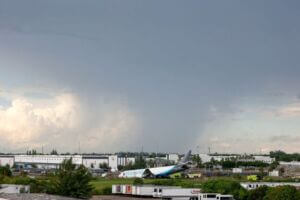
How this is affecting travel
The crash scene and cleanup are causing delays. Flights headed to the South Florida hub were expected to be an average of 2 1/2 hours late, the Federal Aviation Administration advised at 7 a.m.
Two of the airport’s four runways are closed for most of Monday, an FAA notice to pilots stated. Runway 30, where the Amazon Boeing 767 tried to land, as well as Runway 26L, just north of it, are closed until 7 p.m. ET.
As of 10 a.m., 65 flights in or out of Miami were canceled and about 140 delayed, tracking site FlightAware reported.
Questions about safety measures
Runway excursions – when airplanes go off the runway – are the No. 1 incident involving airplanes worldwide, according to data from the International Air Transport Association.
While the cause of Sunday’s crash is still under investigation, Miami International Airport lacks a key safety feature that might have prevented the aircraft from overrunning the airport property and reaching a roadway, aviation experts said.
The Engineered Material Arresting System – or EMAS – places a series of concrete pads at the end of a runway. Although they look solid, the lightweight material is designed to be crushed under the weight of an airplane.
“When the airplane goes off the end of the runway, the wheels crunch into it. The plane is stopped,” said Mary Schiavo, a CNN transportation analyst and former inspector general of the Department of Transportation.
“An airport this surrounded by population, they need an arrestor bed system at the end of these runways to stop this from happening again,” she said.
CNN has reached out to the FAA and the airport for comment.
https://www.cnn.com/2026/09/07/us/amazon-cargo-plane-crash-how
Pilot Seriously Injured After Single-Engine Biplane Crashes in Lake Stevens
Mario Lotmore
LAKE STEVENS — A single-engine biplane crashed Sunday evening into a residential yard near a private fly-in community north of Lake Stevens, trapping the pilot and leaving him with serious injuries.
Snohomish County Fire District 22 crews were dispatched about 6:05 p.m., September 6, to the 11000 block of 127th Avenue Northeast after reports of an aircraft down. Getchell firefighters already were nearby on an unrelated medical call. A chief officer diverted to the scene and found the airplane in a yard adjacent to Frontier Airpark, fire officials said. 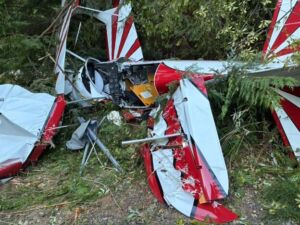
Neighbors began first aid before firefighters arrived, assistance officials later credited with helping produce the best possible outcome. Additional units helped extricate the pilot, who was taken to an area trauma center. Fire officials said there was no ongoing risk to the community.
The National Transportation Safety Board identified the airplane as a Pitts Model 12, a high-performance, single-engine biplane designed in the 1990s by aerobatic aircraft designer Curtis Pitts. The two-seat aircraft is known for its stacked wings, fabric-covered steel-tube fuselage and powerful radial engine, most often a Russian-designed Vedeneyev M-14 series powerplant of about 360 to 400 horsepower. Many examples are built by owners from kits or plans rather than assembled on a production line. The model is used for aerobatics and personal flying and is sometimes nicknamed the “Macho Stinker” or “Pitts Monster.”
The Snohomish County Sheriff’s Office and the NTSB are investigating. Officials have not released the pilot’s name, the flight’s origin or destination, nor a cause of in the incident.
Frontier Airpark, also known as WN53, sits just north of Lake Stevens. Established in 1985, it is a private residential airpark with a paved runway of about 3,800 feet and homes connected by taxiways so owners can fly from their properties.
Agencies that assisted Snohomish County Fire District 22 crews included Snohomish Regional Fire & Rescue, Granite Falls Fire, the Marysville Fire District and Snohomish County Fire District 19.
https://lynnwoodtimes.com/2026/09/06/single-engine/
2 children dead, 2 injured when plane crashes near airport in Fresno
By Anthony Galaviz
A small plane reportedly crashed on Saturday afternoon at the San Joaquin River embankment in Fresno.
The location of the plane crash stretches from Milburn to Blythe at Sierra Sky Park Airport. 
Fresno Fire spokesperson Josh Sellers said two people were pronounced dead at the scene and two others were taken to the hospital in critical condition. In an update later Saturday, the Fresno County Sheriff’s Office said two children were killed.
Sellers said the crash happened around 1:45 p.m.
First responders arrived to find a fixed wing single-engine aircraft had crashed off of the runway in the river bottom area of the San Joaquin River.
It is unknown if the plane was departing or arriving.
The crash caused a fire that burned 5 acres.
The Federal Aviation Agency and that National Transportation Safety Board were en route to the scene to conduct investigations, Sellers said.
Sheriff spokesperson Tony Botti said deputies are holding a safety perimeter Saturday night and Sunday to prevent the public from accessing the crash scene and to preserve it for investigators.
https://amp.fresnobee.com/news/local/article317143996.html
Private aircraft suffers nose gear collapse at San Antonio International Airport
by Victoria Arredondo
SAN ANTONIO — A small private aircraft carrying three passengers ran off the runway Friday morning at San Antonio International Airport. 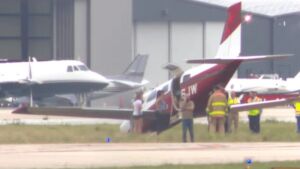
The incident occurred around 7:16 a.m. on Friday. Equipment issues caused the plane to veer off the runway during its takeoff roll, resulting in a nose gear collapse.
All three passengers on board safely deplaned, and no injuries were reported.
No flight delays have been impacted by this incident.
https://news4sanantonio.com/news/local/airplane-incident-at-san-antonio-airport-ends-with-no-reported-injuries
A small aircraft veered off the runway while landing at Opa-Locka Airport, and there are no injuries reported
By CiberCuba Editorial Team
A small plane veered off the runway during its landing this Friday at the Miami-Opa Locka Executive Airport, located in the northwest of Miami-Dade County, with no injuries or visible damage to the aircraft reported, according to WSVN. 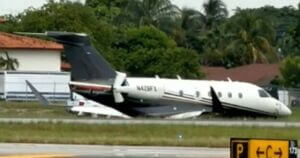
The incident occurred in the afternoon when the small aircraft missed its touchdown point and ended up off the runway.
Units from the Miami-Dade Fire and Rescue Department responded to the airport after receiving the alert.
Authorities confirmed that the aircraft left the runway upon landing, though they did not specify the reasons for the deviation.
The Telemundo 51 helicopter flew over the area and captured images of the incident, which circulated in the local afternoon news broadcasts.
The Miami-Opa Locka Executive Airport (code OPF) is one of the oldest in the region, founded in 1927, and operates as a hub for private and executive aviation 24 hours a day, seven days a week.
Its main runway, 9L/27R, measures over 8,000 feet long, making it one of the longest in the country designated for general aviation.
The airport has a history marked by episodes related to the Cuban community in exile: from there, the planes of Brothers to the Rescue departed on February 24, 1996, before the Cuban regime shot down four of their aircraft over international waters.
In more recent years, the facility has hosted other significant events: in May 2026, Alex Saab landed in Opa-Locka after being deported from Venezuela, and in June of that same year, a private humanitarian flight bound for Venezuela was diverted to the Dominican Republic after the Venezuelan government denied it entry.
This is not the first time that aviation incidents have been reported in the vicinity of the airport: in November 2022, a Cuban airplane suffered an accident in the Everglades about 15 miles to the west, sustaining significant damage after an emergency landing.
The airport has scheduled the rehabilitation of its main runway, with a closure expected on October 7, 2026, just a month after the incident reported this Friday.
https://en.cibercuba.com/noticias/2026-09-05-u1-e199894-s27061-nid339598-avioneta-sale-pista-al-aterrizar-aeropuerto-opa#google_vignette
NTSB Prelim: Barry Lynn Kromer Zenith Cruzer
Shortly After Takeoff, The Pilot Reported That The Left Wing Dipped, Followed By The Right Wing
Location: Chatham, MA Accident Number: ERA26LA305
Date & Time: August 14, 2026, 10:40 Local Registration: N673BK
Aircraft: Barry Lynn Kromer Zenith Cruzer Injuries: 2 Minor
Flight Conducted Under: Part 91: General aviation - Flight test
On August 14, 2026, about 1040 eastern daylight time, an experimental amateur-built Zenith Cruzer, N673BK, was substantially damaged when it was involved in an accident near Chatham, Massachusetts. The pilot and the pilot-rated passenger received minor injuries. The airplane was operated as a Title 14 Code of Federal Regulations Part 91 flight test.
According to the pilot and the owner/builder of the airplane, the accident flight was the airplane’s fourth during its phase one testing. The previous three flights were uneventful except for oil temperature anomalies. The owner/builder had adjusted the oil cooler position and the purpose of the accident flight was to verify whether repositioning the oil cooler improved the engine oil temperature readings.
The pilot stated that the accident flight was delayed a short time until wind conditions improved. After observing other aircraft operating in the airport traffic pattern, the pilot and the owner/builder decided to proceed with the flight. The preflight inspection, engine runup, and flight control checks were normal. Shortly after takeoff, the pilot reported that the left wing dipped, followed by the right wing, and that the airplane subsequently rocked laterally from side to side. The pilot announced to the owner/builder there was a problem and decided to land the airplane on the remaining runway. Video surveillance footage from the airport showed that the airplane impacted the runway in a left wing down attitude, after which the main landing gear collapsed and the nosewheel separated from the fuselage.
The wreckage was retained for further examination.
FMI: www.ntsb.gov
NTSB Final Report: Moose SR 2500
As The Pilot Attempted To Correct The Drift While Establishing A Climb, He Exceeded The Airplane’S Critical Angle Of Attack
Location: Sonoma, California Accident Number: WPR26LA213
Date & Time: May 27, 2026, 16:19 Local Registration: N135DS
Aircraft: Moose SR 2500 Aircraft Damage: Substantial
Defining Event: Aerodynamic stall/spin Injuries: 1 Serious, 1 Minor, 1 None
Flight Conducted Under: Part 91: General aviation - Personal
Analysis: The pilot reported that he experienced a bounced landing and initiated a go-around. He noted that the go-around was conducted in conditions that reduced the airplane's performance margin as he was operating at a low altitude, low airspeed, and a high gross weight. During the go-around, the airplane encountered shifting wind conditions and drifted left of the runway centerline. As the pilot attempted to correct the drift while establishing a climb, he exceeded the airplane’s critical angle of attack and entered an aerodynamic stall. The airplane subsequently impacted the ground, which resulted in substantial damage to the fuselage, wings, and empennage.
The pilot reported no preaccident mechanical malfunctions or failures with the airplane that would have precluded normal operation.
Probable Cause and Findings: The National Transportation Safety Board determines the probable cause(s) of this accident to be -- The pilot's failure to maintain airspeed during a go-around in shifting wind conditions, which resulted in an exceedance of the airplane’s critical angle of attack and an aerodynamic stall.
FMI: www.ntsb.gov
NTSB Final Report: Pipistrel Alpha Trainer
Flight Instructor’s Inadequate Preflight Inspection Which Resulted In A Total Loss Of Engine Power Due To Fuel Exhaustion
Location: Salinas, California Accident Number: WPR26LA173
Date & Time: April 17, 2026, 17:00 Local Registration: N143AW
Aircraft: Pipistrel Alpha Trainer Aircraft Damage: Substantial
Defining Event: Fuel exhaustion Injuries: 2 None
Flight Conducted Under: Part 91: General aviation - Instructional
Analysis: According to the flight instructor and student pilot, they performed a preflight inspection which included viewing the visual fuel quantity indicators inside the cabin, which they observed the level to be full. The flight instructor reported that he did not check the fuel quantity by removing the fuel caps. After flying for about 39 minutes in the airport traffic pattern performing several takeoffs and landings, during an initial climb, the engine had a total loss of power about 250 ft above ground level. The flight instructor assumed the flight controls and chose an empty street near the airport to initiate a forced landing. Subsequently, the airplane landed hard, which resulted in substantial damage to the fuselage.
Post accident examination of the airplane revealed that the fuel tanks contained no usable fuel, and the fuel system was intact with no evidence of leaks. The fuel sight gauges were a purple, transparent color, which would have likely made it difficult to see if fuel was present in the system.
The pilot’s operating handbook indicated that fuel quantity should be checked both in the cabin and through the fuel cap on each wing during a preflight inspection.
Probable Cause and Findings: The National Transportation Safety Board determines the probable cause(s) of this accident to be -- The flight instructor’s inadequate preflight inspection which resulted in a total loss of engine power due to fuel exhaustion.
FMI: www.ntsb.gov
Today in History
15 Years ago today: On 7 September 2011 YAK Service flight 9633, a Yakovlev Yak-42, crashed shortly after takeoff from Yaroslavl-Tunoshna Airport, Russia, killing 44 occupants; one survived the accident.
| Date: | Wednesday 7 September 2011 |
| Time: | 16:05 |
| Type: | Yakovlev Yak-42D |
| Owner/operator: | YAK Service |
| Registration: | RA-42434 |
| MSN: | 4520424305017 |
| Year of manufacture: | 1993 |
| Total airframe hrs: | 6482 hours |
| Engine model: | Lotarev D-36 |
| Fatalities: | Fatalities: 44 / Occupants: 45 |
| Other fatalities: | 0 |
| Aircraft damage: | Destroyed, written off |
| Category: | Accident |
| Location: | 1 km W of Yaroslavl-Tunoshna Airport (IAR) - Russia |
| Phase: | Initial climb |
| Nature: | Passenger - Non-Scheduled/charter/Air Taxi |
| Departure airport: | Yaroslavl-Tunoshna Airport (IAR/UUDL) |
| Destination airport: | UMMM |
| Investigating agency: | MAK |
| Confidence Rating: | Accident investigation report completed and information captured |
Narrative:
YAK Service flight 9633, a Yakovlev Yak-42, crashed shortly after takeoff from Yaroslavl-Tunoshna Airport, Russia, killing 44 occupants; one survived the accident.
The surviving passenger died on September 12 of his injuries.
The airplane carried members of the Lokomotiv Yaroslavl ice hockey team for a match in Minsk.
The Interstate Aviation Committee (IAC) reported that the flight was cleared for takeoff from runway 23. Before takeoff the crew selected flaps at 20 degrees (takeoff position) and the stabilizer at -8.7 degrees (nose up). A control check was performed. The runway length available for takeoff was 3000 metres and V1 speed was calculated to be 190 km/h. However, the correct V1 speed should have been 210 km/h.
Weather was fine with wind from 360 degrees at 3 m/sec., a visibility of 10 km, with significant stratocumulus clouds at a lower limit of 990 m. The temperature was +17.8 degrees C.
Takeoff was initiated at nominal engine thrust. At a speed of 185 km/h the nose wheel lifted off the runway but the pitch angle did not increase. After six seconds takeoff mode power was selected. However, the speed momentarily decreased. The crew used additional elevator and trimmed the stabilizer to 9.5 degrees nose up. The airplane still did not become airborne. It travelled past the end of the runway onto the grass, finally lifting off about 400 metres past the threshold.
The aircraft struck a localizer antenna and rapidly attained a 20 degrees nose-up attitude, reaching a height of 5-6 metres. The airplane then rolled left, struck the ground and broke up on the side of the Volga River.
PROBABLE CAUSE: It was determined that:
- the crew calculated the V1 speed to be 190 km/h; however this was incorrect as it should have been 220 km/h;
- the copilot had medical issues, he had leg coordination disturbances and the deep sensibility disorders of lower extremities. The medicine Phenobarbital, which has a negative impact on the nervous system, was found in his blood which degraded his performance;
- while the captain had over 1300 hours of experience flying Yak-42 aircraft, he flew the smaller Yak-40 aircraft before that and had more experience in those aircraft. The same applied to the copilot. Both aircraft have a different method of braking and the captain or copilot (it could not be concluded who pushed the brakes) probably held his feet on the pedals during takeoff in a similar manner that he had used on the Yak-40. In the accident he inadvertently activated the brakes while pulling on the controls to lift the nose for takeoff.
The investigators established that there were at least four contributing factors, including a lack of pilot training, the absence of control over the crews preparation for flight, the pilots failure to follow standard takeoff procedures and poor coordination between the crew during the takeoff.
