Here are the stories for today...
Of note, yesterday we talked about aircraft that carry Haz-Mat for agricultural use, like pesticides, fungicides and fertilizers. Today we have the story of an Air Tractor AT-802A that was transporting diesel fuel when it crashed in Indonesia. 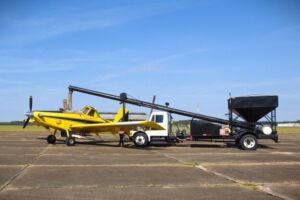
The Air Tractor AT-802A features an 800-gallon tank for chemicals or liquids that is centrally mounted in the fuselage ahead of the cockpit as well as having dual wing fuel tanks holding 254 gallons of Jet A or its equivalent as it is powered by a P&W Turboprop engine.
Bottom line, you never know what may be in the holding tanks of these aircraft, so dress accordingly!
Stay safe out there!
Tom
--
An Aman Air plane carrying fuel skidded while landing at Mulia Airport.
Seputar
JAYAPURA, Seputarpapua.com | An Aman Air plane with registration PK-WNU skidded off the runway while landing at Mulia Airport, Puncak Jaya Regency, Central Papua, Tuesday (15/9/2026). 
The plane piloted by Captain Sriram Manoharan was known to have flown from Timika to Mulia carrying diesel fuel.
While landing, the plane skidded off the runway and came to a stop on the side of the runway.
Puncak Jaya Police Chief AKBP Yudha Wicaksono said the incident was suspected to have occurred due to strong winds when the plane landed.
"The plane failed to land due to strong winds, causing the plane to fail to land and skid to the right," said Yudha, Tuesday afternoon.
There were no fatalities in the incident. The pilot reportedly survived, while the aircraft sustained minor damage.
Following the incident, flight operations at Mulia Airport were temporarily suspended to allow for the evacuation of the aircraft's fuselage, which was located alongside the runway.
"For the time being, flight operations are temporarily suspended. Airport operations will reopen once the evacuation process is complete and the runway is declared safe for use," he concluded.
https://seputarpapua.com/view/angkut-bbm-pesawat-aman-air-tergelincir-saat-mendarat-di-bandara-mulia.html
NTSB Says One-Third Of FAA Answers To Safety Recommendations Are ‘Unacceptable’
NTSB Said FAA Did Not Indicate If It Intends To Write Rules To Require ADS-B In
The NTSB said responses by the FAA to 11 of 33 recommendations made by the board after a 2025 mid-air collision killed 67 people near Washington were "unacceptable" and failed to address safety concerns, Reuters reported.
The January 2025 collision of an American Airlines (AAL.O) regional jet and an Army Black Hawk helicopter near Ronald Reagan Washington National Airport was the deadliest U.S. aviation disaster in more than two decades.
The NTSB said the FAA had not agreed to mandate a key safety system known as ADS-B In, which was one of the board's recommendations.
NTSB Chair Jennifer Homendy said the system could have given the passenger plane pilot an alert 59 seconds before the collision and the helicopter crew 48 seconds before the collision.
How many more decades have to go by before we again and again and again have to recommend it after terrible tragedy?" Homendy told Reuters.
Homendy and families from some of those killed in the collision will again urge Congress on Tuesday to pass legislation to address the causes of the accident.
FAA Administrator Bryan Bedford told Reuters in July the FAA could move forward on ADS-B without action from Congress but would prefer direction from lawmakers.
In a letter seen by Reuters detailing its responses to the safety board on Tuesday, the FAA said it is reviewing helicopter routes in six major cities, has completed reviews of routes in four cities, and has issued a directive to keep planes and helicopters separate.
The NTSB said Monday the FAA did not indicate if it intends to write rules to require ADS-B In.
The safety board makes recommendations and then issues status updates on its push to convince regulators to make changes. It labels them unacceptable if the agency disagrees with the recommendation, offers an alternative the NTSB finds would not address the concern, or fails to take action in a timely fashion.
In January, the NTSB found systemic failures by the FAA led to the 2025 collision. It said the accident was caused by the FAA’s decision to allow helicopters to travel close to the airport with no safeguards to separate them from airplanes and its failure to review data and act on recommendations to move helicopter traffic away from the airport.
The U.S. House of Representatives in April voted 396-10 to pass a sweeping aviation safety reform bill to address dozens of recommendations, while a rival bill known as the ROTOR Act passed the U.S. Senate unanimously in December but needed a two-thirds majority in the House to pass under fast-track rules and it fell one vote short.
Congress continues debate over the two different pieces of legislation to address the issues.
FMI: www.ntsb.gov
NTSB Final Report: Piper PA-34-220T
During The Landing Process, The Airplane Struck Multiple Trees And Impacted A Road Before It Came To Rest Upright Against A Tree In The Front Yard Of A Residence
Location: Roy, Utah Accident Number: WPR24LA254
Date & Time: July 24, 2024, 15:52 Local Registration: N134MG
Aircraft: Piper PA-34-220T Aircraft Damage: Substantial
Defining Event: Collision during takeoff/land Injuries: 1 Serious, 1 Minor
Flight Conducted Under: Part 91: General aviation - Instructional
Analysis: The flight instructor and pilot receiving instruction reported that during a local instructional flight, they extended the landing gear; however, the right main landing gear indicator did not show that the landing gear was down and locked. After briefly troubleshooting, they performed a low approach so the airport traffic control tower controller could observe the landing gear condition. After maneuvering near the runway, they extended the upwind leg of the traffic pattern by 2 miles before turning left crosswind. During the crosswind turn, the pilot receiving instruction advanced the power to the left engine, while the flight instructor simultaneously shut down the right engine to avoid damage to the propeller and right engine if the right main landing gear were to collapse upon landing.
The flight instructor reported that after shutting down the right engine, initially the airplane was able to maintain altitude and airspeed with maximum power on the left engine. Once established on downwind, the “over-boost” light illuminated on the annunciator panel, consistent with the operating engine exceeding the manifold pressure limit of 40.5 inches of mercury. The flight instructor told the pilot receiving instruction to retard the throttle to not over-boost the left engine; however, the flight instructor reported that slight movement of the throttle resulted in a decrease in manifold pressure to about 23–25 inches of mercury.
As the airplane passed midfield, the instructor noticed the airplane was unable to maintain altitude and began the steps to restart the right engine; however, due to their altitude and airspeed, he aborted the restart attempt and decided to land on a road south of the runway. The flight instructor took control of the airplane and began to maneuver toward the road.
During the landing process, the airplane struck multiple trees and impacted a road before it came to rest upright against a tree in the front yard of a residence. Postaccident examination of the recovered wreckage revealed no evidence of any preimpact mechanical malfunction that would have precluded normal operation. Damage sustained to the airframe precluded functional testing of the landing gear system. The investigation was unable to determine the reason for the activation of the right main landing gear indicator.
Probable Cause and Findings: The National Transportation Safety Board determines the probable cause(s) of this accident to be -- The flight instructor’s decision to shut down an engine on an extended leg of the airport traffic pattern, which led to a loss of performance and inability to maintain altitude.
FMI: www.ntsb.gov
Today in History
38 Years ago today: On 15 September 1988 Ethiopian Airlines flight ET604, a Boeing 737-200, crashed after the engines lost power due to multiple bird ingestion after takeoff from Bahar Dar Airport, Ethiopia, killing 35 occupants; 69 survived the accident.
| Date: | Thursday 15 September 1988 |
| Time: | 13:05 |
| Type: | Boeing 737-260 |
| Owner/operator: | Ethiopian Airlines |
| Registration: | ET-AJA |
| MSN: | 23914/1456 |
| Year of manufacture: | 1987 |
| Total airframe hrs: | 1377 hours |
| Cycles: | 1870 flights |
| Engine model: | P&W JT8D-17A |
| Fatalities: | Fatalities: 35 / Occupants: 104 |
| Other fatalities: | 0 |
| Aircraft damage: | Destroyed, written off |
| Category: | Accident |
| Location: | 10 km SW of Bahar Dar Airport (BJR) - Ethiopia |
| Phase: | Approach |
| Nature: | Passenger - Scheduled |
| Departure airport: | Bahar Dar Airport (BJR/HABD) |
| Destination airport: | Asmara International Airport (ASM/HAAY) |
| Confidence Rating: | Accident investigation report completed and information captured |
Narrative:
Ethiopian Airlines flight ET604, a Boeing 737-200, crashed after the engines lost power due to multiple bird ingestion after takeoff from Bahar Dar Airport, Ethiopia, killing 35 occupants; 69 survived the accident.
Ethiopian Airlines flight 604, a Boeing 737-200, was a scheduled service from Addis Ababa to Bahar Dar and Asmara. The first leg of the flight was uneventful. At 09:50, the engines were started normally and the airplane was taxied to its take-off position. The flight crew reported that In order to gain additional thrust they elected not to use engine bleed air during take-off.
The airplane accelerated at a normal rate during the take-off roll and passed V1 (take-off-reject) speed. As the airplane passed V1 and very near VR (rotation speed) the flight crew saw a flock of pigeons lifting up from the left side. At this time the captain took over control from the copilot and pulled up. Almost immediately after rotation, the airplane struck the flock of pigeons at an airspeed of 146 knots and altitude of 5730 feet above mean sea level. Loud bangs were heard.
The captain then called for gear up and the copilot complied. At approximately 100-200 ft. above the ground, both engines started backfiring. At this time, the flight crew reported that they experienced a considerable power loss and the airplane started mushing down at which time the captain "fire walled" the thrust levers. The engines reportedly responded and the airplane began to gain some altitude. The gain in attitude encouraged the captain to make a right turn away from Lake Tana and back to the take-off runway for landing.
During the initial 32 seconds after the impact, the airplane had gained altitude from 5,730 feet to 6,020 feet and had accelerated from 146 knots to 154 knots.
The crew report further indicated that both engines continued to surge and the exhaust gas temperature gauges (EGT) were reading at the top extreme and the engine pressure ratio (EPR) gauge readings were fluctuating at about 1.6. During this time the captain reported that the he reduced engine thrust to prolong the operational life of the engines. The frequency of the surges decreased with engines power reduction. The airplane entered an approximate 90 degree right turn. Altitude remained constant 6,020 feet while its airspeed increased from 154 knots to 162 knots. The airplane then began another right turn and entered the downwind leg of the return to runway 04. Altitude had increased to 6,410 feet and airspeed to 173 knots. On the downwind leg the aircraft further climbed to 7,100 feet. Then, within a timeframe of about five seconds, both engines lost power completely.
The copilot pointed out a cleared area slightly ahead and to the right. The captain then turned towards the clearing and performed a gear-up landing. The aircraft broke up and a fire erupted.
Out of the 104 occupants, 35 suffered fatal injuries.
PROBABLE CAUSE: " The accident occurred because the airplane could not be safely returned to the runway after the internal destruction and subsequent failure of both engines to operate arising from multiple bird ingestion by both engines during take-off."
