These are the stories for today...
Be safe out there!
Tom
--
3 dead including reporter, pilot in news helicopter crash in LA
The NTSB and FAA are investigating the crash in Chatsworth, California.
By Jack Moore
A reporter, a pilot and one person on the ground were killed when a news helicopter crashed in Los Angeles near the scene of a deadly bus collision in what Mayor Karen Bass called a "heartbreaking night for our city."
Both incidents unfolded Tuesday in Chatsworth, a suburban neighborhood in the San Fernando Valley.
The helicopter crashed between two commercial buildings in a fiery blaze shortly before 7 p.m. local time, officials said.
NBC Los Angeles confirmed that its reporter Eliana Moreno and pilot George Marciniw were killed, saying the duo "logged hundreds of hours together in the sky" on stories including the January 2025 wildfires. 
A third person, a pedestrian on the ground, was also killed in the crash, according to the Los Angeles Fire Department, and a fourth person was taken to a hospital.
Multiple news helicopters and reporters were at the scene due to a crash between a Metro bus and an SUV that occurred around 5 p.m. local time. That crash left two people dead and several others injured, authorities said.
The mayor said in a statement, "I’m absolutely devastated by the loss of life in Chatsworth tonight. My heart is with the families and loved ones of those we lost."
"Our hearts are with the victims and families of tonight’s devastating Metro bus and helicopter crashes in Chatsworth, and with the entire NBC4 family," Gov. Gavin Newsom said in a statement. "Thank you to the first responders working tirelessly tonight."
The cause of the helicopter crash was not immediately known. The National Transportation Safety Board and Federal Aviation Administration said it would investigate.
Robert Luna, the sheriff of Los Angeles County, said he was extending "my deepest condolences to the families, friends, and loved ones of all those who tragically lost their lives."
"My heart is also with the colleagues of the NBC4 team and everyone impacted by these heartbreaking events," Luna said in a statement.
ABC News' Jennifer Watts and Vanessa Navarrete contributed to this report.
https://abcnews.com/US/helicopter-crashes-los-angeles-site-earlier-fatal-bus/story?id=136481785
Traffic resumes at Malmö Airport after cargo plane landing incident
Sweden Herald
Air traffic at Malmö Airport was halted for a few hours on Tuesday after a small cargo plane had trouble landing.
The cargo plane landed at 4 p.m.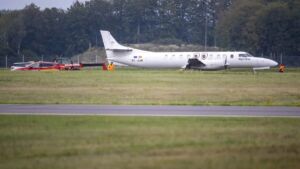
"We are waiting for it to be moved from the runway before traffic can start again," wrote Susanne Norman, head of operations at Swedavia, in an email.
At 8 p.m., Swedavia announced that air traffic had resumed, but there were resulting delays.
No one was injured in the incident and there was no damage to Swedavia's infrastructure.
https://swedenherald.com/article/traffic-temporarily-halted-at-malmo-airport
NTSB Final Report: Avid Avid Flyer
Pilot Applied Right Rudder In An Attempt To Regain Alignment; However, Directional Control Was Not Maintained, And The Airplane Departed The Runway
Location: Anchorage, Alaska Accident Number: ANC26LA025
Date & Time: April 9, 2026, 15:10 Local Registration: N394BJ
Aircraft: Avid Avid Flyer Aircraft Damage: Substantial
Defining Event: Nose over/nose down Injuries: 2 None
Flight Conducted Under: Part 91: General aviation - Personal
Analysis: The pilot reported that, while maneuvering onto the runway for takeoff in a tailwheel-equipped airplane, the application of engine power during the turn resulted in the airplane overshooting the runway centerline. The pilot applied right rudder in an attempt to regain alignment; however, directional control was not maintained, and the airplane departed the runway surface.
The main landing gear subsequently contacted an area of heavy, wet snow adjacent to the runway, and the airplane nosed over. The nose-over resulted in substantial damage to the left wing lift strut. The pilot reported that there were no preaccident mechanical failures or malfunctions with the airplane that would have precluded normal operation.
Probable Cause and Findings: The National Transportation Safety Board determines the probable cause(s) of this accident to be -- The pilot’s failure to maintain directional control while maneuvering onto the runway for takeoff. Contributing to the accident was the presence of heavy, wet snow adjacent to the runway.
FMI: www.ntsb.gov

Today in History
19 Years ago today: On 16 September 2007 One-Two-Go Airlines flight OG269, an MD-82, crashed during a mishandled go-around at Phuket Airport, Thailand, killing 90 occupants; 40 survived the accident.
| Date: | Sunday 16 September 2007 |
| Time: | 15:40 |
| Type: | McDonnell Douglas DC-9-82 (MD-82) |
| Owner/operator: | One-Two-Go Airlines, lsf Orient Thai Airlines |
| Registration: | HS-OMG |
| MSN: | 49183/1129 |
| Year of manufacture: | 1983 |
| Total airframe hrs: | 65965 hours |
| Cycles: | 35498 flights |
| Engine model: | P&W JT8D-217A |
| Fatalities: | Fatalities: 90 / Occupants: 130 |
| Other fatalities: | 0 |
| Aircraft damage: | Destroyed, written off |
| Category: | Accident |
| Location: | Phuket International Airport (HKT) - Thailand |
| Phase: | Landing |
| Nature: | Passenger - Scheduled |
| Departure airport: | Bangkok-Don Muang International Airport (DMK/VTBD) |
| Destination airport: | Phuket International Airport (HKT/VTSP) |
| Investigating agency: | AAIC Thailand |
| Confidence Rating: | Accident investigation report completed and information captured |
Narrative:
One-Two-Go Airlines flight OG269, an MD-82, crashed during a mishandled go-around at Phuket Airport, Thailand, killing 90 occupants; 40 survived the accident.
One-Two-Go Flight 269 departed Bangkok-Don Muang Airport at about 14:30 for a domestic service to Phuket, Thailand.
The flight was conducted uneventfully and as the flight arrived in the Phuket area, the flight crew conducted the ILS runway 27 approach to the airport, with the first officer as the flying pilot. After the flight crew reported to Air Traffic Control (ATC) that they were established [on the] localizer, the crew that preceded the accident flight, reported information about the weather encountered during their approach. This information included an airspeed gain and loss of 15 knots during the final portion of the approach and noted a "CB over the airport." The flight crew of OG269 acknowledged the transmission and they were cleared to land at 15:37, with a wind report of 240 degrees at 15 knots.
One minute later, the controller issued another wind report, "OTG269, strong wind 240 degrees 30 knots." The pilot of OTG269 acknowledged the report, and shortly after, inquired again about the wind condition. The tower responded "240 degrees 40 knots," and the pilot acknowledged the report.
Information obtained from the CVR and FDR indicated that the flight crew conducted the ILS approach with the airplane aligned just to the north of the runway 27 centerline.
Between 15:39:41 and 15:39:43, as the airplane was descending through 115 feet above threshold level, the airspeed dropped from 140 KCAS to 126 KCAS. At 15:39:43 the captain called for power, and the engine pressure ratio (EPR) subsequently increased toward 'go around thrust.' The EPR for both engines increased from about 1.16 to 2.0 in approximately three seconds and remained about 2.0 for the following 2 seconds, until about 15:39:48. Between 15:39:40 and 15:39:47, the pitch angle increased from 0 degrees to 5 degrees, and then decreased to about 2 degrees at 15:39:48.
Despite the increase of thrust and pitch, the airplane continued to descend until about 15:39:48, reaching an altitude of 48 feet above threshold level before starting to climb. The airspeed increased during this time, from 126 KCAS at 15:39:43 to
166 KCAS at 15:39:48. At 15:39:47, the crew received a "sink rate" warning, and at 15:39:48, as the airplane descended below 50 feet, the autothrottle system initiated an automatic reduction of all engine thrust. The engine EPR decreased from 2.0 (go around thrust) at 15:39:48 to about 1.14 (idle thrust) at 15:39:53.
At 15:39:49, the first officer called for a go-around, and the pitch of the airplane increased from about 2 degrees to about 12 degrees, as the airplane climbed. The thrust continued to decrease towards its idle position, while the airspeed decreased from 165 KCAS to about 122 KCAS at 15:39:57.
At 15:39:50, the first officer transferred aircraft control to the captain as the thrust was reaching idle EPR. The EPR remained at the idle level for about 13 seconds, as the airplane continued to climb to a maximum altitude of 262 feet at 15:40:01, and then started descend again. During this time, the landing gear was retracted, and the flaps were set to 15 degrees; however, the takeoff/go-around (TO/GA) switch was never pressed.
The pitch angle decreased from 12 degrees to about 0 degrees, while the airspeed remained relatively constant at around 122 KCAS, with about +/- 4 knot excursions about this average.
At 15:40:06, a "don't sink" warning sounded in the cockpit, as the airplane was descending through approximately 175 feet. The EPR began to increase again, reaching go around thrust at 15:40:09; however, the altitude and pitch continued to decrease.
At 15:40:09, a "sink rate" warning, followed by a "pull up" warning sounded in the cockpit. During these warnings, the pitch began to increase from 0 degrees. The pitch increased to approximately 5 degrees over the next second, until the aircraft impacted the ground next to the runway at 15:40:11. The aircraft slid across a concrete ditch and burst into flames.
PROBABLE CAUSES:
After thorough investigation, the AAIC determined that the probable causes of accident are as follows:
1. the flight crew did not follow the Standard Operating Procedure (SOP) of Stabilized Approach, Call Out, Go Around, and Emergency Situation as specified in the Airlines Flight Operation Manual (FOM).
2. the Take Off/ Go Around (TO/GA) switch was not pressed, resulting in the failure of increasing in airspeed and altitude during the go around. Also, there was no monitoring of the change in engine power and movement of throttle levers, especially during the emergency situation.
3. the flight crew co-ordination was insufficient and the flight crew had heavy workloads.
4. the weather condition changed suddenly over the airport vicinity.
5. the flight crew had accumulated stress, insufficient rest, and fatigue.
6. the transfer of aircraft control took place at a critical moment, during the go around.
METAR:
08:35 UTC / 15:35 local time:
SPECI 0835 UTC: 270/09KT 4000 +RA SCT015 BKN110 BKN300 26/24
Wind 270 degrees at 9 knots; visibility: 4000 m in heavy rain; scattered cloud layer at 1500 ft; broken cloud at 11000 feet and 30000 feet; Temperature 26deg C; Dew point 24deg C
08:45 UTC / 15:45 local time:
SPECI 0845 UTC: 270/28KT 0800 +RA SCT015 BKN110 BKN300 25/22
Wind 270 degrees at 28 knots; visibility: 800 m in heavy rain; scattered cloud layer at 1500 ft; broken cloud at 11000 feet and 30000 feet; Temperature 25deg C; Dew point 22deg C
