We start new week with these stories...
Be safe out there!
Tom
--
Cargo plane engine fire extinguished at Fort Lauderdale-Hollywood airport
By Alexandra Phelps
FORT LAUDERDALE-HOLLYWOOD INTERNATIONAL AIRPORT, FLA. (WSVN) - A cargo plane at Fort Lauderdale-Hollywood International Airport has been extinguished after one of its engines caught fire Saturday evening. 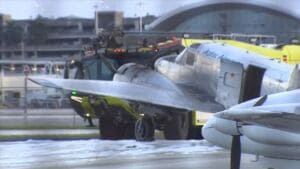
The Broward Sheriff’s Office Department of Fire Rescue and Emergency Services responded to reports of an aircraft fire near Gate A8 at approximately 6:13 p.m.
The left engine cowling and propeller were seen scorched after the flames were put out.
Emergency responders say no one was on the plane at the time of the incident, and no injuries were reported.
The cause of the fire is under investigation.
Cargo plane engine fire extinguished at Fort Lauderdale-Hollywood airport
Aircraft crash at Boerne Stage Field under investigation
by Victoria Arredondo
SAN ANTONIO — Two men escaped without injuries after a plane crashed and caught fire Friday afternoon near Boerne Stage Field. 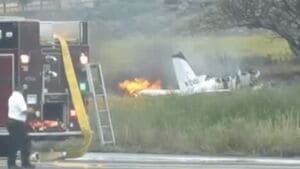
The crash was reported around 1:50 p.m. on Boerne Stage Road, minutes from the airfield. According to the Bexar County Sheriff’s Office, the aircraft struck a utility pole after going down.
Firefighters said they heard the plane experiencing trouble before responding to the crash site, which was near their station. Both men on board got out of the aircraft on their own, and crews extinguished the flames.
CPS Energy responded because of the damaged utility pole.
The Federal Aviation Administration and National Transportation Safety Board will investigate the crash.
Small plane crash-lands at Mesa-Gateway Airport after landing gear issue
By Sara Filips
The Brief
-
- A Piper Seminole aircraft completed a gear-up landing and crash-landed at the Mesa-Gateway Airport on Saturday afternoon.
-
- Both occupants inside the plane were able to exit the aircraft on their own, and no injuries were reported.
-
- Mesa Fire and Medical Department crews reported no visible fuel leaks during their search, and the aircraft was safely shut down.
MESA, Ariz. - A small plane with a landing gear issue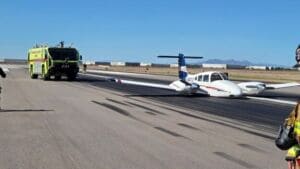 crash-landed at the Phoenix-Mesa airport on Saturday afternoon.
What we know:
Mesa Fire and Medical Department crews responded to a Piper Seminole aircraft with a landing gear issue at around 2 p.m. on Oct. 3.
"The aircraft completed a gear-up landing before coming to a harrowing stop" at the Mesa-Gateway Airport, according to the department.
Both people inside were able to get out of the plane themselves. There were no reported injuries.
Crews said there was no visible fuel leak during their primary search after the crash-landing. The aircraft was safely shut down.
What we don't know:
It is unclear the exact landing gear issue the aircraft and occupants experienced. No identities were released.
https://www.fox10phoenix.com/news/small-plane-crash-lands-mesa-gateway-airport-after-landing-gear-issue
One injured after plane crashes into home in rural Guttenberg
By KCRG Staff
GUTTENBERG, Iowa (KCRG) - The Clayton County Sheriff’s Office said one person is injured after a plane crash in rural Guttenberg Saturday night. 
The Sheriff’s Office said it received multiple calls around 6:00 pm reporting that an aircraft had crashed into a residence on Abel Island in rural Guttenberg.
Upon arrival, first responders determined a multicolored ultralight aircraft had been attempting to take off from the Abel Island Airport when it lost control.
Officials said the aircraft struck power lines in the area before crashing onto the roof of a residence.
The pilot sustained minor injuries.
The crash is under investigation by the Clayton County Sheriff’s Office, the Federal Aviation Administration and the National Transportation Safety Board.
https://www.kcrg.com/2026/10/04/one-injured-after-plane-crashes-into-home-rural-guttenberg/
Pilot injured after small plane crashes onto State Route 225 near Alliance
JMN
A pilot suffered minor injuries Saturday morning after a small plane crashed during landing and came to rest on state Route 225 just north of Alliance, according to the Ohio State Highway Patrol. 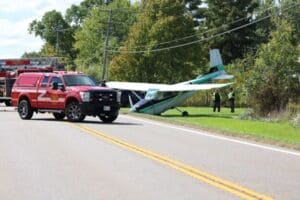
The crash occurred at approximately 10:41 a.m. Saturday, Oct. 3, at Lee Airport in Lexington Township, Stark County.
According to the Highway Patrol, the aircraft was a 1957 Cessna 182A single-engine plane operated by Canton Air Sport, a business known for taking customers skydiving.
Information obtained by Jordan Miller News indicates a skydiving instructor and a customer had just jumped from the aircraft and landed safely in a nearby field. The pilot then circled back toward the airport to land.
Authorities said the pilot lost control during landing, causing the aircraft to continue through the designated landing zone, strike a ditch and come to rest on state Route 225.
The pilot, identified as Savannah Lambert of Twin Falls, Idaho, suffered minor injuries. She was transported by Emergency Medical Transport to Cleveland Clinic Mercy Hospital in Canton for evaluation.
The Stark County Sheriff’s Office, Lexington Fire Department, Emergency Medical Transport, Marlboro Towing and Ohio Department of Transportation assisted the Highway Patrol at the scene.
The Federal Aviation Administration and National Transportation Safety Board have been notified and will conduct a separate investigation into the crash.
The Ohio State Highway Patrol’s Canton Post is continuing its investigation.
Airplane collides with fence while preparing to leave Stevensville Airport
By: Cynthia Carranza
STEVENSVILLE — (UPDATE, 10:45 p.m.) An investigation is underway into what caused an airplane to lose control while trying to take off from Stevensville's airport Sunday morning.
"It's about 267 feet northeast of the parallel taxi," John Boe, Stevensville's police chief, told MTN. 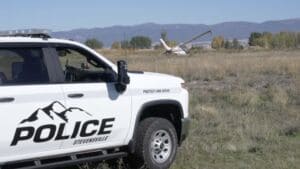
A plane collided with a fence at the airport around 10 a.m. Sunday. Boe reported the plane was about to make its way to Reno, Nevada.
"It's more or less a taxi incident," Chief Boe said.
The investigation will look into what caused the aircraft to lose control. While it is unverified, officials are looking into a possible mechanical failure, according to Brian Germane, Stevensville's airport manager.
No injuries were reported.
Local officials contacted the Federal Aviation Administration (FAA) as well as the National Transportation Safety Board (NTSB).
"They've given us permission, or they provided permission, to remove the aircraft," Chief Boe said.
He added the plan is to recover the aircraft Monday morning.
In the meantime, the airport is in full operation.
(1st Report, 3:34 p.m.) Officials are investigating an airplane taxiing accident at the Stevensville Airport on Sunday morning.
The plane was preparing to leave when it collided with a fence, according to Brian Germane, the airport's manager.
The aircraft was never airborne.
Officials are investigating a possible mechanical failure, but cannot verify the cause of the accident just yet.
No one was injured in the collision.
Airport staff and Stevensville Police Chief John Boe were on scene.
The Stevensville Airport operated as usual on Sunday.
We will update you with any new information.
https://www.kpax.com/news/ravalli-county/airplane-collides-with-fence-while-preparing-to-leave-stevensville-airport
NTSB Final Report: XAG P150 MAX
The Pilot’s Failure To Maintain Control Of The Uas During Takeoff
Location: Wolcott, Indiana Accident Number: CEN26LA245
Date & Time: July 2, 2026, 08:12 Local Registration: None
Aircraft: XAG P150 MAX Aircraft Damage: Substantial
Defining Event: Loss of control in flight Injuries: 1 Serious
Flight Conducted Under: Part 137: Agricultural
Analysis: The pilot/operator commanded the takeoff sequence on the agricultural unmanned aircraft system (UAS) and the UAS climbed to about 15 ft above its launch rig. Hearing an abnormal “popping” noise coming from the UAS, the pilot initiated the automated landing sequence and the UAS descended to about 2 ft above the rig and about 4 to 5 ft from the operator’s station.
The pilot lost control of the UAS as it moved towards his position causing the pilot to duck behind the operator’s barrier. When he ducked, the UAS’s right-rear propeller struck his left hand resulting in a serious injury. The UAS descended and crashed into terrain resulting in substantial damage to the right-rear arm and propeller.
The operator sent the UAS on-board data to the manufacturer for decoding. The manufacturer’s report found that about 1 second after the UAS started up, a joystick input was received which paused the UAS’s takeoff. A couple seconds later, additional control inputs were recorded and the UAS responded accordingly.
The data found no mechanical malfunction or failure with all engine parameters in the normal range.
Probable Cause and Findings: The National Transportation Safety Board determines the probable cause(s) of this accident to be -- The pilot’s failure to maintain control of the UAS during takeoff.
FMI: www.ntsb.gov
NTSB Final Report: Piper PA-30
Pilot’s Failure To Verify The Airplane’s Fuel Quantity Before Departure
Location: Meridian, Mississippi Accident Number: CEN26LA225
Date & Time: June 14, 2026, 19:50 Local Registration: N8143Y
Aircraft: Piper PA-30 Aircraft Damage: Substantial
Defining Event: Fuel exhaustion Injuries: 2 None
Flight Conducted Under: Part 91: General aviation - Personal
Analysis: The pilot instructed the fixed base operator line crew to top off the main tanks and fill the auxiliary tanks to ½ inch gap from the top of the tank. The pilot reported that he did not open the fuel caps to verify the fuel level.
The flight departed with the pilot believing that sufficient fuel was onboard to complete the flight with an adequate reserve. Near the destination airport, the left engine began surging and subsequently lost power. The pilot's attempts to restore engine power, including the use of the auxiliary fuel tanks and electric fuel pump, were unsuccessful. Shortly thereafter, the right engine also began surging and lost power.
After determining that the airplane could not reach the destination airport, the pilot conducted a forced landing to a pasture. During the landing rollout, the airplane collided with trees, resulting in substantial damage to both wings and the empennage. The pilot reported no preaccident mechanical malfunctions or failures that would have precluded normal operation of either engine.
In the accident report the pilot emphasized the importance of physically verifying fuel quantity before each flight, and reliance solely on assumptions regarding fuel quantity may increase the risk of fuel-related incidents.
Probable Cause and Findings: The National Transportation Safety Board determines the probable cause(s) of this accident to be -- The total loss of power to both engines due to fuel exhaustion. Contributing to the accident was the pilot’s failure to verify the airplane’s fuel quantity before departure.
FMI: www.ntsb.gov
NTSB Final Report: Rotec Engineering Rally 3
The Pilot Thought The Airplane Operated Under Title 14 Code Of Federal Regulations Part 103 As An Ultralight, However The Airplane Carried More Than One Person
Location: Hooker, Oklahoma Accident Number: CEN26LA246
Date & Time: July 7, 2026, 07:00 Local Registration: UNREG
Aircraft: Rotec Engineering Rally 3 Aircraft Damage: Substantial
Defining Event: Loss of engine power (total) Injuries: 1 Minor
Flight Conducted Under: Part 91: General aviation - Personal
Analysis: The accident flight was the non-certificated pilot's first flight in the unregistered airplane since he had overhauled the experimental engine. The pilot, who was also not certificated as a mechanic, performed the engine overhaul and subsequently conducted more than 5 hours of engine ground runs.
During the initial climb after takeoff, the pilot observed an exhaust gas temperature of about 1,200°F. In response, he reduced engine power and initiated a right turn with the intention of reentering the airport traffic pattern. At about 150 ft above ground level, the engine seized and experienced a total loss of power.
The pilot conducted a forced landing straight ahead to a plowed field. During the landing roll, the main landing gear dug into the soft terrain, and the airplane nosed over. The empennage subsequently separated from the fuselage resulting in substantial damage. Following the accident, the pilot removed the wreckage from the accident site and disposed of it before the airframe and engine could be examined by investigators. The pilot did not possess a current FAA medical certificate.
The pilot thought the airplane operated under Title 14 Code of Federal Regulations Part 103 as an ultralight, however the airplane carried more than one person.
Probable Cause and Findings: The National Transportation Safety Board determines the probable cause(s) of this accident to be -- The total loss of engine power due to an engine seizure for undetermined reasons because the wreckage was disposed of before it could be examined.
FMI: www.ntsb.gov

Today in History
96 Years ago today: On 5 October 1930 A Royal Airship Works R-101 airship crashed near Allonne, France, killing 48 occupants; 6 survived the accident.
| Date: | Sunday 5 October 1930 |
| Time: | c. 02:10 UTC |
| Type: | Royal Airship Works R-101 |
| Owner/operator: | Air Ministry |
| Registration: | G-FAAW |
| MSN: | R-101 |
| Fatalities: | Fatalities: 48 / Occupants: 54 |
| Other fatalities: | 0 |
| Aircraft damage: | Destroyed |
| Location: | Allonne, Oise Department, 2.5 miles SW of Beauvais - France |
| Phase: | En route |
| Nature: | Executive |
| Departure airport: | Cardington, Bedfordshire |
| Destination airport: | Karachi, Sindh Province, India |
| Confidence Rating: | Information is only available from news, social media or unofficial sources |
Narrative:
A Royal Airship Works R-101 airship crashed near Allonne, France, killing 48 occupants; 6 survived the accident.
Nosedived into the ground on its inaugural flight from Cardington, England to Karachi; in the wind and rain the outer cover split open at the front, causing 2 forward gasbags to rupture.
It was the fire following the crash which killed so many of the passengers and crew. This might have begun by sparks caused by friction on impact igniting the 5,500,000 cubic feet of hydrogen. Another possibility is that some electrical short circuit in the wiring inside the balloon caused by the crash ignited the gas.
